Software
Houzz Logo Print
cloud_shine

evergreen huckleberry

17 years ago

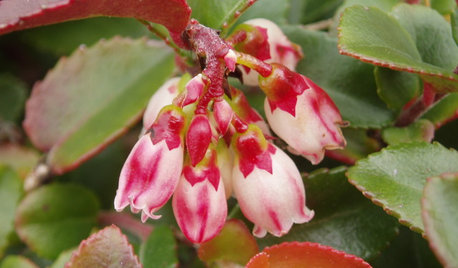
I am thinking of adding this NW native - Vaccinium ovatum - to my shade garden. Anyone out there growing this and if so, how do you like it? Because it is a native plant, I'm hoping that it will need minimal care once it is established.

Is one plant sufficient for a good crop of berries or is a pollinator needed (or recommended)?

Thanks for your advice!

Mary

Comments (15)

  • 17 years ago

    Characteristic of sandy soils in nature. Some shade will produce most attractive foliage. Fruiting seems to be not hard to get, but planting more than one seedling should assure results. You can plant several close together so that they merge to form a drift, much of the time this is better design than planting a solitary specimen anyway - especially with small-parted shrubs like this that do not have any conspicuous features.

    Note that is seedlings as in raised from seed and therefore not genetically identical to one another, rather than seedling as in of small size.

  • 17 years ago

    I have seen some here and there in Portland used as specimen plants, some are hedge-pruned so fruit production is minimal. They all appear good-looking even though somewhat neglected.

    My single plant fruits pretty reliably, it will take a few years though. 2 or 3 pounds of berries in a good year.

  • 17 years ago

    It would be a waste to prune them, imho--the natural fountain shape is so very beautiful! I have five of them planted between large evergreens--they don't seem very picky about exposure and I get lots of fruit for the birds and enjoy the beautifully colored new foliage (I am a freak for flashy foliage.)

  • 17 years ago

    Pretty consistent about being spotty, bronzy or reddish and less deeply green in full exposure in this region.

  • 17 years ago

    Thanks to everyone for your input. I bought a couple of plants today and put them in. If they do well, I may add more in the future.

    I do like their growth habit and foliage ... as well as the fact that their berries make them very bird-friendly.

    kris ... since you have them planted between evergreens, it sounds like they compete well with trees, right? Mine will have to hold their own as I have quite a few trees.

  • 17 years ago

    Local plants often seen beneath Douglas firs in nature, on same sandy or dryish soils that tend to be dominated by salal - a frequent competitor in local patches, where it's usual to see a relatively small number of huckleberry bushes scattered among extensive growths of salal.

    Appears more numerous and happy out at the ocean, where it seems to love the very sandy soil and abundant atmospheric moisture, grows right off the beach.

    "Occurs in hypermaritime to maritime summer-wet cool mesothermal climates on moderately dry to fresh, nitrogen-poor soils; its occurrence decreases with increasing elevation and increases with increasing precipitation"

    --Klinka/Krajina/Ceska/Scagel, INDICATOR PLANTS OF COASTAL BRITISH COLUMBIA (1989, UBC Press, Vancouver)

  • 17 years ago

    Curiously, my out-in-the-open ehuck attracts few birds when the fruit is ripe. Juniper, cotoneaster, and blackberries have been a bigger bird-draw.

    The berries need several weeks to sweeten after turning dark. They are good cooked also.

  • 17 years ago

    Yes, Mary, they do quite well planted between 20'-30' tall Leyland cypress. They get a peek of sun now and then throughout the day, but are mostly in shade. The first year or two I may have thrown some water on them in the driest part of the summer, but otherwise they are easy keepers.

    You should see the conditions in the Redwood forest in which they prosper--you would not have a worry about exposure in your yard then.

  • 17 years ago

    Being heath family shrubs heavy weevil damage is possible beneath low-branching conifers and building overhangs.

  • 17 years ago

    It's used as a hedge next to the parking lot at Darlingtonia State Park, just north of Florence, Oregon.

  • 17 years ago

    Last spring I planted a couple huckleberries. One Evergreen and one Thunderbird. I was told I would need to plant two varieties to get fruit. So far they have thrived and produced a few berries in the first season. Right now I see several flower buds so I am optimistic for more berries this year. They are planted in full sun with a little shade under a cherry tree.

  • 17 years ago

    Both are evergreen huckleberry, of course, the second one being a named form of the first.

  • 17 years ago

    All vaccinium are self-fertile. You will just get better cropping if you have cross pollination.

  • 17 years ago

    Another point about this species regarding the fruit is that those individuals producing berries with a pruinose surface making them appear powdery blue or otherwise not blackish purple are also said to be preferred for picking. The difference is significant enough that I've even heard patches of the normal blackish fruited ones differentiated from the powdery ones as "huckleberries" vs. "blueberries". The different appearance of the latter certainly makes them more conspicuous and ornamental.

    One in my neighborhood that was making powdery fruits has changed to making ones that are blackish blue instead of blackish purple. It seems the bloom has gone off, so to speak.

  • 10 years ago

    I live on the kitsap peninsula west of Seattle and we have the acid soil described previous. The evergreen huckelberry is almost a weed on my 21/2 acres. I have observed and harvested the lighter blue variety , they are sweeter larger and not as plentiful as other variety. My goal is to figure out a way to get them to produce more consistent. Does any one have a way to make fruit production more consistent. I'm not sure but it appears the lighter blue variety may have changed to the darker variety. Logging in some areas seams to produce a significant crop in a few years, but seams to affect fruit size because of extra sun.

Sponsored
Buckeye Basements, Inc.
Average rating: 5 out of 5 stars40 Reviews
Central Ohio's Basement Finishing ExpertsBest Of Houzz '13-'21