Software
Houzz Logo Print
zkathy

Southern Blight

11 years ago

So I'll be in airports and planes for the next 8 hours and I figure that's enough time to share about my Southern Blight experiences this year. The first hosta I lost was a Patriot that was planted at the top of a sloping bed which was under manual irrigation, which means I had to remember to walk out there and drag the hose to a noodle head sprinkler I had placed at the edge of the bed. I posted about this experience At the link below.

The undulata mentioned in the linked post is old and well established. But it has only one dripper to water it, and I now think the leaves lost may not have been getting enough water. I never saw any little balls on the ground or at the base of the petioles and didn't think it was Southern Blight, but now I think it might have been.

Boarding now, I'll compose the rest offline and post in the next airport.

Zkathy

Here is a link that might be useful: My first post about Southern Blight

This post was edited by zkathy on Sun, Nov 23, 14 at 19:02

Comments (9)

  • 11 years ago

    The next hosta I lost was my Night Before Christmas. It was planted in a bed near my front door under the overhang of the roof corner and also on manual watering. I frequently forgot that the overhang would keep the rain off of that little corner of the bed that housed NBC. There's a pattern starting to emerge, which is all the hostas I lost had been stressed by insufficient watering. My soil is very sandy, drains quickly and can dry out incredibly fast. In this picture from August 20 you can see where all the leaves are gone and the flower scapes and bracts are the only things left standing. I have scooped the top inch of dirt away from the scapes and thrown it away. I did see little balls in the dirt and attached to the base of the petioles that had fallen off. They were small, about a mm or two in diameter and white to orange in color. I also researched Southern Blight and went shopping for fungicides. By three days later the bracts had started to fall off. I freaked and dug the whole thing up, tossed it, treated the hole with a Bayer Advanced product that contained tebuconazole and planted a Ladies Mantle there. I want to stress that a week earlier, the NBC looked like a big, normal, healthy hosta. Seven days from fine to dead.

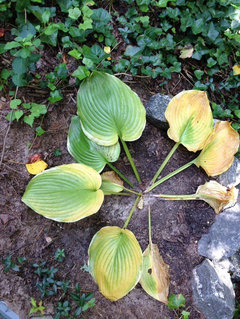
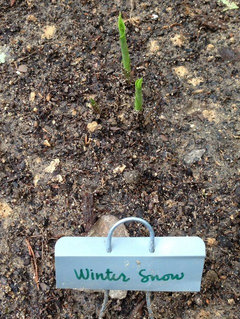
    A week after I tossed the NBC I found another small, but established Undulata in a different, older, irrigated bed with some downed petioles. Only one eye was affected. I posted about that day in the link below. After I doused it with tebuconazole it lost no more leaves than the ones depicted in the older post. That same day I found my Winter Snow prostrate, also. I'm posting the picture again so I can point out that all the leaves but one (11 o'clock) are flat on the ground. The hole the WS was in was too small and dug in the middle of an English Ivy field. I had planted it that spring and I was astonished at how badly it had already been invaded by ivy roots. It also was ignored on some hand watering days (operator error).

    Here is a link that might be useful: Another discussion about fungus on hostas

    This post was edited by zkathy on Sun, Nov 23, 14 at 19:05

  • 11 years ago

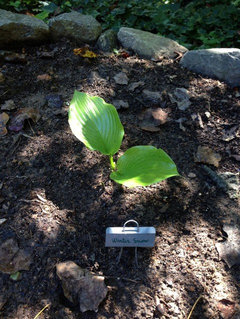
    Southern Blight is a fungus that is a major agricultural problem. It causes millions of dollars of crop losses per year. It frequently shows up 10 days after a drenching rain that follows an extended dry spell. It's been found as far north as Illinois and seems to be able to survive severe freezes if it's under mulch. There are a lot of warnings about not contaminating unaffected soil, but the beds affected in my garden are massively separated. There can be flat white mycelium mats on the soil surface and the little round balls which are reproductive bodies on the soil or attached to the plants. It produces oxalic acid which just dissolves the plant matter. The affected petioles might still be standing, but they will pull off the plant with the slightest tug. The tebuconazole seems to be the only fungicide available without a license. It was very discouraging to read about and I'm still afraid of it. But here's what my WS looked like six weeks later.

  • 11 years ago

    And here's what it looked like on October 4. So I'm hopeful that completing my irrigation system this winter and more vigilance on my part next summer can keep this thug under control.

    Zkathy

  • 11 years ago

    I've got to add a thanks to Chris at Hallson's for sending me a new Night Before Christmas as a bonus with my last order. He's a good man.

    Zkathy

  • 11 years ago

    You don't need a license/ applicator's permit for Bayer Prostar or Scotts Contrast (active ingredient flutolanil). You can buy them on the Internet or order them from your local farmer's co-op. Search this forum for "southern blight" and you will find previous posts about how to treat it. Prevention is the best medicine...that means to keep your hostas healthy and strong by regular watering and feeding, and using one of the above products early in the season as a prevention rather than a remedy/curative treatment after it is already infected.

    zkathy z7a NC thanked donrawson
  • 11 years ago

    Don,

    I read all the forum threads about flutolanil. I could not find anyplace on the web or in a store that carried the Bayer Prostar or Scott's Contrast. I'll look again.

    Kathy

  • 11 years ago

    My experience with southern blight is not extensive, but I have lost one hosta to it in 2012, a big fine The Razor's Edge. It was fine one day, and the next it was flat to the ground. It died.

    Then in 2013 I was quite careful of it, but late in the year I found Totally Twisted coming down with it--I'd learned the signs--so I treated it with an ammonia/water solution and repotted it totally.

    In 2014 I did not catch Totally Twisted in time, but decided to see what would happen. There was total devastation of the plant itself, but in the middle of it was ONE EYE that was not affected. So with that new eye I hope TT comes back resistant to southern blight. I'll let you know next year. The one eyed Totally Twisted is now dormant.

    My presumption with southern blight is that it shows up when it is very humid and the air circulation is poor. I hope you can remember if the plants in your garden stricken by SB were in areas pretty much enclosed where no breath of fresh air can circulate?

    Plus, SB affects many other species of plants. My DH had some issues with peppers this season. He dug them out with a large section of the raised bed. I asked him what he did for them. He said he cried!

    hehehehe

    He explained that he lost the first two peppers. But then he found a way to deal with the blight. I had bought some of the recommended chemical for treating SB, forget what it is now.

    Well, he looked at the label for ingredients (he has 1 degree in organic chemistry) saw the active ingredient was the same as in hydrogen peroxide available at the drug store...a whole lot cheaper.....which is in a 5 % solution to begin with.

    What he did was dilute that in a container with plain water to have the total H peroxide used from the bottle to be 5-10% of the mixture. I kept seeing empty brown peroxide bottles in the garden, and wondered. He dosed the roots of the affected plants until they started looking better, which took about 3 to 5 days. He lost only the first two peppers, saved the rest.

    So, it is worth a try if the need arises. It could happen to any other plant which falls dead (or nearly so) and you can test this remedy for yourself. Nothing poisonous about it.

    Am I making myself clear about mixing it?
    The original hydrogen peroxide is only a 5% solution.
    If you used the whole bottle, you'd need to mix 10 bottles (same size) of plain water to spray your plants. That's the simple form of math that I can remember. One to ten.

    zkathy z7a NC thanked User
  • 11 years ago

    I don't know why I couldn't find this product online this summer. Here's a link to purchase flutolanil.

    Kathy

    Here is a link that might be useful: Where to purchase