

mabgo anthracnose
Hello, i live in Greece, on the island of Paros, zone 9b, and am pationed with mango trees. ( i love this fruit)
I have been trying since three years now to grow several different varieties ( Kant, Keitt, Irwin, Tommy Atkins, Nam doc mai, and other Thai and Indonisian varities, BUT unfortunatelly i have big problem with anthracnose.
Only shortly after i buy the plants, they start geting infected, and gradually either they die, or simply they keep on loosing their leaves, and not managing to grow.
I have been spraying with copper ,and other fungicides like Alliete, but no much help..
Can you give me some tips please how to get over this fungus?? is their any better more specialized fungiside??
any chance if i make a total spraying of the property that i might get rid of it ?? I can see it also affecting my annona trees.... not making such a big damage like on the mangos, but certainly making them tired and holding them back..
Any advice i will reallly appreciate,
Thank you
Kostas
Comments (22)
 16 years agolast modified: 11 years ago
Kosta,
Are you 100% sure the problem is anthracnose? Anthracnose is usually associated with high humidity and I believe Paros has low humidity (correct me if I'm wrong). I also find it very suspicious that ALL your young mango trees die soon after you buy them in spite of using fungicides. My guess is that your problem could be due to wrong watering or fertilization practices.
Nikitas
 16 years agolast modified: 11 years ago
I also wonder if your problem is actually anthracnose. I have a nam doc mai and even here in FL where the humidity is just insane I have no problems with anthracnose on that tree.
Related Professionals
California Landscape Architects & Landscape Designers · Portsmouth Landscape Architects & Landscape Designers · Brooklyn Landscape Architects & Landscape Designers · Monroe Landscape Architects & Landscape Designers · Mission Viejo Landscape Architects & Landscape Designers · Denver Landscape Architects & Landscape Designers · Ocala Landscape Contractors · Shreveport Landscape Contractors · Montrose Landscape Contractors · Wichita Architects & Building Designers · Vicksburg Architects & Building Designers · Boston Architects & Building Designers · Portland Architects & Building Designers · Ontario Architects & Building Designers · Jackson Architects & Building Designers- 16 years agolast modified: 11 years ago
Kostas:
I have never known anthracnose to kill a mango tree....no matter the size. It will prevent fruit set, blacken the blooms, but never even bother the leaves or stems other than to facilitate some black sooty mold. If Copper and/or Alliette have been applied correctly, that would cure any anthracnose problem that existed. What other possible issues do you think might be the cause of your young mango tree demise? Your answer lies in something other than anthracnose.
Harry
- 16 years agolast modified: 11 years ago
ive seen anthracnose kill Julie and Mallika trees at SPYKES grove, the black fungus kills all vegetation right down to the graft of small nursery trees.
im in a dooryard setting and have never experienced problems of that size. Anthracnose to me is limited to black spots on leaves.
i would generally stay way from Indian varieties. Nam Doc Mai should not give you any anthracnose problems, Asian varieties should be resistant. i use neem oil on my Indian varieties and hybrids like Julie.
sorry, your setting sounds unique. i hope you find a solution.
- 16 years agolast modified: 11 years ago
Mango Kush:
Your report of tree kills at Spyke's is of interest to me. But the question I have is how do you know it was anthracnose that killed their trees to the ground?
The guys in the know about this say:
ANTHRACNOSE
Anthracnose, the most important mango disease, is caused by the fungus Colletotrichum gleosporioides. Flower blight, fruit rot, and leaf spots are among the symptoms of this disease. Infections on the panicles (flower clusters) start as small black or dark-brown spots. These can enlarge, coalesce and kill the flowers (Figure 1), greatly reducing yield.Figure 1. Anthracnose on the panicles can enlarge, coalesce, and kill the flowers.
On leaves, anthracnose infections start as small, angular, brown to black spots (Figure 2). If tissue is young when originally infected, spots can enlarge to form extensive dead areas (Figure 2). Infections that begin in older leaves usually result in smaller lesions with a maximum diameter of 1/2 inch (6 mm) that appear as glossy dark-brown to black angular spots.
Figure 2. Anthracnose infections start as small, angular, brown to black spots.
Fruit infection commonly occurs and can result in serious decay problems in the orchard, in transit, at the market, and after sale. The fungus apparently invades the skin of young fruit and remains in a "latent" (a living but nonsymptom-producing) state until fruit ripening begins. Ripe fruit, either before or after picking, can then develop prominent dark-brown to black decay spots (Figure 3). These may coalesce and penetrate deep into fruit, resulting in extensive fruit rotting. An interesting manifestation of anthracnose fruit damage is the symptom called "tear staining" (Figure 4). Anthracnose stains are created on the fruit surface where fungus spores wash along in spore-laden water droplets falling from infected twigs and panicles above the fruit.
Figure 3. Ripe fruit can develop prominent dark-brown to black decay spots.
Figure 4. Tear staining caused by anthracnose fruit damage.Anthracnose is usually more serious in years when rain and heavy dews are more frequent during the critical periods of infection from the onset of flowering until fruit are about half size.
Control of anthracnose, especially on very susceptible cultivars, such as `Haden' and `Irwin', centers on a diligent fungicide program. Effective control of even the postharvest phase of this disease is best accomplished by a good spray program in the orchard. Begin fungicide applications at the first appearance of panicles and continue spraying at recommended intervals until the preharvest waiting period is reached.
Homeowners with only a few trees may consider planting Indo-Chinese/Philippine-type mangoes. Many of the mangoes in this group are relatively resistant to anthracnose and will significantly reduce homeowners' dependence on regular spraying for control. Although not as colorful as the much more familiar Indian types, many of the Indo-Chinese/ Philippine mangoes combine this anthracnose resistance with good flavor and a desirable low-fiber flesh.
***************************************************
My research and experience does not find that kind of die back causally related to anthracnose. Any further info you have about this would be appreciated.
Harry
Here is a link that might be useful: Mango Diseases
kostas-paros
Original Author16 years agolast modified: 11 years agoThank you very much everybody.
I feel that you are right almost 100 %. the damage could not be done only from the fungus.I am afraid that i have over manured/ fertilized the plants at a very early stage. This has probably stressed them much , and at this time the fungus had the opportunity to make even more damage..
Thank you so very much for your advices, kostas
- 16 years agolast modified: 11 years ago
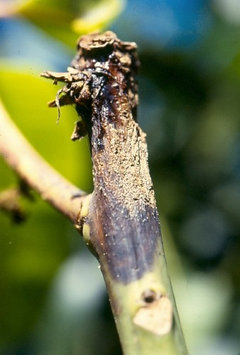
i dont know what killed it exactly, but they were dead sticks covered in black fungus. for some reason that location in Spykes gets alot of dew. they had this problem especially with Mallika, which is supposed to be somewhat resistant
like this right down to the graft line
- 16 years agolast modified: 11 years ago
Mango Kush:
Hmmm......that doesn't look too good at all. But, I don't think it is anthracnose. At least not like any anthracnose I have seen. It would be interesting to culture the spores to see if it can be ID'd.Re: heavy dew.....I can't imagine anywhere getting any heavier a dew than I get at my house. I have no irrigation and the grass stays green year round (except in the elevated areas near the street) just based on the daily very heavy dew that forms. Thankfully, I have never seen such a black rotting fungal problem like that.
Harry
- 16 years agolast modified: 11 years ago
almost looks like the blackspot i posted on my Julie tree.
i also get the normal anthracnose black spots. thats mostly cosmetic. this type is definitely a killer fungus though if not taken care of when it gets on the stem.
on my Julie i noticed there was a small pruned branch on the graft line which made for a bare spot in the bark, for some reason the fungus liked that spot.
- 16 years agolast modified: 11 years ago
Harry:
I figure I join the anthracnose debate. I really want to gain a better understanding of anthracnose, because it is a constant problem for me here, from November to March.Where I live, I get very heavy dews (dripping water off everything) during the fall, winter, and spring. Any new growth that I get on my mango trees during that time, becomes heavily infected with anthracnose and falls off. I've tried spraying with copper, but the fungus always beats me... when I don't spray, the leaves never even form and the stem does not even elongate more than 1/2 inch or so.
I use to have a Julie mango tree and it didnt just drop its leaves, the actual branches would become infected and die all the way down to mature wood. The Only way I have been able to save new growth on my mangos during the fall/winter has been to put them in a place where there is less dew formation (when they were in pots). I know it should not be that bad, but it is...
I think that in part, the cooler temperatures in the fall and winter make my trees more susceptible to anthracnose and also result in a significant decrease in growth rate of the new leaves, allowing the fungus to eat them up... Now, once the mango leaves are mature (grew in the summer), copper spraying (once every 6 weeks) keeps them in perfect condition through the fall/winter. My anthracnose problems seem to disappear in the summer time, when I get little or no dews...
My three mango trees are seedlings (Asian), so they have not flowered yet. I am worried that when they start flowering the anthracnose will prevent them from setting fruit...
What mango variety would you say is highly resistant to anthracnose? I might just get one and give it a try...
Is there a systemic fungicide I could try that works for anthracnose?
- 16 years agolast modified: 11 years ago
the only treatment i know of is to keep them covered in copper, coat the tree good so it makes a protective barrier.
spray them after each heavy rain.
- 16 years agolast modified: 11 years ago
Mostro, here's a systemic fungicide that lists "anthracnose in mango"...maybe you can email the company and get more info and details? Good luck with your mango trees.
- 16 years agolast modified: 11 years ago
Thanks pug, I am going to try one of the systemic products to see what kind of results I have... Bayer makes something called "Bayer Advanced Disease Control for Roses & Flowers" that should probably work too. I am going to see what I can find at my Lowes...
- 16 years agolast modified: 11 years ago
systemic means that traces will show up in the fruit right?
are you going to wait a few seasons before harvesting fruit?
- 16 years agolast modified: 11 years ago
Mango Kush brings up a good point. I wonder to what extent the systemic fungicide gets into the fruit. And, how long it remains in the tree's system. I guess you could eat the fruit anyway.....might prevent toe nail fungus.
- 16 years agolast modified: 11 years ago
Definitely something to seriously consider...the reason I suggested you email the company and ask qustions. I wonder sometimes just how much we actually eat with store bought fruits...because you know some of them use systemic to ward off fungus and diseases :o(
- 16 years agolast modified: 11 years ago
Mostro,
This comment: "when I don't spray, the leaves never even form and the stem does not even elongate more than 1/2 inch or so" plus the fact that you said copper does not work makes me think it might not be anthracnose that is killing your new growth. I had the same problem with newly grafted julie mangos. At first I thought it was a fungus because of the same problem you described but copper was not working. I then sprayed the plants with sevin and the problem was solved. I do not know the exact cause of the problem but because sevin worked I assume it was probably some sort of insect. Maybe you could give sevin a try before you go to the systemic fungicides. - 16 years agolast modified: 11 years ago
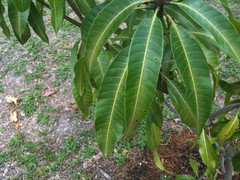
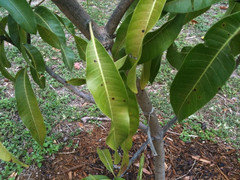
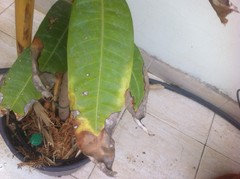
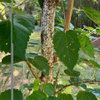
So i believe I'm also battling with this. Some questions:
1)Should I pull off the leaves that have the black spots?
2)I have read contradicting info., some sources say once the tree has it, there's really no use in spraying copper. Other sources say to spray it anyway.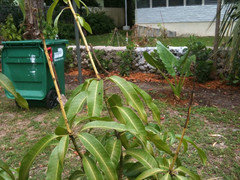
- 16 years agolast modified: 11 years ago
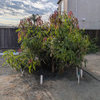
that tree is fine, what variety is it? you probably dont have to use anything at all
do not pull off the leaves, they are cosmetic fungus spots typical during our rainy season
- 16 years agolast modified: 11 years ago
It is a Graham. If you look at the first picture, the last of the new stuff that tried growing all died.
I shouldn't even be spraying copper?


mango mango