Software
Houzz Logo Print
jamreb91

What to do about my mango tree?

3 months ago
Hello,


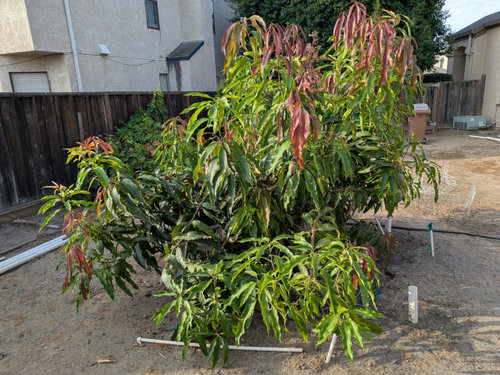
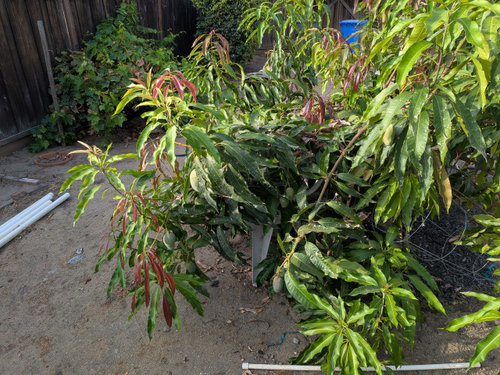
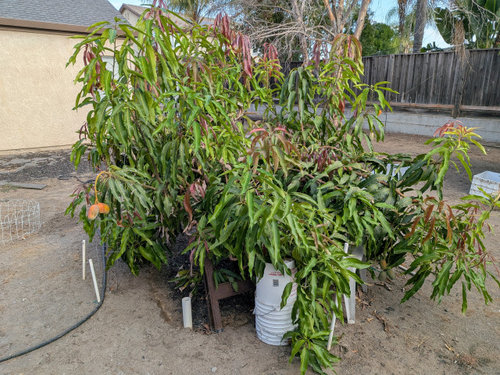
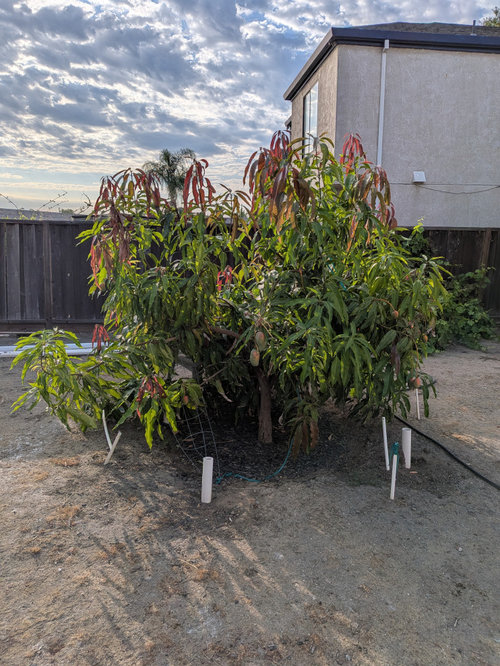
I know almost nothing about growing trees, let alone a mango tree. I had mango tree (still in a pot) gifted to me about 7 years ago. The last few years it's been growing branches that go out and down, instead of up or at least out and up. I've tried trying them together with that green 'tape' stuff, tried supporting them with various objects, but they just keep growing/drooping down. Is there anything I can do 'fix it'?


Thank you.


Comments (22)

  • 3 months ago
    last modified: 3 months ago

    Google up some images. You'll see that mango trees are not upright growers. They're natural spreaders, especially if bearing a heavy crop.

  • 3 months ago

    What’s up with the pvc pipes? and it looks dry in your yard-is it getting enough water?

  • 3 months ago

    floral-I was at a resort in Costs Rica and I was admiring the large, tall mango trees, and the monkeys in them, when I was almost urinated on by one of the monkeys. But the trees were tall. perhaps they were pruned to be tall and skinny

  • 3 months ago
    last modified: 3 months ago

    Rebekah,

    First thing I'd want to ask about that Mango is, where in the world are you?

    What USDA growing zone are you in?

    Does it get near to, or freezing temperatures in the winter season?

    A lot of variables can affect how a tree progresses.

    Let's get more information about this then maybe we can find a reason for the problem.

    PS: In a hot humind climate, with a tree that is irrigated (and possibly fertilized?), a large amount of long, lush, leafy growth can occur on the branches to the point they can't support themselves. More so, on a tree that naturally grows that way. That could be one reason your mango is growing in that way. But let's get more info first.

  • 3 months ago

    Hello,


    First, thank you for the replies to everyone.


    But in answer to some of the questions and replies:

    I'm in Zone 9b ("Far" East Bay Area, California).

    Yeah, it is definitely a dry area where I live. My wife does try to water it every few days, but sometimes it can go up to 6 or 7 days between watering.

    The PVC pipes are there from when the tree was younger and I would tie the 'green garden' tape to branches directly across in order to help keep them upright. (We also can have some windy days).

    The temperature doesn't really go below 40 degrees F in our winters. Speaking of temperatures, it can get up to 110 degrees F in the summer, although that's not all that often. Usually it's in the 90s - low 100s.

    I do try to fertilize the tree about 3 times a year. We tried pruning it a few years ago, but that seemed to freak it out - it didn't grow or give fruit for like 2 or years after that.


    Hope that helps.


    Thank you!

  • 3 months ago
    last modified: 3 months ago

    Yes it does help quite a bit. Thank You!

    Fertilizing any plant is generally a result from a soil test showing deficiencies in one or more macro and/or micronutrients, that a plant needs to grow in a healthy manner.

    Generally, over time, you get to know your soil and how much your plants need and you can sort of 'wing it' with applications that are spaced apart in a timely manner.

    Now these are my thoughts and anyone else that sees a gap here can chime in with superior knowledge and correct me but here is my theory. 😉

    Even a Mango tree, in a warm climate has a dormant period, ~3 to 5 months, generally once the temperatures cool and sun angles decrease. This can be apparent when new growth hardens off and ceases to grow. It's a resting time the tree needs and in some areas, it's also a dryer time.

    Now, you didn't say what type of fertilizer you're using but most commercial fertilizers have 3 main ingredients, Nitrogen, Phosphorus and Potassium and may contain some lesser ingredients like Sulphur, Magnesium and there may be other trace minerals.

    By applying a fertilizer containing Nitrogen, 3 times a year, I would expect the tree is going to grow, extending its branches, practically all year round, which may be why you're having trouble with long, lanky branches.

    Before I say you should get the soil tested because it could save you some money by not spreading fertilizer that you don't need and not having fertilizer leaching down into the ground water.

    I will say that your tree doesn't need Nitrogen all year round. It needs it primarily during the spring and summer growth period and I would stop applying any N, several weeks before your tree goes into dormancy (mid-summer), then not applied again until a few weeks before spring growth appears (whenever that occurs in your area).

    This should limit annual branch growth so the tree will handle them better.

    Cutting back on water during the dormant season should help also.

    Plants need less water during dormancy. Check the soil for dryness before watering.

    PS: A woody tree like Mango, doesn't need much Nitrogen in the first place. Use it very sparingly during the growing season. Best get a soil test to see if you need any at all.

  • 3 months ago
    last modified: 3 months ago

    I think mangos are considered somewhat marginal almost anywhere in NorCal...at least in terms of getting them to produce, even if showing enough foliar hardiness. Are you aware of the California Rare Fruit Growers Association? They might be a good place for advice.

    There was a fellow named Axel in Santa Cruz who used to run a forum called Cloudforest Cafe with many, many threads about trying to grow mangos in Northern California. He eventually moved to Hawaii ;-)


  • 3 months ago

    OPs tree is bearing fruit, so, this year at least, they are growing mangoes successfully.

  • 3 months ago
    last modified: 3 months ago

    fair point Floral. OP's story seems...possibly incomplete though. We don't know whether the tree is getting winter protected: 'in a pot' implies maybe it is sometimes moved to get cover - or covered with something like frost cover cloth? ("The temperature doesn't really go below 40 degrees F in our winters." - well usually. Otherwise OP would be USDA zone 11a, and not 9b.) TBH in a climate fully suitable for them, and planted in a ground, I think a mango would be bigger than that after 7 years.

    It reminds me of a former coworker who grew mangos in a southern suburb of Houston. He left them in huge pots, but only had to move them into a polyhouse during rare freezes. (which, alas, have been less rare in recent years)

    possibly useful thread

    https://www.houzz.com/discussions/4882026/california-mangoes-in-the-bay-area

  • 3 months ago

    Here is the updated CRFG link about mango https://crfg.org/homepage/library/fruitfacts/mango/

    It occurred to me after reading that this might be a dwarf cultivar, and keeping it in a pot just makes watering it easier.


  • 3 months ago

    Although OP mentions a pot I can't see one. Looks as if it's in the ground now.

  • 3 months ago

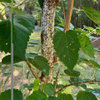
    The first picture shows the trunk going directly into the ground and the last picture show fruit.


    I wasn't too far off with my fertilizer recommendations:

    From the crfg:

    ' Fertilization: Mango trees require regular applications of nitrogen fertilizer to promote healthy growth flushes and flower production. Chelated micronutrients, especially iron, are also often necessary. A feeding program similar to one used for citrus is satisfactory, but do not fertilize after midsummer. Organic fertilizers perform best, since the trees are subject to fertilizer burn. Young trees are particularly sensitive to over-fertilizing, but respond well to fish emulsion. Sandy soils require more fertilizer than loam or clay.


    I think too it's a dwarf.

  • 3 months ago
    last modified: 3 months ago

    Some people temporarily bury pots of 'temperennials', but you have to be careful, the roots will often break out of the drainage holes. Unless OP's mango is dug up periodically, believe me, it's not in a pot anymore!

    Kinda OT but I remember a report a long time ago, around 1999 or 2000, that in a string of mild, freeze free winters, a mango in a 4 sided London courtyard got quite large. Sadly, digital cameras were not so ubiquitious then, so no pictures. It's believable though considering I have seen pictures of a huge Grevillea robusta in London. At the time, on the GOTE forum, people remarked they (G. robusta) weren't grown in places like Cornwall. So although maybe not quite as mild as the SW coast, maybe the urban heat island warmth suits things that need a bit of a baking in summer, like mango, or 'silky oak' (the common name for G. robusta). Or maybe in mild years, London is freeze free, and it's the colder winters like 2010 that separate London from Scilly and Penzance.

  • 3 months ago

    Grevillea robusta grows quite robustly in my neck of the woods so summer heat must not be a big factor. 😉

    I would also point out that evergreen trees and shrubs, specially those from tropical locations, never really go dormant. Growth may slow slightly during the colder months in non-tropical locations but the plant never stops photosynthesizing nor do roots pause with regeneration or extension.


  • 3 months ago
    last modified: 3 months ago

    I find it hard to believe that OP ist lifting a tree that size every winter.

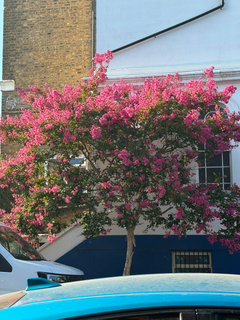
    Central London is warmer than most of Cornwall due to the urban heat effect. Recently DS sent me a photo of a tree he'd seen in north London for identification. It was a Crape myrtle in full flower. A thing I've never seen in my life in this country.


    There are also reports of fruiting avocados in very sheltered London gardens.

  • 3 months ago

    Hi again everyone!


    Thank you for all the comments.


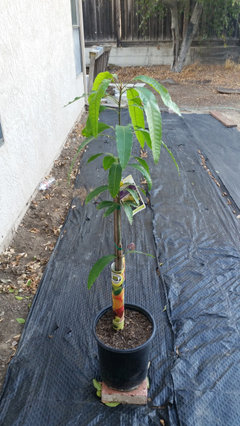
    OK, just to clear up the whole pot or in the ground thing, Herbert is directly in the ground (no pot). When he was given to me, it was either in 2017 or 2018. And he stayed in the pot for about a year I think. I would leave him outside in the day, and bring him into the house at night to protect him from the cold. There's a picture when he was still in a pot back in 2018.


    Someone said that he's small for being 8 years old, and I agree - I've seen other people's mango trees on YouTube and the trunks on them are at least twice as big. I don't know why that is.


    For the 1st 2 or 3 Winters of being in the ground, I completely surrounded him with painters plastic at night using a simple PVC pipe structure. And at least the 1st Winter I actually placed a single halogen light at the base for warmth.


    I'm not real sure of the type of fertilizer I used, but always store (Home Depot) bought, and usually it said 'citrus' on the package. But the last couple times I purchased some, I found one that specifically mentioned mangos, so I used those. I noticed that when I actually remember to fertilize, he has growth spurts.


    He has provided fruit for many years in a row...up until we pruned him which he didn't seem to like - he didn't hardly grow or gave fruit for about 2 consecutive years.


    I guess my main concern are his branches growing downward - it just doesn't seem right, but I'm afraid to cut them off in risk of stunting his growth again. I'm just not sure what to do.


    I'll be happy to provide any other info that may be helpful - just say the word. :)


  • 3 months ago

    My whole point about the fertilizer, is the same as the article from the california rare fruit growers said, is that you don't want growth sprurts between mid-summer and late winter. That's why you don't fertilize after mid-summer until late winter.

    Rebekah Navarro thanked BillMN-z4a
  • 3 months ago

    Gardengal - that's interesting. Back in the days of him participating at Cloud Forest and Hardy Palms & Subtropicals, Ian of Desert Northwest said G. robusta wasn't quite hardy enough for Seattle, or anywhere north of the coastal southern Oregon climate like Brookings etc. (also the farthest north you see big Washingtonia palms)


    There are none showing here... https://depts.washington.edu/uwbg/gardens/bgbase.php


    Anyhow, back to 'Herbert', maybe this tree is a dwarf and bearing as well as can be expected. I hate to be a doom-sayer, but it's not like mango trees are something new on the horizon. Citrus have been cultivated in NorCal for what - well over 100 years. I saw scads of them in Sonoma county on my trips there. If mangos were perma-hardy they'd be more common. Maybe nurseries are selling dwarf trees with the implicit understanding they will be easier to protect in the once every 10 winters or whatever, that that is necessary.


  • 3 months ago
    last modified: 3 months ago

    So, if I understand correctly, Rebekah's 'problem' is just that the shape is not what she expects. Otherwise the tree is growing and fruiting acceptably. Being a lazy gardener myself I'd remove the ugly plastic clutter, live with the tree's natural shape and enjoy the delicious fresh mangoes. Fwiw I have never seen an orchard mango that wasn't a broad spreading tree. I've seen huge tall mangoes in the tropics but they were many decades old. Never seen an upright mango.

    Rebekah Navarro thanked floral_uk z.8/9 SW UK
  • 3 months ago
    last modified: 3 months ago

    " Fwiw I have never seen an orchard mango that wasn't a broad spreading tree."

    I think a lot of trees in orchard settings are pruned with a specific goal in mind.

    Asking AI: are fruit trees in orchards pruned to make harvesting easier?

    Yes, harvest accessibility is one of the primary reasons commercial orchards prune fruit trees. Keeping trees at a controlled height and open shape allows pickers to reach the canopy safely from ground level or low ladders, while also leaving space for specialized machinery to pass between rows.

    Also "The natural shape of an unpruned mature mango tree is a broad, symmetrical, and rounded or oval canopy with a thick, sturdy trunk and dense evergreen foliage. Left to grow on its own, it can reach heights of 30 to 100 feet, "

    Rebekah Navarro thanked UpperBayGardener (zone 7)
  • 3 months ago

    I would buy one of the pop up greenhouses and the red tie downs Home Depot sells. Clean up the pvc pipe. You will only have to use the greenhouse if it gets cold.

    Plant some flowers around it.

    I would love a mango, it looks great!

    Rebekah Navarro thanked Sherry8aNorthAL
Sponsored
Peabody Landscape Group
Average rating: 3.5 out of 5 stars8 Reviews
Columbus' Reliable Landscape Design & Contracting