Software
Houzz Logo Print
daninthedirt

'topping' cherry tomatoes?

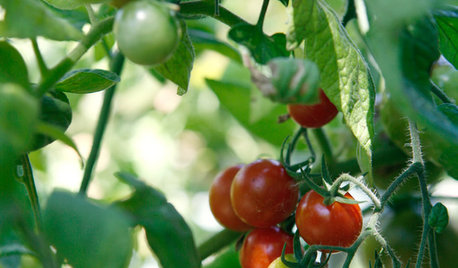
I have a stand of Sweet 100 cherry tomatoes. I do such a stand every year for cherry tomatoes, with great results. (I'm in Central Texas). I put them in in early March, and they grow like crazy. As of now, the vines, which I tie up) are getting close to six feet tall. It's a little scary how fast they grow.

My question is whether I should lop the tops off, and keep them from growing higher. Ideally, that would encourage budding further down the stem, which will be more supportable water-wise when the weather turns very hot.

My trellis is only about five feet tall, so if I don't lop them off, things will get messy pretty quick. But does "topping" of these really encourage budding further down?

Comments (11)

  • 15 years ago

    But does "topping" of these really encourage budding further down?

    No. That's not the way indeterminate varieties grow. They are vines and you can't turn a vine into a bush.

    What will happen is one to two new side-shoot branches will develop just below where you cut off the top and they will keep growing even taller. So now you will have 2 tall tops rather than just one.

    Instead just let the plant do what it does naturally and as it grows the tall top will drape back own over the support and keep growing and producing fruit. To prevent the jungle development side trim back leaf branches instead. In other words 'slender' down the plant rather than 'topping' it.

    Dave

  • 15 years ago

    Excellent advice. Thank you.

    Here in Central Texas, in the summer, with temps over 100F, long vines need very frequent watering (as much as once every day or two!) I was trying to avoid that. So my idea was to trim back farthest from the roots and encourage development closer to the roots. But I guess side trimming the leaf branches will help the vine ends get more water as they drape down.

  • 15 years ago

    If you're concerned about watering, attack that problem by adding plenty of mulch on top of the soil, watering when the sun goes down, and maybe putting soaker hoses or drip on a timer. You want deep, slow watering to promote deep roots.

  • 15 years ago

    I'm not sure if you're used to gardening in a REALLY hot climate. My soil is heavily mulched, but when the daytime temperature is well over 100F (and nighttime temps don't go much under 80F), tomato leaves loose enormous amounts of water, and very long vines just have a hard time carrying it, no matter how deep the roots are.

    Sure, soaker hoses are nice, but then one is just watering continuously.

  • 15 years ago

    Will agree with you mostly. I live north of San Antonio about 40 miles. In about a month or so it will be ridiculously hot, and the tomatoes will have trouble producing, except for the cherries, which do seem to be immune to hot weather. I'll give you my experience and you can take from it what you will. I grow in raised beds, and use drip irrigation. From the day i plant i am diligent about not watering my tomatoes until they begin to droop a bit. Then i soak the hell out of them. I mean ALot. When just transplanted, i'll try to get 3-4 gallons on them at atime and go up from there. When it gets real hot, i generally only have to water once every 5-6 days, unless the wind blows, like it has for the last 3 month. I think if you starve them for water to begin with and make them establish a larger root system, you can keep from having to water them so often. Just my two cent.

  • 15 years ago

    Where I live we have temperatures up to 110 in July and August, but it usually cools down well overnight, so I don't have quite as much evaporation as you have where the weather stays in the 80s at night. I water deeply about every third day at the hottest part of the summer(in the evening or very early morning.) My beds are double-dug so the roots can easily reach deep into the soil, and my clay soil holds a lot of water. If you look at my pictures now my beds aren't mulched, but I usually mulch thickly with straw (I have to borrow a truck to get it...)

    FWIW, I've never noticed that long vines have a tougher time of it than short ones. My main heat-related problems are blossom-drop and sunscald.

  • 15 years ago

    I interpret the tops (and only the tops) of the vines starting to droop as a sign that the vines just can't carry enough water.

    In the hottest parts of the summer, my vines can probably go for three days, maybe, without the tops drooping. That's after putting a LOT of water on. Now, FWIW, the bed has soil that is VERY friable, so the water probably evaporates out of it a lot faster than it would if it developed a crust, and it probably doesn't hold a lot to begin with. Clay soil may actually be advantageous in that respect.

    That's a good point about starving the seedlings for water. When they first went in, I waited until they drooped before watering. Just trying to get those roots to reach deeper.

  • 15 years ago

    I interpret the tops (and only the tops) of the vines starting to droop as a sign that the vines just can't carry enough water.

    I don't think I would agree with that interpretation at all. Assuming indeterminate varieties, many things can cause what might be called "drooping", some of them quite normal. Indeterminate varieties are vines and vines naturally droop or drape thanks to the effects of gravity.

    Not to mention that most all plants will "droop" during the hottest part of the day only to perk back up with no intervention by the gardener as the day begins to cool. Its a normal defense mechanism of plants.

    But what is easy for the gardener to create is water-dependent plants. Excessive watering leads to plants that then cannot adjust normally to extremes in temperature.

    Extreme heat during the summer doldrums is something many of us have to deal with but heavily mulching the plants with several inches of straw or similar organic mulch and even rigging temporary shade for them is often more beneficial than just supplying them with more water.

    Dave

  • 15 years ago

    I'm talking about *leaves" drooping on the top of the vines, not the vines drooping. Sorry I didn't describe that well. Pretty clearly dehydration, because they do perk up with water.

    Yes, late afternoon droop is normal. A fixture in pepper plants. I'm used to that.

    My tomatoes are planted in adjacent frames aligned east-west. So one frame shades the other quite nicely. The plants on the northenmost frame droop just as much as on the southernmost frame. In fact, the plants on the two frames are almost identical in height and vigor.

  • 15 years ago

    Dan - Leaves will droop in hot temperatures to save water even when the plant is not water stressed. When water transport can't keep up, it droops and that closes the pores that allow water to evaporate from the underside of the leaf.

    If they don't perk up when the sun goes down and the temps drop, THEN they need water.

    Water deeply to encourage deep roots and mulch heavily.

  • 15 years ago

    A suggestion: since you apparently have several plants why not try

    1) topping a couple as you originally asked,

    2) doubling or even tripling the mulching on another couple and don't water them as often,

    3) leave a couple to "leaf droop" as you call it without any intervention from you, and

    4) a couple as controls treated as you normally would have with the extra watering..

    It is the way we all learn, by first hand experience, and that way you can see exactly which approach works best for you in your growing environment. There would be several valuable lessons for your use in the future.

    Dave

Sponsored
Custom Home Works
Average rating: 4.6 out of 5 stars10 Reviews
Franklin County's Award-Winning Design, Build and Remodeling Expert