Software
Houzz Logo Print
anney_gw

Irrigation system fixtures

17 years ago

I'd like some advice on how to set up the irrigation system I envision.

In years past I've used a regular hose and splitters to send water through my drip irrigation hoses. They irrigation hoses are still good and I'm not going to change them.

But what I want to change is the awkward hose-splitter mess I've had.

I want to run a straight length of PVC straight out from the main hose and set it up to water three long raised beds, which I think will need one elbow and two T-fixtures to orient the drip hoses perpendicular to the PVC pipe like this:

:____:____:_____________

I'm pretty sure this is doable, because gonefishin posted several pictures where his similar setup was visible, though he irrigated more than three "rows". It looked like his on-off valves for each line of irrigation were plain old faucets, which I'd like, too. Those little dinky levers on some plastic valves can get muddy and stuck.

So can somebody tell me what fixtures and adhesives I need to get and the material they should be? It may seem simple to you, but heck!, I hardly know what to call the fixtures.

I'd appreciate some guidance if you can help.

Comments (9)

  • 17 years ago

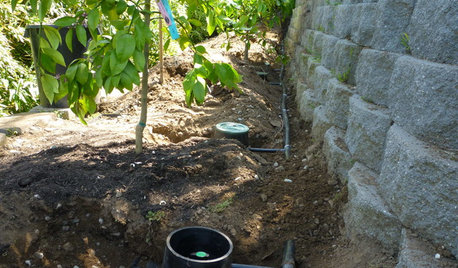
    This is my setup; From my hose bib on the side of the house I attached a 3/4 inch pvc pipe, buried it and ran it into my garden where it connects to a sprinkler valve. The valve in this picture is manually operated. I replaced that valve this year with an automated valve which is wired into a nine station Rainbird timer. Off of the valve in the garden there is a pressure reducer and an inline water filter. This all reduces down to a connection that 1/4 inch drip tubing is connected to. I have one main drip tube that goes across the top of the garden, from this line I "T" off for the individual rows. This year I am growing a giant pumpkin in this plot and I do not have the drip tubing set up yet. The valve closest to the fence waters the garden and the other valve waters my fruit trees.
    {{gwi:17837}}

    {{gwi:17841}}

    Here is a link that might be useful: Watch me grow a giant pumpkin

  • 17 years ago

    Hello Anney , I may be able to help. I remember Gonefishin' posting photos.I am going to presume you are using soaker hose and not drip tape. Also, presuming you are furnishing water with a garden hose and not plumbing into a water line. I would use 3/4 pvc pipe. The first connection would be a 3/4 female pvc to 3/4 female hose thread swivel adapter.Then A section of 3/4 pvc pipe. A 3/4 pvc "t"(As you presumed)another section of pipe, another "t" ,another pipe and the elbow as you stated. I believe you had this much figured out. You will need a saw (Hacksaw works fine) or a special cutting tool which I feel is unnecessary for this small project(Too expensive)to cut the pvc pipe. Saw the sections to the length to match width between beds. Use a knife to remove the burrs caused by sawing and blow shavings from inside pipe to keep from entering soaker hoses.Try to make a square cut across the pvc pipe so it fits in the fittings better(They don't have to be perfect. but decent).O.K. ,now you will need a pvc primer/cleaner. It comes in a small container with a screw on lid with a swab attatched. Also, a small container of pvc cement.Comes in same type container.Dry fit all connections and make sure the assembly is what you want. Take a pencil and put an alignment mark on the "T" fittings and pipe so you can align them more quickly when you get the glue applied. Disassemble everything .Prime and glue one fitting at a time aligning the pencil marks.When priming, prime the inside of fitting and outside of the pipe and let dry a few seconds. Then the glue , get a generous amount on the swab and apply to inside of the fitting and outside of the pipe and assemble together aligning pencil marks. Work quickly and use hand pressure to hold the connection together for a few seconds(They try to come apart till glue sets for a few seconds).Wipe excess glue from outside of joint.You can use a short nipple cut from the pipe to attatch the faucets to this header.Just buy 3/4 pvc faucets and glue to header nipples. If you want brass faucets you will need a fitting from 3/4 pvc to whatever thread the brass faucets have. Your supply store should help with this.
    Hope this helps.(Wear gloves to keep glue off hands)
    CDGTXS

  • 17 years ago

    I type so slow ,I see someone has already responded. Maybe some help from both.
    CDGTXS

  • 17 years ago

    Anney , also read and follow all safty precautions on the primer/cleaner and glue.
    CDGTXS

  • 17 years ago

    cdgtxs

    Oh, thank you!

    Yes, I'll use the hose running from the house to connect to the PVC pipe, end to end. And yes, soaker hoses, not drip irrigation. (I tried drip iriigation two years ago and wasn't satisfied with it, though I know lots of people are.)

    Anyway, after reading your post, I did some internet checking and realize that I'd be better off with a PVC valve rather than a faucet, all of which appear to have that 90 degree curve downward. I think GF's PVC water feed pipe was somewhat elevated so it didn't matter. Mine would lie flat on the earth, so it just needs an on-off valve on each line leading to the beds. But I'd sure like to find one that has a round handle to turn rather than those levers! Maybe I can.

    Is the header/header nipple the part that extends between the valve (which attaches to the T on the other side) and the threaded soaker hose? IOW, will it have the threads I need to connect the soaker to the cut-off valve?

    And yes, I'll be very careful about that glue! I'm very suspicious of most really tight glues after a stupid run-in with Krazy Glue several years ago!

  • 17 years ago

    Sorry, didn't intend to jump over your post!

    That looks like a complicated setup to me, and I'm sorry I didn't say that I'll be using soaker hoses instead of driplines. So my setup can be simpler than yours, as well as my having straight beds whereas yours is triangular. But it looks like you've just run straight drip lines from the long side of the triangle, so maybe not that complicated from one perspective at least.

    Anyway, thanks, and maybe someday I'll bury the waterline from the house out to the garden. I'd like to set up a simple table and basin under an elevated faucet to prepare some of the veggies before bringing them in the house, like shucking corn and tossing the husks back in the garden, maybe shelling or washing and picking over beans. That kind of thing.

  • 17 years ago

    Anney , what I was calling a nipple is just a short piece of pvc pipe cut to any length . I was suggesting one in each "T" and one in the elbow to attatch the valve to. It wouldn't have threads and would glue into the "t" s and elbow. You could probably find a valve that would glue onto this nipple. If not you can find a fitting that will glue to the nipple and will have threads on the other end to fit the valve. The term nipple probably is not the proper term but is what I call any short piece of pipe between fitting and valve/fitting and fitting etc.There are many ways to work with pvc and the nipple probably is not required. You probably can find a valve that will glue directly into the "t"s and also the elbow.I just thought the nipple(Extension) might give a little more room from the "t". A good hardware store should be able to help you purchase the proper fittings. I do understand what you mean about the inline feature of the valve and I THINK they make what you are talking about but don't know for sure what it is called. Really, pvc is very versatile(sp?)and any connections you can rig that will work will be fine , it doesn't have to be exactly as I described, but I try to keep it as simple as possible for appearance.
    I am not an expert but have worked with pvc so any questions I can help you with , please ask.
    CDGTXS

  • 17 years ago

    cdgtxs

    Thanks so much for your help and advice. I think I found the piece I need for attaching the Ts and elbows to the soaker hoses as well as at the beginning of the PVC pipe

    , or something like it. Smooth on one end and threaded on the other. I'll have to check and see if the fittings need to be male or female but that should do it.

    Okay, I think I'm all set now, know what I need, at least what they look like even if I don't know what they're called!

  • 17 years ago

    Anney , the fitting looks like one type you can use if you get the correct size on each end. The pvc end is simple enough 3/4 pvc male or female depending if fitted in the t or on a nipple. The terms for threads was what I thought you might not be familiar with. 3/4 mht is 3/4 male hose thread and 3/4 fht is 3/4 female hose thread.These fit your hose connections. mpt/fpt is male pipe thread and female pipe thread . These will fit the valve if you buy a threaded valve.They will need to be the same size as the threads in the valve(1/2pipe or 3/4 pipe usually). You may have already known this but thought you may not.
    CDGTXS