Software
Houzz Logo Print
johnpeter_gw

Hillbilly Potato Leaf fruit stems too delicate

17 years ago

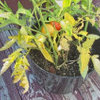
I have one of these cultivars growing in my backyard garden... in a 10 gallon pot... with a common tomato cage holding the vine upright. I have never grown HPL before.

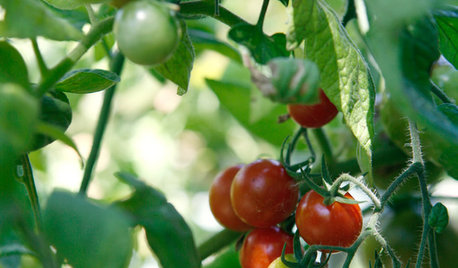
There are several green tomatoes growing on the plant... a sign of admirable yield. The fruits are still quite small.

I was shocked to see that the stems to several of these small fruit had already collapsed, a scene typical of fruit that has achieved near-final size. In other words, I believe there is a genetic fault in this plant such that the fruit stems are not bulking-up sufficiently to support the growing fruit.

While fruit will survive under a collapsed stem, it has been my observation that nourishment is attenuated, and fruit is thereby stunted in size. So I have used newspaper twine (something handy here) to erect supports for each of the fruits on my HPL vine. Needless to say, this is an almost-silly and tedious process... but something I'll put up with if the fruit is "worth" the trouble.

Can anyone else growing HPL share his experience on the matter of collapsing stems? It seems my HPL is inferior to my many other cultivars on this point. But I have only one HPL... hardly a fair statistical sampling.

How about taste? Any opinions on HPL appreciated.

Comments (5)

  • 17 years ago
    last modified: 11 years ago

    I've grown both Hillbilly and HB PL with no problems, especially of the kind you refer to.

    Hillbilly RL and Hillbilly PL taste the same and the fruits are the same, the only difference being the leaf form.

    Hillbilly is just one of way over 100 defferently named red/gold large beefsteak bicolors and when they're good they're very good and when they're bad their horrible in my experience. To coin a phrase.

    That is, I've found the red/gold bicolors to vary from year to year even when growing the same variety. They can be juicy and fruity sweet one season and the same variety can be mealy and lack good taste the next season.

    So I've decided they react to weather , as a group, more so than do many other varieties.

    Do you see any other problems on your plant other than petioles that seem to collapse?

    Carolyn

  • 17 years ago
    last modified: 11 years ago

    Hi Caroline,
    Thanks for the reply.
    This is the first and only "Hillbilly" I've grown, so my statistical sampling "couldn't be worse." Well, I suppose "zero" would be worse. Then I'd be making it all up, wouldn't I!

    The weak petiole is most startling in this plant, and I'm wondering if you've ever noticed that.

    I like the plant for all other reasons... with the biggest reason (tasty tomatoes) still pending. I've got abundant green toms, to my delight. As you've no doubt discerned from my occasional other postings to this forum, heirloom yield has long been a problem here for me. Notable exception to that rule came with Crnkovic Yugoslovian... some years ago.

    So I'm delighted with any heirloom that gives me fruit, and this year I'm going at it big-time in my small-time suburban backyard. Each plant is in a 10-gal pot, all lined up where they get the maximum solar exposure... a new configuration for me. (Shadows are a problem considering the tallness of neighbors' trees, tall perimeter block walls, and my two-story house.)

    Considering that Hillbilly Potato Leaf is comparatively high-yield, I'm hoping it's worth its weight in moonshine flavorwise. Then I'll keep seeds and multiply the process next year.

    I prefer potato leaf varieties not for disease-resistance (not a problem here in this rainless climate) but because PL is recessive and it's easy for me to spot an interloper in my seedling production efforts. That said, I know which fruits on my small garden are assuredly self-pollinated, and will save seeds only from them.

    I never see honeybees at work on my backyard toms, though I have incessant bee activity with my colossal rose bushes, which are about a dozen in number in my front yard. Maybe bees don't like toms or maybe my bees just get enough pollen from my roses. I suppose your comments on whether bees like toms would be helpful.

    You've told me before that toms don't need insects to pollinate. Still I suspect otherwise with the elongated-pistil anatomies exhibited by almost all heirlooms I've observed. Our big black carpenter bees somehow work (ever-so briefly) the tomato flowers, however. (I observe this commonly at our massive public garden, 1 1/2 miles from my home.) These ungainly bumblebees briefly dangle unside down from large tom flowers, and seem to suck something from the pistil, for a mere second. Then the insect flits off to another flower and repeats, over and over again.

    The tom yields at the big public garden are higher, but hybrids predominate there. I have some heirlooms in my 20'x 30' plot there, still coming up. My hybrids ("Big Beef" etc.) are indeed vigorous, big, and loaded with green fruit. My heirlooms are doing well but trail given their later plantings. This will be a good year and so I'll be able to make some comparative comments about yield... assuming our admirable mild weather persists for a few more weeks.

    I've had lousy yield results since 2001 (ever since my mom-in-law died) until this year. Maybe she is looking over my garden this year. I used to provide her with numerous tasty toms... especially appreicated given her infirmed body... but still-viable taste buds.

    By the way, my Stupice (that Czech heirloom) plant has produced numerous tasty cherry-sized tomatoes. The flowers have short-pistils, like most hybrids, and the yield has been correspondingly high.

    None of these potted plants gets big, like ones planted in terra firma. So my comments about "high yield" are qualified by that overriding fact.

    Thanks for staying in touch.

    Best regards,
    John

  • 17 years ago
    last modified: 11 years ago

    John, just a few observations.

    First, in almost ALL heirloom varieties the stigma, at the top of the pistil, does not stick up, is not exherted, so that pollen from the anthers can fall on it easily.

    Domestication of the tomato was accompaniued by retraction of the pistil, so for instance, a good proportion of the currants, aka S pimpinellifolium, for example, still have exherted stigmas and have to be insect pollinated.

    Pistils can also exhert when they normally wouldn't due to, due to weather. The only way I can guess at which of my heirlooms might normally have exherted stigmas is when, after growing the same variety out several times for seed production, I tend to get crossing, and of the several varieties that I've done that for I can only remember Aunt Ruby's German Green and a couple of others that gave me higher rates of X pollination.

    I think what's confusing is that as a blossom is pollenized or X pollinated the end result is that the stigma does end up above the anthers so it may appear that it's exherted, but it isn't/wasn't, to start with. And most blossoms are pollenized before the blossom it totally open.

    All sorts of bees can work tomato blossoms, but they do so for the protein in the pollen b'c tomato blossoms don'thave nectar.

    But if you read around on the net I think you'll find that those sewat bees are the most common of the bees that work the blossoms, especially if you read the article wriiten by Dr. Jeff McCormack that's still at SESE.

    About petioles. You say that they fall off when there are wee green fruits on them. Are you perhaps looking at the wee tomato ovary which is present all the time until fertilization occurs and that allows the ovary to grow and mature into a mature fruit? And no, other than the petiole breaking off when there's blossom drop, see below, I've never seen that happen spontaneously. There are some varieties that fall of the vine when they're ripe, Eva Purple Ball and Redfield Beauty are two that I remember, but they do so only when the fruits are ripe.

    When blossom drop occurs, for whatever reason(s) the blossom does break off at the petiole so I wonder if that might be going on.

    Carolyn

  • 17 years ago
    last modified: 11 years ago

    Hi Carolyn,

    Thanks for the explanation! I will look more carefully at my blossoms, and yes it seems that the pistil "grows longer" during the life of a flower. You said the flower will tend to be pollinated before the pistil sticks out beyond the stamens... something I never realized. I'll ponder this and read more.

    I will clarify the original point of my posting here. The petioles aren't breaking. They're merely collapsing under the weight of the fruit... which is about the size of a big grape. I considered such collapse to be remarkably premature. Normally I see it happen when the fruit is near to full size.

    So I'm "unkinking" those that kinked, and supporting ALL the petioles at the immediate proximity of the fruit with newspaper twine... suspending the weight by tying the other ends of the twine to points above, on the tomato cage. I am not strangling the petioles.

    John

  • 16 years ago
    last modified: 11 years ago

    I am in Houston and on my second year of heirlooms, which I grew by the bushel in Illinois. Last year I had a total of 5 mature tomatoes in nine plants, and the birds got the best three. This year I have ten in and grew from seed in ground the second week of March. The weather has been great for propagation this year but I am getting many, many blossom drops, especially in my one Hillbilly Potato Leaf. I water twice a week, about an inch total, because with the wind and comparative heat (it has been in the 80's here during the day) the top 4-5 inches of the ground dry. I fertilized three times, the last being when the plant started to show flowers. I would love to know what is causing my flower drop and if there are any tricks on Hillbilly as well. My varieties include Eva Purple, Cherokee Purple, Aunt Ruby Green, Tiger Stripe and Austin's Red Pear. The red pear is doing great, setting fruit and well on its way to providing salad tomatoes. Too much fertilization, too little, too much or little water, no bee activity? I can't figure it out.