Software
Houzz Logo Print
californian_gw

Big black bumblebee pollenating tomato blossoms

19 years ago

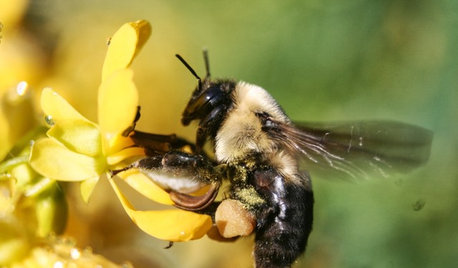
I have never seen a honeybee attracted to my tomato blossoms, but there is a big black bumblebee that I have seen several times visiting the tomato blossoms. It was on one of my Brandywines today, so I guess I can forget about saving a pure strain of seed from that plant.

Comments (16)

  • 19 years ago

    If it had a shiny black abdomen, it's likely a carpenter bee. There's always the chance that the flower self pollenated before the bee had a chance to screw things up...

  • 19 years ago

    And of course I assume you will be getting new blossoms which you can bag before they open...
    I adore my carpenter bees! I say Hello to "my bumbles" every morning.
    Carla in Sac

  • 19 years ago

    About the only kind of bees I've seen this year are either the carpenter bees or the bumble bees -- that's it -- no honey bees.

    I have two yellow crookneck squash plants and I've even taken to hand pollinating those because I had been getting small hard, dried-up fruits because there were no bees coming around to pollinate the blossom flowers.

    I read somewhere that bee colonies have been dying out because of some sort of virus. My mother in law in Kentucky has also mentioned that she's not seeing any honey bees around her garden either this year.

    Judy

  • 19 years ago

    Same thing is happening with the bees here in Missouri. Last year had so many, they were all around the Oriole and Hummingbird feeders. Now this year none at all.

  • 19 years ago

    No honeybees here. :( I'm starting to get worried. Last year, I helped my neighbor across the street remove an enormous hive from his attic. This year, no bee sightings. I think I may have seen one last February, but not since then. Lots and lots of yellow jackets, a couple of bumble/carpenter bee sightings, and many hummingbirds.

    I haven't seen the hummingbirds around my tomatoes. They seem to love my various sage bushes.

  • 19 years ago

    Tomatoes self-pollinate before their blossoms open.

  • 19 years ago

    Trudi, I know that tomatoes usually self pollenate. But if an insect happens to bring pollen from another variety of tomato to the flower it will be partially pollenated by that pollen too.

  • 19 years ago

    so I guess I can forget about saving a pure strain of seed from that plant.

    The odds of CP are slim to none but if you need to be 110% sure then just bag the next set of blooms. There is no need to write off production from the entire plant because of the bee visit to one set of blooms.

  • 19 years ago

    "I have never seen a honeybee attracted to my tomato blossoms, but there is a big black bumblebee that I have seen several times visiting the tomato blossoms. It was on one of my Brandywines today, so I guess I can forget about saving a pure strain of seed from that plant." [Californian said in the Original Post]

    Californian,

    I have never seen a honeybee visit a tomato blossom either. I think that's because there is no nectar to attract the honey bee.

    Like you, I have seen bumblebees frequent tomato blossoms, and I think that's because the bumblebees use the pollen as a protein source.

    It's curious to me how the bumblebees approach a tomato blossom. In my garden, I haven't seen them crawl all over the blossom like they do on some of my other veggies and herbs. They just seem to buzz in for a moment and do their thing, then buzz off to visit another tomato blossom on the same plant or a nearby plant.

    If you look quickly and really close, you can see the bumblebee pull the flower down into a vertical position, puts its belly against or very near the stigma protruding from the anther cone, and buzz its wings causing a pollen release to fall onto the bee's fuzzy, statically charged belly.

    Hortist, another member who contributes here, once posted a really neat picture of a bee collecting tomato pollen in this fashion. It may have been a bee other than a bumblebee ... like maybe a halcid bee ... but the picture was facinating. Maybe he'll post it again.

    If you are really concerned about the absolute purity of your seed, you may bag them as suggested, or you may emasculate blossoms prior to their opening and hand pollinate those stigmas with anther cones harvested from the same or another plant of the same variety. Either way, tag the blossoms you intend to let mature into seed fruit.

    Bill

  • 19 years ago

    I haven't seen a single honeybee yet this year here in Chicago.

  • 19 years ago

    Hortist, another member who contributes here, once posted a really neat picture of a bee collecting tomato pollen in this fashion. It may have been a bee other than a bumblebee ... like maybe a halcid bee ... but the picture was facinating. Maybe he'll post it again.

    *****

    Bill has just mentioned sweat bees, known as Halictid bees, and they are very tiny so that you seldom see them and they are the primary pollinators of tomato blossoms in most parts of the country.

    Anyone interested in NCP ( natural cross pollination) and Sweat bees might enjoy reading the excellent article about this written by Dr. Jeff McCormack which can be found at SESE ( Southern Exposure Seed Exchange)

    If all ovules in the tomato ovary are self fertilized initially then no X pollination can occur. Only if some of the ovules remain unfertilized can blossoms become X pollinated.

    And yes the various bees are after the pollen as a protein source as Bill mentioned. Tomato blossoms do not contain nectar.

    Carolyn

  • 19 years ago

    This thread made me curious about some particulars of bumble bee pollination of tomato blossoms, and I did a little research this morning and found that ...

    One study conducted in greenhouses where bumble bee colonies were used for pollination showed fruit set in flowers receiving no pollination visits was 30.2%, whereas 83.3, 84.4, 81.2 and 100% of the flowers set fruit at "bruising levels" 1, 2, 3, and 4 respectively. [Source]

    Bumble bees bruise the tomato flower when they grasp the anther cone with their jaws and draw the flower into a vertical possition to vibrate with a wing motion at a particlar frequency. Honey bees cannot set up the frequency required to cause a tomato flower to release pollen. After the bumble bee releases the anther cone, a small brown bruise develops where the bee grasped it, ensuring the grower (or the person conducting the study) that the flower was visited. Bumble bees are most active in the morning and in the afternoon at temperatures between 50 and 86°F. They function best at temperatures between 59 and 77°F. [Source]

    Recent studies demonstrate that tomatoes pollinated by native bees produce larger and more numerous fruits. The studies showed that visitation by native bees increases fruit set by approximately 45% in Sungold tomatoes relative to wind pollination. Bee visitation also results in larger tomatoes. On average, the weight is nearly doubled. When native bees visit and vibrate these flowers, they not only cause the pollen to release but also often cross-pollinate the plants. The data suggest that the extra yield caused by bee visitation is due to both of these factors. [Source]

    Apparently, except when seed purity is the issue, bumble bees are our good friends!

    Bill

  • 19 years ago

    I never see bees around my tomato plants--I always flick the blossoms with my finger each day to encourage fruit set. I hope the bees visit the vegetables when the squash and cucumbers start to bloom.

    But I do have lots of bees this year as always. Earlier this spring they preferred the citrus blooms--Meyer lemon, Mexican lime and naval oranges. Their favorite flower right now is a long hedge of Japanese privet (ligustrum). This shrub has clusters of tiny white flowers that have a strong pungent smell and it drives the bees crazy. There are hundreds of honeybees (with pollen sacs on their legs) and small black bumblebees with yellow shoulders. The honeybees also like geranium 'Rozanne" and catmint 'Walker's Low'. I also get huge black bumblebees that like to roll around in open blooms of roses such as Mermaid and Westerland.

  • 19 years ago

    Carla in Sac quote:

    "I adore my carpenter bees!"

    Hi Carla, may I ask you why??? I also have a carpenter bee that hangs around my porch where I keep my tomatoes and he/she's awfully brazen! When I go out to water my plants it agressively comes at me right up in my face. I leave it alone thinking it will become use to me and back off but it's not working. I'd hate to end it's life because I think I read somewhere that they are helpful to the garden. So please tell me why you like your carpenter bees so much you just might save this annoying bees life, lol :D

  • 19 years ago

    I love my bees and wasps. Catch and release from the house and all. But I won't tolerate a poorly located nest. An agressive bee would cause me to bring out the old badminton racket. I wouldn't write off a whole species over one bee, but I'd write off that one bee.

    The numbers are down, but there are still a few honeybees around here. Native numbers seem the same. I've been seeing the humming birds visiting the toms a lot. Never noticed this at all before.

    I've read that commercial honeybee colonies are greatly stressed just by how their handlers move them around so much, trying to maximize revenue. Add to that widespread indisciminate pesticide use, disease and mites, and it's just too much for them. From what I've read, beekeepers who don't stress their bees so much, aren't having these problems.

    If farmers reintroduce little patches of wild bee habitat to their endless monocropped acres, they can reduce or eliminate their need for honeybees to be brought in.

  • 19 years ago

    Look at the pollen covering the halictid bee in the bottom photograph! Click Here

Sponsored
Snider & Metcalf Interior Design, LTD
Average rating: 5 out of 5 stars25 Reviews
Leading Interior Designers in Columbus, Ohio & Ponte Vedra, Florida