Software
Houzz Logo Print
tomahtohs

Is it possible for tomatoes to get TOO much sun?

17 years ago

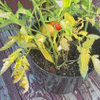
I have a hunch that the answer is "No", but some of my plants are having issues with regards to sun. I have a few smallish plants that were sitting directly in pretty much all day sun. Their leaves slowly were yellowing, (no drooping, though) getting purple patches, and curling upward.

Noticing this, I set them in a much shadier location. Within four days, the yellowness had gone away, and the purple patches were very diminished. The curling was better as well. Does anyone know what might have been causing this?

Comments (28)

  • 17 years ago

    Too much sun. It is a nutrient/physiology issue commonly seen with small plants, especially when trying to harden them off. The leaves have a very high cholophyll to transport pathway enzyme ratio in order to squeeze as much sugar out of low light conditions as possible. When light increases the relatively dense cholophyll produces more sugar/photosynthesis products than can be loaded into the vascular system and removed from the leaf so you get a feedback loop from backed up sugars ending in chlorophyll breakdown (yellowing) and anthocyanin increase (red/purple to block light). Nitrogen is needed to produce more enzymes that move the sugars into the vascular system. Magnesium can help as well because it is a cofactor that helps the nitrogen rich enzymes function better.

    Basically, it helps to jack up the nitrogen in pots when you want to put little tomatoes in full sun.

  • 17 years ago

    Wow... I guess my hunch was incorrect.

    spiced ham, I thank you for that amazingly informative, yet concise reply. It seems you know your tomato facts well. Very well :)

    Jessicavanderhoff, thanks for your input as well.

  • 17 years ago

    Thank you spiced ham!
    I am having the same issue and was wondering what to do.

  • 17 years ago

    'I have read other posts where if it's very hot, the tomatoes might do better in shade. Doesn't sound right if you're in zone 6 though'

    Well, zones only refer to minimum temperatures, not maximums. While we never get 110 in the zone 6s I've lived in, where I am now easily stays in the mid-hi 90s for a good portion of summer. I am more comfortable with my tomatoes getting some afternoon shade, because they are still getting over 6 hours a day. Zone 6s can vary quite a lot with regard to high temperatures, just like say parts of New York state that are zone 7 because they freeze less only get into the 80s in the summer, and plant with the zone 5s because of nighttime temperatures. Every situation is different, zones bother me because I think they can be misleading :)

    When they are small though, and this early, I agree they might not have been hardened off enough. spiced_ham explained it, but here is a link anyway that I think Anney here passes around that has the best explanation of it that I have ever read! I have it bookmarked. :)

    Here is a link that might be useful: Bracing Up

  • 17 years ago

    Hardiness zones refer to how cold it gets in winter, it has no effect on annual plants like vegetables. You need to know what your last and first frost dates are for your area to really know your growing season for annuals and vegetables. The hardiness zones are guides for perennials in the garden.

  • 17 years ago

    To be precise, mature tomato plants probably can't get too much sun, but they can get too much heat and humidity that causes them to languish, stop producing, and sometimes die. Tomatoes are grown in warmer areas of Alaska that have nearly full-time summer sunlight and if the tomatoes don't do well, it's usually because it's too cool, not because there's too much sun.

    Here in the lower 48, particularly in the South, shade and/or lower temps are often the answer for tomatoes that aren't doing well since indirect sunlight bathes the plants but the heat is reduced.

  • 17 years ago

    Well, ok, but it still tends to be cooler/less sunny in the early summer in the lower zones than the higher zones. This is correlated to winter lows.

  • 17 years ago

    Jessica

    Yes, you are correct, and I was just thinking about the "too much sun" question without relating it to Zone 6. IOW, the OP's problem probably isn't related to heat and humidity in that zone, more likely sunburn or not hardened off enough as you mentioned.

  • 17 years ago

    I'm in extreme SW KS in a semi arid climate. With hot dry winds and temps in the summer can go over 100. I'm zone 6a. And afternoon shade makes a difference here along with a windbreak. A plant that has shade from 3 on will usually out produce one in full sun. Jali is just north of me in a similar climate. Jay

  • 17 years ago

    This is so interesting, because I'm in FL, zone 9, and I've been telling people for years to put their tomatoes where they are shaded in the afternoon. Every time I try to grow mine in full sun, they do the same thing.

  • 17 years ago

    Yea anney, you said it better than me, I did mean heat not actual sun. Sun can make excessive heat, but not this early in z6, generally speaking. I feel like English is a second language sometimes, can't get what I say to mean what I am thinking. :)

  • 17 years ago

    I think it is more where you are located. Depending on which map you look at we are either 5b or 6a. The last two days have been 95 and tomorrow is supposed to be 97-100. Not sure how much more heat you want with 20-30 mph winds. But know look at other zone 6 locations that aren't near that warm yet. So another instance of knowing where you are gardening and what will work in your climate. Jay

  • 17 years ago

    I'm in zone 6a and it's been in the 70s and 80s here. Nights are also abnormally cool for this time of year. Tonight it's only 58F. But this spring has been unusually cool wet and cloudy. We've had many overcast and drizzly days. All the plants are behind, growing slowly but look healthy.

  • 17 years ago

    megpi

    I also plant as many tomatoes as possible in a spot that has afternoon shade from an oak tree about 3PM on. It is really cooler in that shade than in sunlight and the plants produce well there since they do have about 8 hours of direct sunlight -- their "down-time" doesn't start as soon, though eventually the shady spot is also too hot and humid for them to thrive.

  • 17 years ago

    Because seasonality is due to the tilt of the earth facing towards or away from the sun, the suns angle does not change much in the tropics, but it does at higher latitudes such that we will have the near equivalent of tropical sun up here in the midwest on the longest day of the year. At the same time the tropics don't have more sun (i.e. in July the sun in Ohio is just as strong as in south Florida), but we never see problems then. The difference is in the temperature.

    At high temperatures plants undergo photorespiration. One of the photosynthetic pathways starts to put the wrong things together and the efficiency of photosynthesis is greatly reduced. This is such a problem in tropics and subtropics that a different type of photosynthesis has evolved (C4 pathway). Corn/maize and sugar cane are C4 plants, tomatoes are not.

    At the same time (high temps) it is difficult to separate growth decline due to water stress from photorespiration. In addition, wilting increases photorespiration.

    None of that corresponds to zones, which do not follow lines of latitude so you have to rely on experience at your location. I get better growth on the eastern side of the house than on the warmer southern side where the bricks of the house heat up behind the plants. The soil dries out very quickly ther as well. I'm sure a little shade would help tomatoes there.

  • 17 years ago

    Anney:

    I have a similar spot, because it is the only suitable spot in the entire yard. Only mine gets sun (right now, it does change) from sunrise-11 am, 3-7pm. I was going to hack down this mess of honeysuckle that is shading it for those mid-afternoon hours, but so far everything is full, no lankiness, and fruit is setting like crazy. I hope that when we start approaching 100 (we already have had a few days) it will be for the best.

  • 12 years ago

    I live in Denver and have been struggling with similar issues. I have a few tomato plants, the largest being a Roma that is about 4 feet high and has at least 10 tomatoes that are about 1-inch diameter.

    Being a novice I don't know about hardening, but I figured at this size the plant would be able to take full sun. When I got home today, though, the Roma plant in particular was drooping badly and has some yellow and purple patches on its leaves. I had the plants inside next to a well-lit window, and they grew really well. Now that they're on the roof garden with full, all-day sun, The soil is still moist, but it was 86 her today.

    Does anyone have any ideas whether it is an excessive heat issue, or excessive sunlight? Should I try moving them to get more shade during the day? If so, am I better opting for shade during morning, mid-day or afternoon?

    Thanks in advance for any advice!

  • 12 years ago

    >> To be precise, mature tomato plants probably can't get too much sun, but they can get too much heat and humidity that causes them to languish, stop producing, and sometimes die.

    I'm in an extreme area with no humidity and high heat, and the tomatoes here in full all-day-long sun have smaller fruit, more splits, don't get as red, and don't get as sweet. Mine tend to have huge root systems so that might be the reason for no drooping.

    And just an observation; I didn't learn from last year...

  • 12 years ago

    If they weren't properly hardened off first then yes they can get too much sun. Exposure to full sun for plants grown indoors (regardless of the window) has to be gradual over several days. Move them to the shade and over 5-6 days slowly increase their sun exposure.

    Dave

  • 11 years ago
    last modified: 11 years ago

    BUMP IT !
    This is a very interesting subject to me. .And I have read quite a few informative posts here, some written by a GW member, "spiced_ham".

    This is my 4th year in PNW , growing tomatoes with about 3 -4 hours of direct sun. I have had a pretty good record, matching the results that I obtained back in GA with about 7 hours of DS. That beats the commonly suggested requirements that one needs 6-8 hours as minimum.
    I think that it is not just the sun, also heat is a major player. I would think that a temperature in the range of 65F to 90F ( in 24 hours) probably is optimum.

    I have yet to read a real university study on the subject to be convinced as to the direct sun requirements of tomato plants..
    The common area often not recognized is that "Direct Sun " is NOT the only source of light for plants' photosynthesis. Even in an overcast day plants receive light, just as solar panels collect energy.
    Another thing that I consider a misconception is that not much of all the solar energy is absorbed and utilized by plants. I read somewhere that is about 8%, in general. So at the intensity that sunshine hits the plants, the plants cannot work at that speed to get all that energy. So I think they can comfortably absorb enough light energy while in the shade in a bright sunny long summer day.

    WHAT IS PRODUCT OF PHOTOSYNTHESIS ?: short answer is SUGAR.

    Now I don't know exactly what happens to the sugar produced by photosynthesis. How is it spent within the plant ?


    So to answer the OP's question: "

    Is it possible for tomatoes to get TOO much sun?

    "The answer (IMO) is "YES".

    Sey

  • 11 years ago

    They finally have fruit that's developing but the amount of rain we're having is unreal. I'm sure I'll have some to can for winter.


  • 11 years ago

    I think my husband and I are about to give up growing a garden. Even with the chickenwire and electric fence animals are getting in and destroying the tomatoes, biting a hole or two and dropping them to the ground - and nothing has kept the borers from killing the summer squash. We gave up on corn because of borers. We're exhausted fighting nature to get decent fresh vegetables and fruit.


  • 11 years ago

    It's a balancing act. Too much sun isn't necessarily a problem if the needs of the plant were met to a relative factor. What do i mean?

    Sun light causes both good and bad conditions. For one thing, it of course 'causes' photosynthesis. However, if nutrient and water needs can not be met by the physics of natural capillary action and osmosis, along with abundant supplies of both resources, then yes there can be 'too much' sun.

    Evaporation and transpiration create lower surface temps on the leaves, helping the plant to cope with 'excess' heat. Again, without access to abundant moisture, then just like people, heat stress sets in.

    Think of how a tomato plant sends roots off the stems - especially at its internodes. If the plant were allowed to sprawl horizontally, then these roots would give the plant greater access to needed resources. In such a case, each 'section' of the plant would have it's own repository of sorts. Of course, that presents physical conditions for which growers are often not able to compensate. Lack of real estate, disease, and fruit rot are just a few examples.

    I would have to find it, but I think I read somewhere that the largest tomato plant was like 65 feet long! -- But I don't know if it was rooted at multiple places along the stem.

    I do believe though, that if multiple root zones could be achieved, you would see the end of BER.

    This isn't an exhaustive discussion, but can too much sun be a reality for modern techniques of backyard growers? I would have to say... a reserved - yes.


  • 11 years ago
    last modified: 11 years ago

    Green thumbs, I'm sorry to hear that. I guess, under extreme conditions, it can be tough to find acceptable coping strategies.

    I'm sure you have, but the only way I could cope would be to pare down to the basics and tackle each issue one at a time.

  • 11 years ago
    last modified: 11 years ago

    "Solar Yellowing" according to UC Davis. I use shade cloth for days over 85, and around here (low humidity), that makes a difference in temperature.

    Solar Yellowing in Tomatoes

  • 11 years ago

    GreenThumbs... Use BT bacteria on those worms. The stuff works great and is "Organic". You do not have to get the BT contacting the worms... the worms will eat the BT and w/in two days are all dead.

Sponsored
Peabody Landscape Group
Average rating: 3.5 out of 5 stars8 Reviews
Franklin County's Reliable Landscape Design & Contracting