Software
Houzz Logo Print
andreajoyames

pests!!!

19 years ago

should i be taking these little critters personally? am i the only person who feels like they're fighting pests CONSTANTLY!!!

it seems that every season it's a new thing...last year my garden was decimated by spider mites..this year, i've been fighting aphids, white flies, horn worms, and now russet mites. (let's not even mention the pill bugs, earwigs, vine weevils, cabbage loopers...the list goes on!)

not to mention the verticillium wilt i've got in one bed...

am i doing something wrong? i'll be honest, i'm not out spraying neem every seven days...but i did companion plant. my soil is healthy. i use compost tea. i just don't understand!!

sometimes i think it WOULD be easier to get a can of sevin and just go for it!

what's the secret to a pest free garden? can people please share? i'd be SO grateful to hear any wisdom on this subject.

thanks,

a

Comments (8)

  • 19 years ago

    Well, except for an annoying overload of pill bugs that decimated a bunch of seedlings, I'd say I have a fairly pest-free garden. It's not that I never see a single pest (I do), it's just that there aren't enough to do more than minor damage. My tomatoes are absolutely untouched, I have to say, even by pill bugs. No disease, no aphids, no tomato hornworm, no nuthin'.... cool.

    Let's see, why is that? Well, on my own property, I try to encourage beneficials as much as possible. I really don't know where they like to hang out, but I plant native flowers and grasses, as well as plenty of herbs and other flowers, and I live in the woods. Also, I'm organic, and live in a hippie area, so I'm dead sure none of my neighbors is spraying anything that would wipe out beneficial populations (I'll bet the neighbor factor makes a difference). I have cucumber beetles and earwigs, but I've stopped squashing them because something seems to be eating them. I have lots of wild honeybees and butterflies and all sorts of creatures..... just nothing that makes an obnoxious impact. Perhaps it's luck?

  • 19 years ago

    There's no pest-free garden, not even in greenhouses where everything's closed in. There are more insects in the world than any other life-form, and fewer than 5% have been identified and named. Look at the information below:

    =====

    Scientists have described and given scientific names to about 920,000 species of insects in the world, which represents almost 85% of all known animal species. For comparison, only about 4,000 of the known animal species are mammals, man being one of these. There are more species of dragonflies than mammals, and almost as many species of cockroaches (3,500 species). There are about 9,000 species of birds, but almost twice as many species of butterflies.

    Most insects have never been given scientific names. It is estimated that there are 20-30 million species of insects on the earth at present. In a good year, taxonomists throughout the world describe and name about 2,000 species of insects. At this rate of naming new species, it will take 10,000 years to describe and name 20 million species. Unfortunately, many of these 20-30 million species of insects will become extinct before they are named because of habitat loss and other environmental problems. Insect Numbers

    =====

    So they're everywhere in the billions. Some are considered to be pests by gardeners and some are considered to be beneficial or at least benign.

    As long as insect pests aren't destroying what you plant, consider yourself lucky. And there's no pest-killer that kills them all, such as Sevin. It isn't effective on some pests but does kill many beneficials. You have to tackle the pests type by type if they're a real problem.

    Nobody talks much about insect pests as a general "state of a garden" rather than a temporary problem, but all gardens have insects -- period -- and some will try to eat your plants or fruits. That's just a fact of life, so to speak.

  • 19 years ago

    i know about beneficials..i have them too. i'm not complaining about them...i LOVE them!! i have quite the praying mantis population this year...probably because i had so many mating in my backyard last year. i see plenty of lady bugs and SO many honey bees. actually, i can't garden between the hours of 10 am and 7 pm because i'm deadly allergic to the bees and they're all over the place!

    i'm not looking for a bug free backyard...maybe i miscommunicated somewhere?

    but it seems that each year, i have a MAJOR problem with pests. not a minor one where i can keep things under control...but a major one that usually takes the garden out before i'm ready to say the season's over.

    i am beginning to think it might have something to do with my neighbors...i know that they aren't organic...they LOVE their green lawns and their bug sprays. i think this keeps the non-beneficial population going strong.

    maybe it's native plants that i need to begin planting. i haven't done that for companion planting. i've planted a perennial border around the garden...but none of them are native...time to study up.

    thanks,
    a

  • 19 years ago

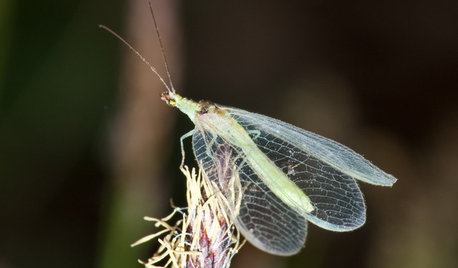
    I hope I can help on the mites, whiteflies and aphids. I release green lacewing eggs each season. I time the application for early to mid June here. Green lacewings do a much better job of destroying soft bodied leaf eaters like those I mentioned than ladybugs and mantis. I have both of those returning every year. Sadly, I must reorder the lacewings each season because they just don't want to over winter here. I spray NOTHING. A garden in balance is my best remedy where I live. Of course, to tip the balance in my favor I order the lacewings.

    Stink Bugs...If you get them early you have a good chance of minimizing any damage. I knock them into a bucket of soapy water and hope I get most of them. They do very little damage then.

    Pillbugs aren't an issue on my tomatoes. They prefer any of my lillies that get sick but healthy plants retard them. They feast on rotting plant matter. Get rid of rotting/sickly plants. They thrive in wet/shady areas.

    Earwigs are only a problem on my dahlias but again I ignore them. They cause very little damage and the birds enjoy them.

    Wormy caterpillars can easily be controlled with Bt. When I used to grow broccoli they were a pain. I don't grow it anymore.

    In my old chem days I was killing this but giving birth to that. A vicious circle. My natural garden (lacewing fortified) works great.

  • 19 years ago

    bigdaddyj..

    do you think it's too late in the season to release lacewing larvae now?

    thanks so much for the advice!!

  • 19 years ago

    For wormy caterpillars.. what's "Bt"? Pardon my ignorance.
    Thanks!

    Erin

  • 19 years ago

    Andrea, I think it depends on how many bad bugs you already have. They recommend you start releasing the lacewings early in the insect war. But I can tell you this, they will certainly put a big dent in your aphid and mite population! You get eggs in a container. Some have already hatched and you see little green specs moving around in the container. These eggs hatch into larva. It's the larva that eat hundreds of mites, aphids, whitefly, etc per day. I'll never forget the first year or two I tried them. A few weeks after I scattered the eggs throughout my garden I paused at a tomato plant and actually saw a larva eating aphids like crazy. I was mesmerised. And I was sold. Since then sucking insects are in very low levels in my gardens.

    I apply to wet foliage so they stick better and have moisture to drink. It is recommended. Then about two weeks later the larva are eating like crazy. They then transform into adult lacewings. I have plenty of flowers so they hang around drinking the nectar and mating and causing a new generation of bad bug eating larva. And it makes me feel great not to be spraying willy nilly. These bugs worked for me better than any of the sprays I used to use in my chem days and all you have top do is release bugs each year. It takes a couple minutes to wet the plants and another minute to scatter the eggs and your good to go all season. Natural and fast!

    Erin,

    Bacillus thuringiensis (Bt) is a naturally occurring bacterial disease of insects. These bacteria are the active ingredient in some insecticides.
    Bt insecticides are most commonly used against some leaf- and needle-feeding caterpillars. Recently, strains have been produced that affect certain fly larvae, such as mosquitoes, and larvae of leaf beetles.
    Bt is considered safe to people and nontarget species, such as wildlife. Some formulations can be used on essentially all food Crops.

  • 19 years ago

    Thanks, Bigdaddy! That's a great explanation. You alleviated my concerns about chemical vs. organic. I'm really wanting to go all organic.

    Now, If I can just find a bird that loves to eat stink bugs. ;)

    Erin

Sponsored
Bella Casa LLC
Average rating: 5 out of 5 stars17 Reviews
The Leading Interior Design Studio in Franklin County