Software
Houzz Logo Print
gardenscout

Bees and cross pollination

19 years ago

I hope this is not a ridiculously stupid question, but I know someone here will know the answer.

I have 10 plants, each of a different variety, and none I have ever tried before. I have quite a lot of bee activity among the blossoms. Will the result of this be...

a) the fruits could all have characteristics of each other, and I may not be eating the actual variety I planted? or...

b) the seeds of my fruits will be suspect, and should not be planted next year?

Comments (10)

  • 19 years ago

    Hi Gardenscout,

    No stupid questions here! That what the forum is for.

    a) AFAIK, in tomatoes cross-pollination has no affect on the current year's fruit. It's just the seed that's affected. Now corn is a different story...

    b) Also AFAIK, most tomato pollination occurs by the vibration knocking pollen from stamen to pistil in the same flower, with some limited cross-pollination. I expect if you grew a large number of seeds from a single fruit you'd get a majority of plants that were true and some that were crosses. Whether that's a problem or an adventure is up to you! If you want 100% self-pollination you should probably bag some of the blossoms.

    Hope this helps!
    Jim

  • 19 years ago

    My gardening book says that cross-pollination in tomatoes is pretty rare.

    The seed from hybrid varieties will probably not be true to the parent.

  • 19 years ago

    If you want 100% self-pollination you should probably bag some of the blossoms

    *****

    Or grow the varieties far part as in geographic isolation.

    Please go to the FAQ link at the top of this first page and you'll find an excellelnt article, with pictures, that discusses how to prevent Cross pollination.

    Each of us has a different X pollination rate because it depends on the weather, in that the environment can cause stigmas that would normally be retracted to become exherted, which leads to a greater chance of X pollination, and there are also varietal differences, and more.

    Frequency of X pollination is also dependent on the specific pollinators and their frequency in any particular area at any specific time.

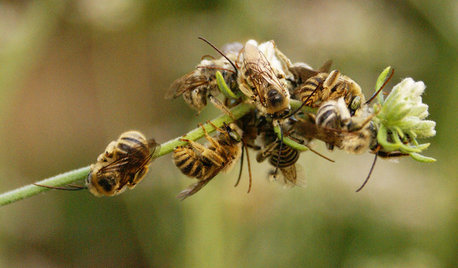
    For more info about NCP ( natural cross pollination) and the process itself and the most probable pollinators ( Halictid or sweat bees which are so tiny you can't see them hardly) please go to SOuthern Exposure Seed Exchange and read the excellent article on NCP written by Dr. Jeff McCormack, the former owner of SESE.

    Carolyn

  • 19 years ago

    As the others have pointed out, tomatoes are self-pollinating so the bees are essentially irrelevant. And any effect they MAY have doesn't affect the fruit produced this year in any way. "Bee-accidents" ;) or any small amount of cross-pollination that MAY happen only affects the seeds if planted next year.

    However, you don't mention if these are hybrid varieties or not. If they are hybrids then as sundevil pointed out, they most likely wouldn't breed true next year anyway. Some gardeners grow them anyway just to see what they will get but if you want variety-true plants you need to start with variety-true seed.

    Check out the discussion linked below for more details. ;)

    Dave

    Here is a link that might be useful: Hybrid seed saving

  • 19 years ago

    Thanks to everyone. I should have mentioned that all of my varieties are OP and not hybrid (except sungold, but I knew I couldn't save seeds from that one.)

    I really just wondered if this year's fruits could be affected by the bees scrambling up the pollen on all of my plants.

    I probably won't save seeds anyway, even all of my plants are OP, because the seeds are cheap enough and I don't grow that many plants.

    Thanks again.

  • 19 years ago

    I'm able to store seeds where they are good for about three years, but after that they produce weak plants. I usually just save seed every third year and so far have not had any cross-pollination problems.

  • 19 years ago

    Quote:
    a) AFAIK, in tomatoes cross-pollination has no affect on the current year's fruit. It's just the seed that's affected. Now corn is a different story...

    ___________________________________________________________

    Corn actually isn't a different story, it's just that the seed is the first thing you see and you're eating the seed.

    The original sweet corn breeders had white corn planted next to yellow corn. The rest was history.

  • 19 years ago

    I'm able to store seeds where they are good for about three years, but after that they produce weak plants. I usually just save seed every third year and so far have not had any cross-pollination problems.

    *****

    And in the past I've made three seed offers here at GW in the Seed Exchange area and offered about 300 varieties, most of which were old seeds that I'd saved years ago.

    At the time they ranged from 1991 to about 1998 and there was lots of feedback as I'd asked for and germination was pretty darn good for almost all varieties and the plants were just fine.

    From time to time I've had to go back and dip into some old seeds to grow new stock and I expect 50% or greater germination up to about 5 years, from 5 to maybe 12 years I double sow to be sure and above 12 years I'll use a few tricks that help to wake up very old seeds.

    But how one stores tomato seeds also is a factor.

    My best so far is waking up seeds that were 22 years old. The ***documented record*** for germinating tomato seed is 50 years and that occured when the Cheyenne, WY station was closed and all germplasm moved to Ames, IA re the USDA>

    Carolyn

  • 19 years ago

    I've only been saving my own heirloom tomato seeds a few years, but I have had very good viability with purchased seeds for a couple of decades.

    I keep them in medical specimen vials that I bought 20 years ago on clearance. I leave the seeds in small bowls in the fridge for a few hours (very low humidity) and then funnel them into the specimen vials. The vials are kept in the cool dark basement in a plywood tray with holes drilled into it the size of the vials.

    This seems to routinely double the years of viability, though, quite frankly, I haven't tried any over 10 years old. I do have some 8 year old carrot seeds growing just fine... I got 80% germination with them.

  • 19 years ago

    I just joined! I live in DE. I have not seen ANY honey bees this year. I have lots of bumble bees and yellow jackets and wasps, but where in the heck are the honey bees. I am growing my tomatoes in pots in my driveway. I have lots of flowers and Butterfly bushes surrounding that area. My yard also contains at least 60 rose bushes. So, where are the honey bees? Anyone else notice this?