Software
Houzz Logo Print
keeperofthememories

Disease identification

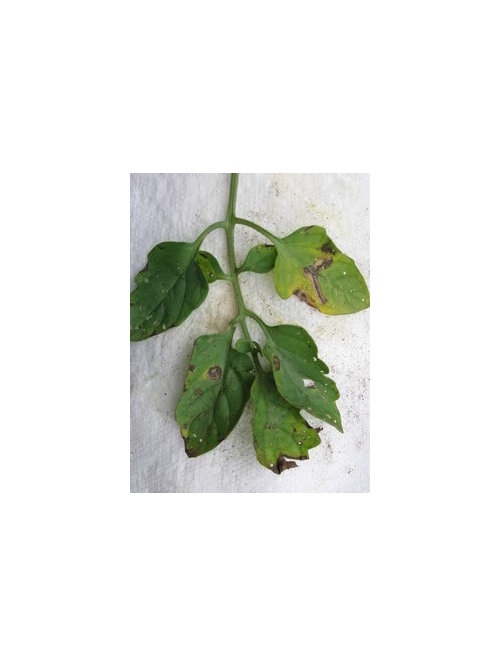
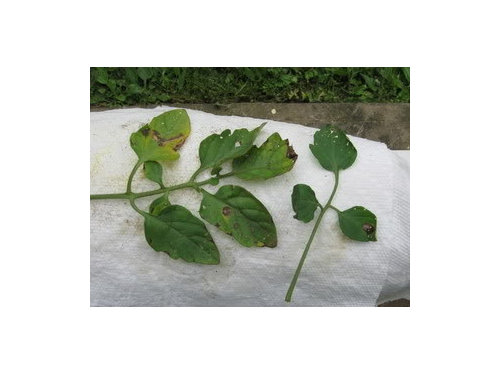
Last year I lost all my tomatoes and potatoes to late blight. A few days ago I noticed some spots on the leaves of my potatoes, tomatoes and peppers. I pulled up all my potatoes thinking it was late blight again. I've been watching the tomatoes but there's no quick decline and spots on the stems like I had last year. I'm getting a lot of flea beetles on them and the spots on the leaves seem to all be at the bottom of the plant. I've also noticed that the leaves are curling on several of my plants and they look a little wilted even with watering. Can you help me identify what is wrong?

Comments (13)

  • 16 years ago

    early blight

  • 16 years ago

    I agree, it looks like garden-variety (ha) early blight. Not fatal, thankfully, though you may want to spray chlorothalonil and pick off the diseased leaves. Mulching can help as well, to prevent rain from splashing spores from the ground up onto your plants.

    I appreciate that everyone's still twitchy after the disaster of last year -- it's probably a bit of a relief to find out that most of what we're seeing is "only" early blight. :)

    --Alison

  • 16 years ago

    Thanks for the identification and tips on what to do. I guess I can be thankful it isn't late blight. Does it affect the fruit if I mulch and pick off the leaves?

  • 16 years ago

    Yes, it can affect the fruits, an area of rot at the stem, not blossom end, but that isn't seen very often.

    It can also show stem lesions, usually where the main stem comes in contact with the soil called Collar rot, but that isn't all that commeon either.

    For most of us Early Blight ( A. solani) is a common foliage disease. Take off and dispose of the affected leaves and there are treatments that might help deter spread although such products are usually used as prevention.

    Initial infections are airborne but the spores can also drop to the ground and then the next year can reinfect in what's called splashback reinfection. The fact that you said most of the affected leaves were at the bottom of the plant suggests that your plants had EB last year and what you're seeing now is splashback reinfection.

    Carolyn

  • 16 years ago

    "splashback reinfection"? Didn't know that. I have some mild EB here on bottom leaves. Is there anything I can do ORGANICALLY to kill the EB spores that over winter? I do practice good fall garden cleanup already and apply a fall lasagna compost of shredded leaves and untreated grass clippings. In spring, after planting, I apply a thick straw mulch. Is there an organic soil drench product or other organic treatment that could be helpul in killing the spores?

  • 16 years ago

    Just a quick note. EB is always there and when conditions are right (splashback, humidity, overhead watering) it'll raise it's ugly head. Early treatment with Daconil will delay and even prevent it's appearance. Best of luck.

  • 16 years ago

    Thanks to you all. You've been a big help. I'm hopeful for some tomatoes this year. After being wiped out last year right before they ripened, fresh tomatoes seem all the more precious this year.

  • 16 years ago

    Bigdaddyj (love that handle),

    I've had respectable results with using black plastic as a barrier. Not the real cheap stuff, but it doesn't have to be really expensive either. A good mid-range priced plastic will do. Prepare the area, cover with black plastic, and cut holes in the plastic to install the plants when it's time to plant.

    Caveats, though, are that my zone is cold and heats up gradually as a rule, so I rarely have to worry about frying plants. The plastic helps to warm the soil in the spring, suppress weeds, and seems to keep the soil more friable.

    I would imagine that, if you get lots of heat and lots of sun early on, it could get too dang hot, especially for seedlings. In that case, you might roast the little darlings. By the time it's hot enough here to worry, the plants have grown and created their own shade over the surrounding plastic.

    Also, I doubt it would help much with airborne EB. And, it probably wouldn't be practical (too much work) for really huge gardens.

    So far no early blight this year, although I've had a little bit of septoria, which the plants have outgrown. Otoh, it's been perfect tomato growing weather so far this year, so it's hard to say if that success is entirely attributable to the plastic barrier.

    I used the plastic last year as well. Despite a cool, gloomy, very rainy summer, there was no EB, although some of the plants did get some bacterial speck early on, which resolved with a bit of copper, removing the affected leaves, and went away when the temps finally got warmer.

    But then late blight set in around early August and it was a total loss. Bummer. Still, though, no early blight. So maybe the plastic helped. Since I didn't get a full season, it's hard to say with any certainty how much EB was avoided due to this "trick". :-)

    I know of no soil drenches, organic or otherwise, that would destroy EB with any degree of success. I'm not even sure if commercial farmers have such a magic potion available to them, although they do have access to systemic fungicides that are not available to the home gardener. If I recall, you are a staunchly organic grower, so that would not be on the table even if it was an available option.

    Since EB seems to occur virtually everywhere, it is apparently a successfully adaptive organism and would not be easily subdued. :-)

  • 16 years ago

    NO, there's nothing you can organically or non organically do to kill the spores that fall to the soil from infected plants. Spores are very hardy structures.

    What you can do each year is to turn over the soil where you grow your tomatoes if you want to, and I don't mean tilling. If you turn over the soil deeply with a shovel you bury the spores and also note that they can survive for several years in the soil.

    Using mulch can help prevent splashback reinfection, but there always seem to be more initial infection from airborne spores almost every year and the only effective way that I know to help prevent new airborne infections is to use a product that covers the specific attachment sites for the spores on the leaf surface and I doubt you'd use it b'c it isn't organic, taking into account that there are also organic products that have low toxicity as well. ( smile)

    Carolyn

  • 16 years ago

    So once you have early blight in your soil, are you better off growing tomatoes in containers for a few years? I do rotate crops and I usually use black plastic on my rows. This year I ran out of plastic before I got to the second row and I did notice that it is worse on the plants without plastic mulch.

  • 16 years ago

    Thank you Carolyn. The fact that every year I get EB on lower branches and you described that as :splashback reinfection' got me to thinking that if it's always lower branches it must be this splash back rather than airborne and what can be done against it. I don't turn the bed over, I lasagna compost in fall and heavy straw mulch in Spring. You would think that that would be enough to cover the spores deeply without shovel turning. Oh well, I asked hoping...;-)

    Lionheart, thanx for your response. I tried black plastic years and years ago and in my zone 7 you are right, they cooked. It was also hard to keep beds watered at just the right amount. Plus these days I'm organic and natural and LAZY and want the soil to breathe. Hope you continue having a blight free season. Here I'm doing fine. My F4 Brandy/NAR cross is showing the most EB and my Marianna's Conflict is second worst. All other varieties only a little spec or spot here or there. It's been really hot here. Now it's 102F. But the humidity has been low and that is good. Thanx again...;-)

  • 16 years ago

    Bigdaddyj,

    Yeah, I thought black plastic might be a bit much for your zone. Usually moisture is not a problem here; the snow melts and we tend to have rainy springs, so there is moisture already in the clay-based, but good draining, soil. Using the plastic means I rarely have to water. The plants let me know if there's a rare occasion when they need it.

    So far, that's one of the few things that's good about a northeastern zone 5. :-)

    Love "Marianna's Conflict" and it sure does sound like you're doing an interesting cross in Brandy/NAR. I hope that one makes you famous.

    I can certainly identify with the LAZY bits. :-)

    Hey, some of us still work full time for a living and don't feel like being overly-committed when we get home. I have a little way to go until retirement, but can see it from here. Speaking of which, I know a handful of people who are retiring to Delaware. It's a pretty state with a good cost of living index.
    ===========================

    Hey, keeperofthememories (another great name; you folks are clever),

    EB is in the air as well, so switching to containers may not be so helpful. But I will say that after trying a few plants in containers last year and this year, there are other benefits (and there are drawbacks, too).

    Unfortunately, it doesn't appear to be any easier to avoid airborne diseases with container gardening, so I don't think it would necessarily mitigate EB infections. Sorry 'bout that.

  • 16 years ago

    Lionheart, I like Marianna's Conflict too. But this is three years running where the EB and Spots and Specs really nailed it good. It's funny how they still give me a nice number of fine tomatoes despite looking so ragged! I finally got seed for the real MP that I will grow next year. These M. Conflicts came as freebies from TGS a few years back.

    Yes Delaware is now the second oldest state behind only Florida. I'm a ways off yet but many people do come from NYC, Philly and DC to retire here, especially down by the beaches. The out of towners have driven up prices by the beaches to unreal heights! No sales tax, LOW property tax and nice climate all contribute to make DE a great place to retire to. Plus here you really do grow the best tomatoes! LOL We've been here 22 years now and I love it!