Software
Houzz Logo Print
wobbly1905

Wall Hood Local Fabrication?

17 years ago

Last time I went to the local sheet metal shop I thought their prices were a bit stiff. However, browsing the net for a chimney-type 36" stainless wall hood without fan disclosed some very lofty pricing for a simple device.

So has anyone here locally fabricated your hood? Stainless grease filters are not that expensive. Controls for an external fan could be mounted on the hood or on the kitchen wall. Installing halogen lights should not be that hard.

http://www.us-appliance.com/chim36ss.html

Here is a link that might be useful: $2300 Wall Hood w/o Fan

Comments (8)

  • 17 years ago

    I'd look at other sources. My custom Modern Aire hood liner PLUS blower and silencer was not a lot more than the hood you linked to without fan. Seems out of line.

  • 17 years ago

    As Clinresga says, you could probably get a similar hood complete with blower, baffles and lights at Modern Aire but it won't be seamless. It's still very nice looking, though.

  • 17 years ago

    I was thinking about housing a hood liner inside a stainless hood made by a local sheet metal shop. The Fantech hood liner design looks very poor for air flow and noise, though. Fantech's 36 inch liner, SGHL36 for instance, has a gross area of 34.5x 18 inches, with an air inlet area of around 30x13. If the cooktop is 30"x 25" it has an area of 750 square inches. The hood liner has an air opening of about 390 square inches or about 52% of the cook top's area. Even though the hood containing the liner could cover the cook top and extend 3" around the sides and front, the areas between liner and the hood would be dead air spaces.
    Air leaves the rectangular liner through an abrupt 8 inch diameter opening. This will generate lots of airflow noise.
    Although this liner might be installed inside a nicely tapering hood, no benefits of smooth air flow from the taper would result, since all the exhaust air flows through a rectangular box into an 8" duct. A tapered hood would be purely for looks.

    It makes more sense for the sheet metal shop to fabricate the hood without trying to incorporate a factory made liner. The $600 cost of a hood liner will go a long way to paying for the hood.

    Here is a link that might be useful: Fantech Hood Liner

  • 17 years ago

    OK now--I'm going to try and convince you that my alternative is still better!

    I think you should look at a custom Modern Aire liner. You can have them build it to any specs you want, just like your local sheet metal shop. Any size, any taper, any duct size, any lighting arrangement, any switch layout, etc etc, all for a very modest custom upcharge. The advantage, versus your local sheet metal shop, is......they know what they're doing.

    Consider the baffles. My guess is your local guys will propose using mesh filters purchased from someone. Mesh filters suck (to use a ventilation term). You want baffles. I guess it's possible they would actually fabricate high quality baffles, but I'd be surprised. They are complex enough that I can't imagine a sheet metal shop can make them for a one-off project with any kind of cost effectiveness.

    It's the baffles that make the hood from my experience--both from a function standpoint, as well as an appearance standpoint. I happen to think that the MA baffles are gorgeous. High quality stainless, with an almost chrome-like finish, yet they can get thrown into the dishwasher and emerge clean and sparkling. They are the professional standard for grease trapping--try to find a restaurant hood that doesn't use baffles. Any other filtering system is suboptimal. Your local guys will either not offer them, or buy them from someone else at an inflated price.

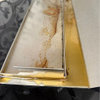
    Picture isn't great, but you can get a sense of how sweet the baffles look:

    Baffles are a big issue, but remember too that your local guys will have to source and install lighting, control switching, duct collar, provide a backflow damper, etc etc.

    I think you're heading towards a project that might save you a few hundred dollars, but will cost you in time and effort, and will end up getting you a hood that is far short in quality and performance of what you could get from a dedicated manufacturer.

    Your sheet metal guy spends his day fabricating ducts, boxes, brackets, gutters, radiator covers etc etc etc. The Modern Aire factory builds hoods. Just hoods.

    Just like with choosing your doctor, when you want the best, go with the specialist.

    PS: I love my MA but it is very important to point out that there are other custom hood manufacturers who build equally great custom hoods too. I'd spend a bit more to get a hood from any of them rather than roll the dice on a sheet metal shop.

  • 17 years ago

    Clinresga,

    One question on hood baffles versus mesh grease filters.
    I noticed on a website selling baffles that the NFPA commercial ventilation code requires that baffles be installed at a minimum of 45 degrees above horizontal.
    Thought I saw some liner installations where the baffles were laid flat.

  • 17 years ago

    I can't speak to commercial code. Ours are slanted downwards from front to back, presumably to facilitate grease flow, but the angle is closer to 25 degrees. I can't really speak to the pros and cons of greater angling. Is kas out there?

  • 17 years ago

    Here's another "baffling" question. If baffles work by centrifugal force, would it not make sense to place them in the throat of the hood where exhaust velocity is greatest?
    This would allow grease to coat the rest of the hood interior, though.

    Here is a link that might be useful: {{gwi:1387258}}

  • 17 years ago

    Don't know what "throat baffles" are, but the ones I'm referring to don't work by centrifugal force. The only system I know that does is the infamous Vent a Hood "squirrel cage" design.

    Typical baffles work by forcing the exhaust stream to travel in a convoluted path. Tthe baffles overlap in such a way as to force the exhaust air through two consecutive 180 degree turns before exiting the hood. The sharp, high velocity turns cause the heavier grease droplets to be flung against the walls of the baffles where they are trapped.

    While locating the baffles in a constricted throat would increase the air velocity, the advantages would seem to be far outweighed by the huge decrease in baffle coverage, and a major "chokedown" of airflow leading to much lower exhaust volumes.

    Again, I'm of the belief that hoods are designed the way they are for good reasons, and thus my continued recommendation that you consider a good hood manufacturer.