Software
Houzz Logo Print
daviddj_gw

help preserving tree during construction

13 years ago
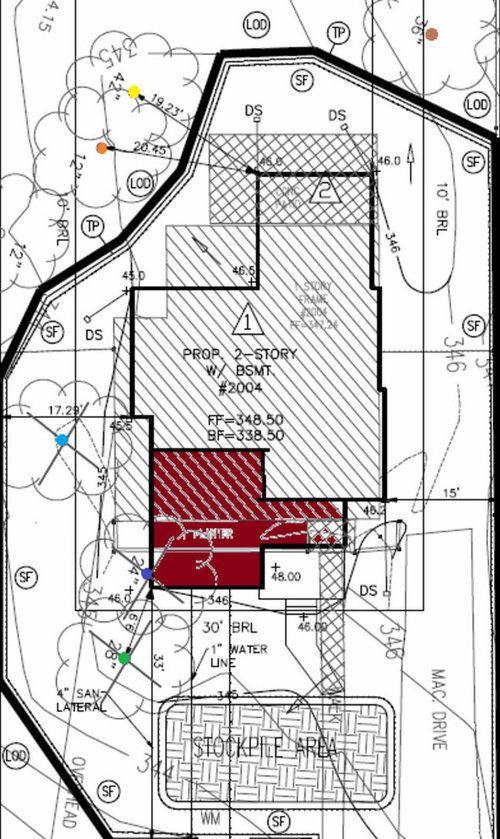
We are tearing down the existing home on our lot and building a custom home. The lot as several very tall red and white oaks. One of our requirement we had for our architect was to preserve as may trees as possible . We got this from the civil engineer and it shows the three trees in the front and left must go (the green, blue, and purple dots). I'm pretty sure the purple tree will have to go no matter what. Any suggestion what can be done to preserve the rest of the trees.

The current house is a 1 store rambler build on a slab, The new house will be a two store house with a partial unfinished basement. I filled in the dark red part to identify the section that is going to be conditioned craw space. The rest will be a dug out basement.

Comments (17)

  • 13 years ago

    You need to ask a tree specialist. I don't know how you will be able to save any of the trees as they are very close to the foundation. It is not just where the house will be that matters, but also where the equipment will be driven while the house is being constructed. Trees don't like it when their roots and the soil above them gets compacted.

  • 13 years ago

    The home I just sold (lived in it 13 years) originally had many trees which were mostly Oak and Hickory and some were as close as 5' from my deck when we first moved in. Several were struck by lightning (talk about a mess and scary) several blew over in high winds (luckily only 1 did minor damage to our deck) several died after we put our pool in and drove over/close to the root I guess, several just died for no reason and all filled our yard, pool, and gutters with munds of leaves.
    We are now building a new home in the middle of the woods and I cleared all trees within about 75' of our home and will plant pine and ornamental trees that don't cause me any more work...we still have about 30 acres of trees to look at.
    I can understand why you would like to save the trees but the ones close to the house were a big PIA to me.

    This post was edited by LOTO on Wed, Feb 27, 13 at 19:16

  • 13 years ago

    2o years ago we built in a beautiful forested neighborhood and had I forget how many trees in the front yard alone. Something like 25. Beautiful oaks. Tulip poplars. Everyone wanted to save their trees. Little by little the trees closest to the houses started dying, dropping branches. Not the beautiful woodsy look anymore.
    My across the street neighbor removed ALL trees within about 75 feet of the house before building, then planted oaks and maples where they complemented the site and house.
    20 years later guess who's yard looks better.
    Other neighbors had many trees fall on their houses. We had several come down with near misses to the house.
    Cut the trees. Have some of the lumber milled and have a wonderful piece of furniture made or flooring for your house
    no its not that expensive.
    Equipment and excavating will damage the root systems and the trees will suffer and probably will die. Just running over the ground with heavy equipment will compact the soil and damage the roots.
    I know how you love the trees but they will be much easier to take down now than after they die and fall on your house.

  • 13 years ago

    Where I build, the City has onerous tree preservation laws for both public and private land. You cannot cut down a tree on your own property without permission, including proof from a licenced arborist that the tree is unhealthy and won't survive long. If you get permission, there's a $100 permit fee, $300 if you're building anything. If you cut down the tree without a permit you will be charged a fine up into the thousands of dollars, added to your property taxes so you can't be a scofflaw.

    As a consequence, you either eat the cost or figure away around it, by moving garages, for instance.

    Anyway, here are the rules for keeping equipment away from the tree. Basically, you ring the dripline with high fences to keep heavy equipment away. (See chart below.) Many species, however, require more extensive precautions. Open the link to see.

    This post was edited by worthy on Wed, Feb 27, 13 at 20:24

  • 13 years ago

    yeah, we were wondering if we could use the trees for something in the house. How would you go about getting some of the tree milled? Is that something most tree removal service and / or lumber yards will do?

  • 13 years ago

    If you do lose the trees, there are native species trees you can plant that grow fairly quickly. Our old tree-nut neighbor was a HUGE fan of the paw-paw tree, he said they shot up pretty quickly.

    It's easy not to think of it when you live in an urban environment, but another place to get free advice about trees and landscaping is your agricultural extension office, via the Master Gardeners program.

    Here is a link that might be useful: Fairfax Master Gardeners

  • 13 years ago

    Dark blue & green marked is gone.

    Light blue likely gone..

    Yellow, orange, brown depends on drip line (spread of canopy) to foundation.

    A 36 inch trunk likely has a decent spread to the canopy.
    Get a local tree expert to look.

    The drip line is (as the chart above indicates in the right column) often the limit for digging and heavy equipment driving (heavy trucks and equipment compact the soil and often break shallow feeder roots near the drip line).

    Further is always better.

    I lost a 48 inch oak to disease a few years ago (single trunk tree).

  • 13 years ago

    Some folks above suggested getting a consulting arborist, that is what we are doing. Even if you just talk to some folks to get estimates for construction consulting/future trimming work, you're likely to get some recommendations about caring for your trees. You'd have to think about what it would be worth to you in terms of design, additional cost and time to try to preserve the trees. For example, preserving our trees is one of the reasons we are choosing not to dig a basement. Good luck!

  • 13 years ago

    We have white and red oaks, hickory, and black cherry trees covering our lot. We wanted to save as many trees as possible, so after we cleared the building site, septic area, and driveway, we only cleared 10' out from the building envelope. After the house was completed, we realized where the branches of the oaks nearest the house would be in a few years, once the lower and middle branches sprouted and grew out from the sun that now reached them. We had the tree guys come back and cut down everything within 25' of the house. It costs less to get it all done at once. And if they have to take down individual trees near a house it gets really expensive!

    BTW, after we'd cleared our lot, lightning hit the neighbor's white oak (~2' in diameter) that was 3' from our lot line. It cracked the tree into 3 parts, which the neighbor had to rope together and tie to our other trees to keep the parts from falling on his house until he could get someone over to take it down. Huge chunks of bark and many branches of all sizes blew all across both lots. Several of our tall trees were bent over by the blast; after 7 years, they are close enough to being straight that they no longer look strange.

    You can't prepare for everything, but the obvious is that a large branch that is over or near a roof can be blown with great force into a roof during a storm, and probably will mean water running down into the house and causing lots of damage, as happened to a neighbor a couple of doors down who kept the 10' perimeter. Siding and windows broken by flying debris are easier to fix temporarily, and the damage would be more limited than a branch falling on a roof. I've seen smaller branches knifed into the soil after storms. The force of the end of a branch hitting the roof plywood or OSB or wedging under shingles can be considerable.

    Anne

  • 13 years ago

    That one where the purple dot is MUST go ... it will lose most of its roots and die soon after construction.

    To save the trees, you have to protect their root systems all the way out past the drip lines of the canopy by 10-20 feet depending on species. Mark that area on your lot and see how much lot you have left.

    That means no equipment driving on it, no materials stockpiled on it, no trash dumped on it, no extra fill dumped on it, no cement truck washing water dumped on it ... it means do not touch that area.

    It adds thousands or tens of thousands of dollars per tree to the cost of construction.

  • 13 years ago

    I think you really could benefit from talking with an arborist about your particular situation since you have an existing house/driveway to which the trees have adapted (presumably).

    For example, we are trying to preserve a large tree that will be about 8' from our garage when complete, so we are building well within in the dripline. In our case hopefully this should be doable since there already is a concrete driveway there -- in fact, the tree currently is less than 2' from an existing wall so the building actually will be farther from the tree when we're done.

    If you're building on acreage or in the woods, you might have more trees than you know what to do with. In other neighborhoods, mature trees can add considerably to the enjoyment and value of a home. Only you will know!

  • 13 years ago

    We brought in a consulting arborist and he said the orange tree and the brown tree have good chance, the yellow tree has a very low chance and all the others have no chance of survival. Not what we wanted to hear but I well have to go with that

    Now when we first met with our architect pretty much our ONLY requirements were to keep the trees. Turns out that with what she designed we have pretty much cut own all of them. Part of our approval of her design was with the assumption the trees would be there. I sort of feel like we should get a do over on the design, but I'm not sure if that doable. Any suggestion on how to approach our architect?

  • 13 years ago

    If you knew you were planning a teardown from the beginning and that trees were important to you, why didn't you have an arborist on board when you were real estate shopping so as to have a report in hand when deciding on what lot would be suitable for your plans ?

    I don't know of any architect who would be able to design a home without the constraints of the design parameters being known from the beginning. If you wanted the trees kept, the first professional stop on the long list of people to consult would have been an arborist---before you ever closed on the lot. An architect isn't an arborist and doesn't fully understand the impact of construction on trees. Once the "no disturb" line around the trees was established, then the actual buildable footprint of the home on the lot could be known, and then you could have seen that the trees were unsalvageable from the beginning if you wanted the larger home footprint.

    Would you have shopped for a larger more expensive lot if you had the arborist report on the lot before closing? Or would you have sacrificed the trees to your plans anyway? It's water under the bridge now. Plant a couple of trees when you are done as compensation and both of you share in that cost. You might also look at finding an "urban sawmill" to come and harvest the wood from the trees and have it kiln dried for some feature in the home.

  • 13 years ago

    So very sorry to hear that. Did the arborist have any suggestions as to how to improve the outlook for the trees? In our situation we had to forgo a basement, I don't know whether this is an option for you or would make a difference in your situation. Could there be some design modifications that would give you a shot at keeping the yellow tree and the green tree as well? If not, perhaps the arborist can recommend some new beautiful trees to plant after your house is done. Good luck.

  • 13 years ago

    We weren't going out of our way to find a lot with trees. The lot we did find happened to have some big trees that we liked so we wanted to keep them. We hired a "green" architect who was a member of US Green Building Council so we sort of assumed her design was tree friendly. In hindsight, obviously we should have brought in an arborist at the beginning, but we did not really know what we were doing, we've never built a custom home before. We were relying on our architect for guidance.

    Oh well guess we'll just plant some new trees after construction. We've bummed that tree suitable for the tree house we promised out son will be gone. In our lifetime they'll never get as big as what we are going to cut down :(

  • 13 years ago

    One of the things that happens when you clear trees in a forested area for a house is that the remaining trees did NOT grow with the wind exposure they will not be subjected to.

    You have a hole in the forest canopy that allows winds to 'pick' at the trees at the edges of the hole.

    Winds that essentially stayed high and flowed over the intact canopy can 'work' the trees at the edges of the hole you have created.

    I remember a large development that was placed in a pine area.
    The are was so thick with equal growth pines they had nice tall thin trunks with limbs and needles on about the top 20 feet of each tree.

    Every house had a clump of pines in the back yard, ad nice clear areas for the houses and streets.

    Many of those pines are now gone (about 15 years latter) as the wind knocked them down at the edge of each group in the back yards.

    Luckily for the most part the 50 foot trees were about 60 feet from the houses.