Software
Houzz Logo Print
powertoolpatriot

Insulated Concrete Forms

15 years ago

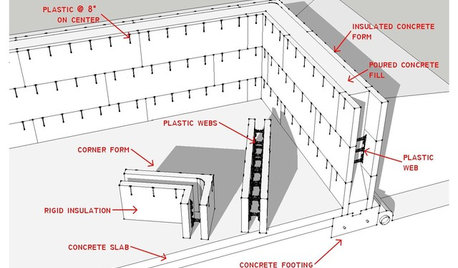
Has anyone used FoxBlocks for their basement walls? If so, what was your experience. Has anyone used other brands of ICF? DIY or installed? The good, bad, and ugly is welcomed. Planning on using one brand or another and would like some feedback.

Thanks!

Comments (13)

  • PRO
    15 years ago

    foxblock is an ok form. logix and some others tend to have better corner and web designs which results in easier construction/stacking etc. However it does not affect the overall structure once concrete is placed.
    However, depending on your construction background, horizontal blocks are not as DIY friendly as they attempt to sell. Infact if you have next to no building experience or concrete experience (building as in constructing full houses, not just random renovations or small projects) do not attempt an ICF install. For good results, the block needs to be installed perfectly, straight, plumb, level, etc. Blowouts and ample bracing must be considered. proper vibration, rebar, and concrete placement are also all things to have experience with.
    Sometimes contractors will reduce labor rates if you help them install them.
    ICF is a great foundation option. However remember if you are not finishing your basement completely, by code you still need to cover with 1/2" gyp prior to occupancy.

  • 15 years ago

    pt....you might want to ck out this web site. greenbuildingtalk.com They have a forum there on ICF.

  • 15 years ago

    We are building a full ICF home as we speak (link at the bottom). We planned building with Arxx Edge but our GC was able to secure a deal on Logix Platinum for no extra cost to us.

    In general, with ICF you get:
    - A tight building envelope
    - Minimal air leakage
    - Excellent sound deadening
    - Excellent insulation (thermal mass)
    - One of the best amplitude suppression (explained below) products on the market

    The net-effect of all of that - if constructed properly, but that's the case with every building material - is very minimal energy loss leading to a very efficient house. Our house is projected (after a pre-build energy modelling session) to have a $300/yr gas bill in North-East Ohio. That is with a regular 95% furnace but with a good heat-pump.

    There are some drawbacks to an ICF house:
    - NEEDS mechanical ventilation (HRV/ERV/Air exchanger) due to the tight building envelope
    - Need to plan ahead where your exterior walls, windows and doors will be since you'll have 6+' of concrete to go through afterwards
    - Experienced ICF crew is recommended for best quality. Can't speak to DIY effort.
    - Costs about $1 to $3 per SF extra but quickly recovered due to lesser energy usage

    Explanation on amplitude surpression: the amount of temperature swing on the outside penetrates inside the house. An ICF house can usually hold the internal temperature steady with a 30F swing outside.

    Hope this helps! Goodluck.

    Here is a link that might be useful: Our ICF build

  • 15 years ago

    6+" (inches) of concrete, not feet ;-)

  • 15 years ago

    If you are interested in DIY ICF, you need to focus on block that is available locally and the service your supplier provides after-the-sale. Will they provide training, rent you the bracing, show up on-site to provide technical assistance, provide contacts at the ready-mix plant and for concrete pumpers, etc. All of this is more important than the block itself.

    If you are interested in professional installation, select your subcontractor and let them use the block they already like. Getting an experienced crew to use a new (to them) block will require some re-learning that you may not wish to pay for.

    After living in an ICF house (Amvic, but that is what my installers liked to use) for the past five years, I wouldn't do it any other way. I also certainly wouldn't limit my ICF to just the foundation.

  • 15 years ago

    One more thought...(DH wrote the technical response above, DW is writing this practical point).

    As our ICF build goes up, we're having a LOT of neighbors and friends ask about it. We talk to others who saw that they considered ICF, but decided against it because of the cost. For us, we started pricing our house with the ICF because we knew it was important to us, and cut back on costs and other features to make our budget. Because we agreed that the ICF was a non-negotiable, we didn't balk at the cost, and we know we will never regret doing the full ICF.

    Whatever you decide as you build your home, if you have to cut costs (and really, who doesn't), spend money on the structurally/foundational things that you can't easily go back and fix later. A tiled shower for example, can be upgraded later. High end floors and fixtures can be done later. You can't go back and update structure.

  • 15 years ago

    I strongly second what KCMO ken said above.

    We did-it-ourselves (Nudura ICFs), but the regional Nudura rep was quite available for advice and help, since they wanted it done right so they could keep their good reputation, and he also introduced us to a guy who had done 5 ICF houses using their product. Hiring him to work with us daily saved our hide!!! Because of his experience, he knew exactly what would be a problem if not done correctly. Plumb and level, bracing and pouring concrete--must be close to perfect.

    Also, getting the rebar in is both time consuming and HARD WORK! We did ICFs to the top of the first floor, so repeatedly raising the 12-14'(?) long pieces of rebar vertically to get them above the ICFs already stacked and threading them down past the horizontal rebar takes someone in excellent physical condition. Even if you just do the foundation, you'd better have some muscles and a strong back!

  • 15 years ago

    When we decided to use ICF's we strongly emphasized to our GC that we wanted to use someone who had experience with ICF's. We didn't want to be someone's guinea pig, or learning experience.

    He assured us his concrete guy had a lot of experience with ICF's. Well, dh and the concrete guy got to talking and the guy told dh that he had never even seen an ICF form before, much less ever worked with them.

    We were using Logix and dh made a panicked call to them. They had a Logix rep come out and give them a crash course and walked them through it.

    Our pour went flawlessly and both dh and the concrete guy were really happy with the company, the way they handled it, and the product itself.

    I wouldn't do it that way again if I had a choice but the product seems pretty foolproof indeed, lol.

    oh, and the GC is history. Dh and the concrete guy became great friends and are jointly working together to finish the house.

  • 15 years ago

    Wow, Rosieo! I'm sure glad everything turned out with your build! We are using Logix as well. The day the crew poured the second floor, we had a whole viewing party as all the neighbors came out to watch the massive crane!

  • PRO
    15 years ago

    i just want to touch on a couple things in this thread to clear up some minor misconceptions with ICF. First off, I am by no means bashing them, they are a great product, I am using them for some of my own basement in fact. However ICF are great products in their respective areas. If you want strength and security, they can not be beat. If you want sound deadening, they are also good (but make sure you have great windows as well!)
    If you want a naturally tight structure, they will get you there. And finally if you want a solid r-23-26 in heating dominate climates, then ICF are also for you.

    So focus on the last one. ICF makers claim r-30s, 40s even up to 50 due to....."thermal mass". This is simply not true, infant not even close. Multiple studies from ORNL and Building Science have proven the performance of ICF is greatly affected by the climate. Thermal mass works as a buffer when in between 2 foam cores. It is not a heat storage device like many claim since it is insulated on each side. In order for it to store heat, it needs direct access to the heating source....the inside of your house. The insulation in an ICF interior is actually INSULATING the concrete from being your heat storage.

    So back to PROVEN climate studies. The buffer affect ONLY works when the interior and exterior temps rise and drop within a 24 hr period. Meaning, in AZ where the day time temp is higher then the inside, and often the night is lower then the inside, the buffering of the concrete can not cool and warm up within this 24 hr period, thus keeps your interior temp regulated. The results in performance is an 8-10% gain vs tight stick frame construction.
    However in climates where the exterior temp stays a constant far below the interior, such as heating dominate climates, the buffer affect is useless. The extreme cold lowers the core temp of the concrete and keeps it there. In proven studies of homes in Minneapolis and Chicago, ICF have a 2-5% net gain, which they contributed to the naturally tighter structure vs stick frame construction. Depending on the house, this savings can result in a 30,40, 50+ year payoff when upfront investments are compared. Now compare ICF to a very tight house with exterior foam or even a super insulated double stud wall, and they can not even compete. Highly insulated homes in heating dominated climates never use ICF (unless they add additional exterior foam which just drives the cost up that much more) instead are using double stud walls (r-40s, which is my route), thick exterior foams on OVE framing, or thick SIPs panels.

    So, with that being said, choose ICF for its REAL benefits, which is strength, fire proof, sound deadening enhancements, and a naturally tight structure. However if energy efficiency is your goal in a heating zone (which most of north America is) then save yourself upfront costs and heating costs by choosing something else.

    HOWEVER, for a foundation, I really do not think it can be beat! :)

  • 15 years ago

    short version:

    1/. In the middle of winter in a cold climate, it improves comfort because of mass.

    1/.b)
    Its impact on saving money is not as good as in other climates with overnight temperature swings so big that they make you heat at night and AC during the day.

    2/. All other claimed benefits remain as the claims make them out to be.

  • PRO
    15 years ago

    1/. close... Mass in an ICF wall does not aid in cold climates. In a cold climate your wall is still only has high r as the eps forms are, typically around r-20-24.
    However exposed to the interior air mass would aid in regulating heat within, which is not an ICF wall.

  • 15 years ago

    large mass improves comfort. Adding onto that statement, a secondary concept is which side of the massive wall is more insulated, and which side is less insulated. It's secondary.