Software
Houzz Logo Print
dandm_gw

Warm Tile Floors

19 years ago

We are planning on running two heat ducts into the subarea to help keep the tile floors from getting so cold in the winter. We are in CO. Does anyone know if this will warm the floors enough? Am I still going to need to consider electric radiant for the master bath?

Thanks for any advise you can offer.

Comments (11)

  • 19 years ago

    How many tile floors do you have?

    If not too many, electric mats may be a better route to go than the heating ducts you mention.

    If very many, a hydronic radiant system is efficient to operate, and a pleasure to use. Sadly, not cheap to install, though there is a lot of difference from one method to the next-- stapling the tubing to the underside of the subfloor is the cheapest [and least efficient] means, while products like 'Warmboard' cost more at the beginning, less to operate...

  • 19 years ago

    In our home in upstate NY, we have both tile and travertine stone. The tile in the bathroom, as you guessed, gets freezing. The stone in the kitchen always stays room temp or warmer. We don't have radiant heat, but the stone absorbs the room heat. I wish we had put stone in the bathroom.
    Jo

  • 19 years ago

    I wouldn't depend on the ducts keeping tile warm. We enjoy our electric mat underfloor heating in our master bath. I just turned it up yesterday before a cold snap hit last night.

    If I were to build again, I'd have in-floor heating throughout the house! A small boiler can provide a lot of hot water to run through tubing beneath the floors. This warms YOU and furniture you sit on, not the AIR that risies to the ceiling.

  • 19 years ago

    Thanks for the input to date. All floors will be tiled. Majority of the house will be saltillo and I'm considering travertine in the baths. Unfortunately in floor heat thru out is not an option, so to help some we were having ducts ran into the subarea, just didn't know how much it would help. It's interesting that the stone floors stay warm.

    Jojoco - how do you like having the travertine in the kitchen?

    Thanks

  • 19 years ago

    Chisue is heading you in the right direction. You cannot depend on subfloor heating ducts to warm your tile floor. Tiles do not do a good job of transferring heat from one tile to another across the floor. At best, you may notice warm spots directly above the heating ducts, but the tiles in the very next row will be cold. At any rate, your ducting should be insulated and sealed against leaks; they cannot be counted on as a source of heating for your floors.

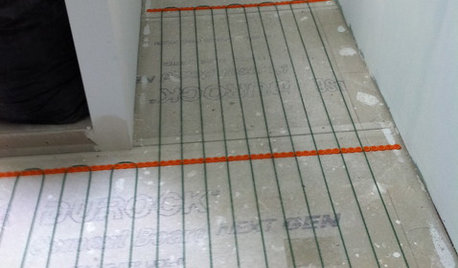
    Go with electric heating grids under the tiles, they are quite inexpensive when done at installation time.

  • 19 years ago

    If all floors are to be tile, look at hydronic radiant as your main heating system. I've never met anyone who regrets using it.

  • 19 years ago

    Thank you for the information. At least now I know what to expect and not expect from tempering the temperature of the subarea. Most helpful.

  • 19 years ago

    We had one of those radiant grids installed in our master bathroom when we were building.

    It was pretty expensive even though our builder split the cost of it with us because he forgot to include it in the bid :), but I will tell you something....it's nice to be able to program when the heat comes on so we'll always have a warm floor on those cold days.

  • 19 years ago

    I LOVE the travertine in the kitchen. It is mess friendly and pleasantly matches my two dogs:


    Plus, I got it on sale for under 4 dollars a foot.
    Jo

  • 19 years ago

    chapnc: I do not understand your basis for your statement re heat transfer in tile floors. Any solid floor will become cooler as it gets further from a heat source if that source is not evenly distributed. Heat conductance and loss will be based on material density, surface area, heat source temperature, etc.

    dandm: If I understand your post, you are running two (uninsulated?) ducts below your floor with the intent of using radiant heat from the ductwork to heat your tiles. Electric mats work very well in small areas but they become very expensive when used for large areas. Talk to your heating contractor but a better solution might be to heat your entire subarea with hot air vice ductwork. Using hot air below your flooring is not as efficient as tubing but the Romans used it and places like the Republic of Korea still use it (albeit with charcoal and the accompanying danger of carbon monoxide poisoning). You would need to seal your subarea airtight, insulate the envelope, and duct the hot air throughout the subarea. You would also have to drill multiple holes in your floor joists (assuming this is your subarea), according to code, to ensure proper air flow. (Although the nature of solid floor joists may still provide too much resistance to air flow over a large area.) This would have to be designed like any other treated space with supply and return vents but the heat would be evenly distributed to your flooring. The volume of your subarea could affect system sizing using this method. Just my .02Â

  • 19 years ago

    Sorry if I didn't use the correct verbiage to explain our plan.

    Terry T - heating the entire subarea via ductwork is what are plan is. The electric radiant would be used in the master bath if plan one doesn't warm the floors enough. I'm not getting consistent input from heating contractors, so I thought I'd look to this forum for additional thoughts.

    Jo - Thank you for the photo and response on your travertine kitchen floor. Excellent blend of colors (floor / dog).