Software
Houzz Logo Print
honeysmomcooks

Geothermal Groundloop - Where did you put yours?

19 years ago

Building single story about 2500 sq ft, slab foundation, no basement, in the Pacific Northwest. Planning for ground loop geothermal radiant heating. Have roughly 1 acre cleared to work with. Installer states we need 1800 linear feet of loop. This could be a 6' deep trench by 300 feet long, but more likely to be a 4' deep, wider trench due to difficulty digging hardpan below that depth. Mulling over where to put this trench. Options currently being considered: 1) Trench and place loopfield under slab. Contractor is not too thrilled with upsetting the soils under where the slab will be (considering future settling). 2)Around outer perimeter of slab after it is poured and house is in progress. 3)Along sides of dirt driveway. Again, contractor not too keen about centering it under driveway - settling issues. 4)Digging essentially a big 4' deep pit (instead of a trench) in what will become the front yard and winding it around (but will this limit what can be planted there?).

So, bottom line.....Looking for a bit of education. How did you lay it out?? Where did you put your loopfield?? Are you happy with the placement?? What, if anything, would you do different?? Thanks, as usual, for sharing your vast knowledge to educate the rest of us!

Comments (10)

  • 19 years ago

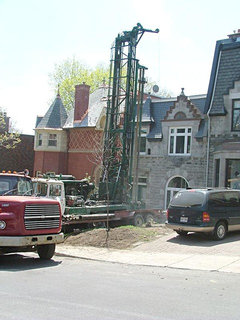
    Here's where we put ours:

    Right in front of the house!

    Paul.

  • 19 years ago

    I would suggest that you contact a drilling contractor and ask him some questions about soil and where to drill or space loops as they are the ones that drill our holes vertical here in Texas. And you can put them under the driveway or any place else for that matter, most well contractor's warranty there wells for fifty years if they are a good company.

  • 19 years ago

    Ha! Think I've seen that picture before, but it still makes me laugh!! Some people just have a fountain in their front yard and a couple flower pots on the porch! ha! What a great visual.....

    HHmmmmm.....Thanks for the input about the vertical loop. It appears that most all of the discussions that I've read on here have discussed vertical loops - not horizontal. This was not an option that was presented to us. Will pick up the phone and ask more questions in the morning. So that I can go in "armed and educated," can any of you tell me .....would we need the same amount of linear feet if we went vertical, or is that figured using different calculations?? Well depths in the area are only about 275 feet. So, would we be talking about drilling several shallower holes?? And what about the cost of drilling vertical versus the cost of trenching horizontal?? Anything else that I should be aware of before I start stirring the pot??

    Again, thanks for your shared wisdom!

  • 19 years ago

    Here in al its one loop per ton,one loop per drilled hole.They generally charge about $1200.00 a loop.Generally one loop per ton of a/c.I am sure they can design a system with shallower loops if need be, you may need several.The ground stays a pretty constant temp after so many feet deep.

  • 19 years ago

    It sounds as if the trenches you're proposing to dig are with a conventional excavator from your description, but you might find a "ditch witch" trenching machine cheaper/faster/more effective, they basically look like a chainsaw and 'cut' quite a narrow trench (I assume you really only need a trench wide enough for the pipe itself which I assume isn't much of a diameter)

    The well-type seems popular and perhaps simpler - certainly less disruption.

  • 19 years ago

    Re: honeysmomcooks

    Your property will look like WWI France by going horizontal!! How are they proposing to dig this up, back- hoe? Â6' deep trench by 300 feet long, but more likely to be a 4' deepÂ; how wide? The most efficient way is with a (6 ft. min.) chain trencher (looks like a massive chain saw).

    Sounds like your system is 3 tons. If you went vertical (closed loop), 200 feet per ton would be PLENTY Â 600 feet and youÂre done (1200 feet of pipe [vertical])! Less pipe, less antifreeze, probably smaller circulating pump (fewer kWh).

    What about open loop? Have you discussed that with your contractor? ThatÂs possible too. You mentioned well depths of 275 ft.

    Your safest, best bet is the closed loop vertical.

    SR

  • 19 years ago

    Iowa here....800 feet per ton per loop

    My geothermal:

    5 ton system (4000 feet total pipe plus 50 feet of larger feeders) put in 5 trenches dug 150 feet long by 3.5 feet wide by 9 feet deep.

    Waited one year to seed and finish lawn.

    Cost to install horizontal loops, pipe and digging $5000

    Going vertical would have at least doubled my cost. You never know whats underground so they rarely give guaranteed quotes. However, if you have no room to dig, vertical is your only option and it should be slightly more efficient. Cost me over 10K to install my potable water well @ 500+ feet......didn't hit water til 275 feet but the gallons per minute were not enough....Keep Digging!!!

  • 19 years ago

    Thanks, guys, for alllll of this great information! Well, here is what I found out.....Spoke to the well guy and found out that he is actually in the process of installing a geothermal unit at his own house. So relieved to find out that he not only knew about geothermal, but was informed about the whole process (whew!). He is using a horizontal ground loop, not vertical, due to the soils that we have in our area. We have hardpan towards the surface, but once you break through that we have sandy loam, which will not support a free-standing hole. The hole would need to be lined with pipe to hold it open. It becomes cost prohibitive.

    So, going back to the horizontal loop plan. We have the space (2+ acres total, 1 ac. cleared). Will need to work further on placement! No seed & lawn in our future, as us W. Wash. Mossbacks can only grow....well, moss!

  • last year

    What happened with this project? I know it is 18 years later but I thought about putting some geothermal tubing under my driveway.