Software
Houzz Logo Print
pudleboy

Granite seam Question

17 years ago

I have 71 sf area and with std edge on counters and ogee on 3 by 6 island it is priced at 7700 with sink. Is this reasonable?

The fabricator says the best way to do my counters is do a seam in the middle of the undermount sink and at the middle of the cooktop. This would mean no cut at corner of ell. He reinforces seams with rods which adds more costs. I had not heard of this approach before. HD proposed one long 24" seam at corner. If this is a fragile stone doesn't rodding it remove material and make it less crack resistant?

This requires four seams albeit small ones.

Recommendations advice on this technique please?

Also is it customary to put half down on order when they already have slabs?

Comments (16)

  • 17 years ago

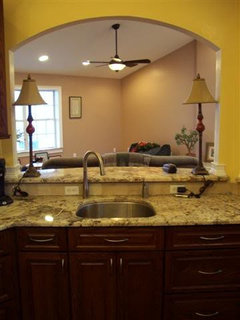
    Does this help . . . I have 36 sq.ft. with an eased edge (green granite) for $4200 no sink included or island involved. And, yes every granite place we went to wanted 50% down when you selected your granite and your name was put on it. A friend of mine just had her granite installed last Thursday and the seam was put in the middle of the sink and she was thrilled because you only see about 3.5" in front of the sink and the same in the back.

  • 17 years ago

    "I have 71 sf area and with std edge on counters and ogee on 3 by 6 island it is priced at 7700 with sink. Is this reasonable?"

    I don't know. What color stone and what part of the country? If it's an "exotic" that may be reasonable. If not then maybe not.

  • 17 years ago

    Do not accept a seam down the middle of your sink! my best advise: not a good idea.

    Seam down the middle of stove ok.

  • 17 years ago

    Do not accept a seam down the middle of your sink! my best advise: not a good idea.

    Can you tell us specifically why it isn't a good idea. If we choose granite and insist on no seam at that point, I would like to be able to explain why.

  • 17 years ago

    Now I am more Confused..... first fabricator said he uses rebar under joints at sink seams as well as cooktop seams together with cabinet bracing at seams he also uses some sort of channel to reinforse and hold the sink. He does this because of the weight of the sink and the water and garbage disposal.
    He uses the seam on the sink to allow a better cosmetic effect allowing a large smooth surface so there are no pattern disruptions in the corner allowing the granite pattern to be cleaner.
    Second fabricator said no seams at cooktop or sink....ever.
    The first guy said most will not do this as he does due to cost and pricing. each rebar site must be chanelled out and this caused the price to be higher..... plus cost of rebar. But you do get a better visual of the actual granite pattern swirls grain than you do when you force a seam at a corner. What are comments about which way is better in the long run.

  • 17 years ago

    I have a very fragile granite. They installed it with seams at both sinks and at the cooktop and I LOVE it!! I have a 45° angled corner with no seam and a 13' long run of granite on the other side with no seams (other than the one at the sink). They did rod mine at the sinks because of the nature of this granite. As busy as my granite is, a seam in the corner or the middle of a run would have looked terrible.


  • 17 years ago

    ccoombs...Love your granite. What is that?
    I think I will go with the first guy and pay a little more for the seams at the cooktop and sink. I see by your counter layout how much better the result is by not seaming the offset corner.
    Petra Granite..Any response on why sink seam is not desirable?

  • 17 years ago

    The granite is Delicatus. Some fabricators won't mess with it because it is fragile and often breaks during fabrication. Once it's installed, it's as strong as any other granite though. Here's my angled corner. It's my main food prep area and I would hate for there to be a seam there. The fabricator did such a great job laying this granite out so that the whole corner up to the sink on one side and cooktop on the other was done in one piece. The small seams I do have are not even noticable. Here's a couple pictures before I put the backsplash up.

  • 17 years ago

    pudleboy-

    There's nothing wrong with having a seam in the middle of the sink,
    as well as the cooktop, Rodding at the openings of each will actually
    increase the strength of the stone - not weaken it.

    Some Fabricators prefer to not put a seam in the middel of a sink, because
    it's much more work in the shop getting the two mating surfaces to match up
    so the seam is next to impossible to feel. Many other guys do not have the skills
    to do this operation well either, so this is why some Fabricators tend to prefer doing
    their seams elsewhere.

    Since your Fabricator is promoting doing the seam in the middle of the sink,
    it tells me that he knows what he's doing, and is comfortable suggesting this
    course of action. Sounds like you're in good hands!

    Post pics here on GW when you are done...OK?

    kevin

  • 17 years ago

    muddypond : here is why my fabricators and my boss' experience in the business for 20 years: May cause drama!
    May: Maybe.
    Seam at sink: water: gravity: you are attaching an undermount sink to a skinny piece of granite in the front and the back. Just think about that. Also: from our experience: cabinets are not always level and either are walls. We have run into a problem like 2 times a year now with seam down the middle of the stove top. Well, customer kept placing the blame on Installer. Well, guess what : customer's cabinets were not level from front to back. We kept telling them that: and they said we were wrong. My boss went there with 6 people standing around and had granite pulled off and stuck a level on the cabinet. We were correct and proved it; this was two months after install, broke granite: and replaced for free: Showed up at customers house: proved their cabinets were not level from front to back and customer's face turned white and he began to shave off the wood in the back of cabinet to level; Because my installers would not touch the wood cabinets. With 6 people standing around. (The customer cut himself in doing so.) My point is : issue can arrise: #1 : I see that we should have never glued the first countertop down in the first place, and 2nd the customer argued and argued with us. And we sent 3 experts out there. Also: we gave them the choice to buy another slab to avoid any seams and they didn't want to do that.

    You never know sometimes until you take off existing tops what might be going on underneith.

    If you feel safe getting the seams down the middle of the sink area that is your choice.

    In two years that I have been running the granite office: my installer have never put a seam down the middle of the sink or next to a DW. Stoves are exceptions: but they are made fully aware that they are able to buy another slab.

  • 17 years ago

    I wanted to add: we avoid problems down the road: and to keep customers happy. I would like to see what a granite expert at the institute states about this: My guys don't put seams around sinks period : keep water away from seams as much as possible. And It's not out of laziness or neglect.
    We always tell them where seams are going to be. And customers are welcome to buy a second or third slab: and pay for it: wholesale price. That is the customer's choice. Most customers are on budgets! Who want match pricing. They don't think about 2 or 3rd slab prices.

    I guess this is whatever the customer and installer agrees on.

    Remember: You are dealing with 3 1/2" in the front of sink and 3 1/2" in the back: skinny piece of granite.

  • 17 years ago

    what kind of granite they are going to use?

  • 17 years ago

    "The granite is Delicatus. Some fabricators won't mess with it because it is fragile and often breaks during fabrication. Once it's installed, it's as strong as any other granite though."

    I love your granite and it's an exotic:
    this is great to help understand the resin process: You have mesh on the back of the Delicatus: (also: granite from India and Absolute black is probably the very strongest granite in the world /most dense)

    Exotics are beautiful and just make sure no one stands on them! and wipe up all messes quickly!

    "The more fragile marbles & granites have also a reinforced backing support, usually in a form of a fiberglass mesh.

    This solution gives a strong and durable surface for transportation purposes and to avoid breakage.

    In this process, the main material used with the net is a polyester resin. Although not a very strong glue, polyester resin in marble is still the method of choice, mainly to reduce costs (and it still has sufficient bonding strength due to the relatively soft and porous substance of the marble).

    The polyester resin has also the added value of fast drying time, making it a perfect solution for automatic line manufacturing.

    Nowadays there are many different kinds of polyester resins, with different viscosity, color and hardening times. Some resins have even the capability of UV hardening, allowing a very fast curing time.

    Generally, the systems commonly used in marble processing are not satisfactory for granite processing lines. The main reasons for this lie in the different chemical structures of the two materials. Granite is much harder, with microscopic fissures and a different absorption rate. The very thin cracks represent an additional problem, since no polyester resin would have the capability to deeply penetrate in the stone, harden up and give a sufficient strength to the material.

    About 20 years ago, after some unsuccessful trials with polyester and acrylic products, a new family of products was tested. Using materials with optimum adhesion (epoxy systems) on granite, the typical problems were resolved and a new technology was developed.

    The epoxy resin has shown the capability to run into each of the cracks and fill all of the pits and micro-fissures present in the granite. Additionally, its long hardening time allows the glue to penetrate deeply into the stone before the complete curing will occur.

    This very durable and extremely elastic family of glues can also follow the different thermal expansion of the granite, leaving the treated product capable of sustaining a wide array of temperatures, making it suitable for inside and outside usage. They also provide a solution when there is a need to glue the granite slab to another material (either aluminum honeycomb, glass or steel).

    The extremely high strength of the glue helps to fix any structural defects, giving the slab a very strong and durable finish."

    http://www.marble-institute.com/

  • 17 years ago

    We finished our kitchen several years ago (so I haven't posted here lately!) but I just wanted to say that our granite seam is in the center of the sink. Not only that, at the back of the sink, the seam runs right through the middle of the faucet hole. Even back then (2005) there were two distinct schools of thought: (1) NEVER PUT a seam in the sink, for ANY reason, and (2) ALWAYS PUT the seam in the sink, as long as it was rodded, etc. SO... our installer wanted to put it in the middle of the sink. After arguing futilely, we agreed. And it has been just fine -- not a problem, virtually invisible. (Mind you, I do not STAND on the edge of the sink -- but I wouldn't whether the sink was there or not! :) I don't baby it in any way, and there's been no problem with that seam placement. I think it completely depends on the installer -- if you trust your installer, then let them decide where they can best place the seam. A skilled installer will take pride in their work, and want the end result to be as close to perfect as possible.

    Here are the front and back seams in our Yellow River granite:

    {{!gwi}}

    {{!gwi}}

  • 17 years ago

    Very experienced installers can and do put seams at the sink, but not at the dishwasher. The installer I was going to use always does them at the sink and is very good at doing them and recommends putting them there to decrease the amount of seam needed.

    Pietra, is my understanding at least in this area that if an installer puts granite on the cabinets he is satisified that the cabinet installation is sufficient to do so. He is accepting the place he is going to put granite as appropriate for the installation he is going to do. I went with quartz, but they certainly put a level on the cabinets in several places and noted if anything needed to be fixed/adjusted before the install. Blaming the cabinets after problems develop when you did not let anyone know about the problem before install does not seem like the best approach. Even when I was considering a less extensive remodel and wanted to put granite on the old cabinets the installer said they would have to determine if the old cabinets were sturdy enough and level enough for the granite or they wouldn't take the job.

    Most customers don't understand the issues involved in granite installation or know what to look for to prevent problems, so blaming them after the fact doesn't seem fair.

    JMHO,

    Sue

Sponsored
Hope Restoration & General Contracting
Average rating: 4.7 out of 5 stars35 Reviews
Columbus Design-Build, Kitchen & Bath Remodeling, Historic Renovations