Software
Houzz Logo Print
arlosmom

Do we need to add attic ventilation?

13 years ago

Hi, I haven't posted to this forum in a long time, but I could really use some helpful insights.

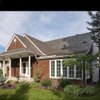
We live in a 1905 hip roof foursquare with a two story addition on the back. The addition has soffit vents and a ridge vent, but the attic in the original part of the house does not have any venting. The addition is not open to the attic of the main original part of the house, so it does not provide any ventilation (the addition does not have an attic).

We have never had a problem with moisture in the attic, but we have made lots of improvements to the envelope of our house over the years, making it much tighter than it used to be. Most recently, this spring we had closed cell insulation sprayed on the basement walls and open cell insulation injected into the balloon framed walls on the first and second floors.

We are in the process of getting estimates for a new roof and I'm wondering if we need to add ventilation to our attic as part of this. As I said, we have never had moisture problems before, but we have also not gone through a winter since insulating our walls.

We could add soffit vents and a ridge vent, but I'm not sure how effective a ridge vent would be in a hip roofed house since our ridge is only about 8 feet long. Would an attic fan make much of a difference? Do we need to do anything at all?

I've spent several hours reading on the internet, but it has left me more confused. In my jaded opinion, lots of contractors try to sell you on what is easier or more convenient for them, not what is best for you.

Any help?

Comments (7)

  • 13 years ago

    Don't know where you live. I live where 110úF is common so it gets mighty hot in the attic. Like 146úF. The only way to tell if you need ventilation is to measure the temperature. For a few bucks you can get a digital thermometer that you can hang in the attic with a remote read out. Do that. Then you will know. Otherwise you are just guessing.

    Believe me if it's 146úF your nose will burn up inside. Get the remote readout. I mounted the sending unit under a hanging straw hat coated with foil to eliminate radiation from the roof. I hung it up after dark when it was cool.

    I installed a fan that comes on when the attic temp reaches 115úF. I plugged all the soffets and put a big opening in the far end of the attic with 1/2 inch screen so the air can flow thru virtually unrestricted. The opening must be sized as per the specs for the fan to ensure proper mass flow.

    With the fan running the temp in the attic is indeed 115úF as per the thermometer.

  • 13 years ago

    As a rule, the costs of running attic ventilator fans exceeds the cooling costs savings. Photovoltaic ventilators are not parasitic. But a test in central Florida in a well-insulated attic showed only a 6% cooling cost savings over a summer season.

    More effective measures are more insulation, radiant barriers and a white roof.

    (It would be helpful if posters would narrow down their climate zone to something more specific than the "United States.")

  • 13 years ago

    Sorry, I should have specified my location -- we are just outside of DC, so we typically have hot, humid summers and fairly cold winters. We don't get the extremes of some areas of the country though.

    I'm encouraged by the comments from both of you. Worthy, thanks for the article. I understood most of it. I think we have done a pretty good job of separating the conditioned living spaces from the unconditioned attic so the underside of the roof stays cool in winter. When it snows, the snow stays on our roof much longer than it does on neighbors' roofs (I always thought this was a good sign that our insulation was working) and we've never experienced any ice dams. We never see signs of moisture or mold in the attic or on things stored there. It does get very hot in the summer. As you climb the stairs from the second floor to the attic, you can feel the temps rise.

    Our basement used to be very damp, but since we had closed cell insulation sprayed on the rubble stone walls, it feels and smells much drier...if we're keeping the moisture out of the house, the attic should be drier as well, yes?

    Worthy, I'm thinking and hoping that you are right and that if it has been fine for 108 years and we've improved the envelope, we should be fine. Thanks so much for weighing in.

  • 13 years ago

    if we're keeping the moisture out of the house, the attic should be drier as well, yes?

    Correct. You have an unvented attic and the benefits that flow from that.
    *********
    The ccSPF you used on the rubble basement was the perfect measure, too, according to Building Science Corp. See the linked document for all the details on how they handled a similar project, which is/was Dr. Joe's own Massachusetts home. The picture below is from that paper.

    Here is a link that might be useful: Rubble Foundations

    This post was edited by worthy on Thu, Aug 15, 13 at 21:06

  • 13 years ago

    Thanks worthy. It's great to get confirmation that we are moving in the right direction. I try to read a lot about each step along the way, but there is so much conflicting info out there.

  • PRO
    13 years ago

    If you can open the soffit and ridge, do so.

    Passive is much better than mechanical although the solar powered fan option that worthy mentioned works well.

    Be sure the fan is equip with both a thermostat and a humidstat.

    The snow remaining on your roof is sign you are headed in the right direction. You still want to vent the roof/attic assembly though.

    You are going to need to open the soffits and either vent via roof top vents/ridge or via powered fan.

    Joe's paper on attic ventilation lays out the options pretty good.

    Was the attic air sealed as well as insulated? Sound like you did something with the balloon framing so I would guess yes.

Sponsored
CHC & Family Developments
Average rating: 5 out of 5 stars6 Reviews
Industry Leading General Contractors in Franklin County, Ohio