Software
Houzz Logo Print
adamm321

Trying to replace insulation in old house

20 years ago

Hi,

We had a leak and damage to the roof of a cape built in the 1950s. All of the insulation under the roof without a dormer had to come out. I believe it was rockwool. Does anyone know what rockwool was? I would like to replace it but can't find any rockwool insulation.

Since the space where the insulation is will be used, I am concerned about having fiberglass insulation in that location. Does anyone know of a healthy alternative if i can't find the rockwool?

Thanks,

Adam

Comments (19)

  • 20 years ago

    I believe rockwool is that nasty fibrous mineral that causes lung cancer. Can't think of the name now. But it isn't sold as insulation anymore. They stopped making rockwool products around 1977 because the airborn fibers are so dangerous.

    Just use fiberglass instead.

  • 20 years ago

    Rockwool is either asbestos, or perhaps perlite (expanded mica, which is harmless).

  • 20 years ago

    Adam,

    Fiberglass is probably one of the best insulations to use (yes, I know California has warnings about it - but California?)

    I have 18" of fiberglass in my attic, and don't worry about it. The attic is separated from the house by a vapor barrier and an inch of plaster (older house-1750's). Insulation is a good thing (but hot to install-unless its winter).

    Don

  • 20 years ago

    Hi,

    Thanks for all the input. I wasn't clear enough in what I was asking. This is a walk in attic space with a sloping roof that we use for storage. We are in and out of it frequently to get things and put things away. There is only a narrow strip where you can stand up and then the roof slopes. It is difficult maneuvering in this space especially without bumping into the sloped roof, as you look through boxes and try to drag the christmas decorations out.

    So I have concern about any rolls of fiberglass insulation being right there for us to be in contact with and potentially put a hole in. I don't want to have to wear a mask everytime we walk into that space.

    On the other hand we also have chemically sensitive people in the house and can't use anything that has been treated with chemicals, such as a borax acid which seems to be common with cellulose.

    The other problem is it has larger than standard space between the rafters and fiberglass would have to be cut and taped together to fit in there. I can't imagine how I would feel after that, wondering about all the fiberglass floating around in there.

    Hope that is clearer..
    Thanks,
    Adam

  • 20 years ago

    If you're using the area that much finsh it off. Your research will eventually turn up something you can use. It's much easier to move around in an attic when everything on some sort of flooring.

  • 20 years ago

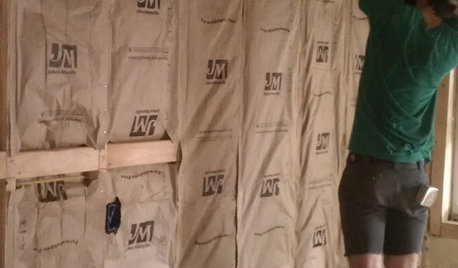
    Check out the encapsulated fiberglass bats, such as Johns Manville "ComfortTherm." They're wrapped with a thin perforated plastic material that helps prevent fibers from blowing around, and makes them MUCH less nasty to install.

  • 20 years ago

    We're about to tackle removing what looks like rock wool insulation. We have to remove the old tongue and groove ceiling, then the insulation in order to shore up some joists. I wonder if getting the stuff wet would keep it from getting in the air as much. Or should I get an insulation removal specialist?

  • 20 years ago

    Bonded Logic is a manufacturer of an organic insulation that is made from natural cotton fibers. Its density allows you to even step on it without it losing its r value. We are considering using it in a home we are building in california. BUT CALIFORNIA? Their website is: www.BondedLogic.com Hope this helps, Happy Holidays to all! Check out the link!!!

    Here is a link that might be useful: That Home Site

  • 20 years ago

    If it's rock wool, it is neither asbestos nor vermiculite. Try some Google searches on rock wool (name used more in UK, Australia and New Zealand) or mineral wool (N American term). The stuff is no more dangerous than fiberglass to work with.

    Adam, if you are using the space frequently, then no matter what you use for insulation you probably need a finished surface over it. Building codes generally require a finish over insulation/vapor barrier because otherwise thre is a fire risk.

    Kevin

  • 20 years ago

    Hi,

    Again, thank you all for adding more input.

    I am not sure the encapsulated insulation will do any good because being an old house, the space between the 2x4s? is not standard size and the insulation rolls will have to be cut to fit. Which is ANOTHER source for concern! If they are cutting it in my space, I am going to have fiberglass floating around forever! Any idea for getting around that?

    I am starting to think that finishing it off isn't a bad idea. I suppose I could use something inexpensive? Something healthy? That won't outgas? paneling of some sort?

    There is nothing wrong with fiberglass except the microscopic glass shards you can breathe right? It doesn't outgas, right?

    thanks for the link sierra..
    Thanks all

  • 20 years ago

    Some fiberglass batts use a binder which contains formaldehyde, which would be the source of any outgassing problem. You can get formaldehyde-free batts though. As to breathing the glass bits, there was a lot of worry about that but it seems to have been established that they don't have the nasty effects like asbestos.

    I did some insulating with unfaced, un-encapsulated fiberglass batts yesterday, cutting to fit weird sized stud bays. I wore a dust mask while working with it, but there was no visible dust produced and when I vacuumed thoroughly afterwards I didn't notice any difference before and after. I am not at all sensitive to fiberglass but my SO is, and he did not react at all when coming into the room afterwards.

    Finishing: drywall is cheap. Paneling is so cheesy :-) I'm in the process of taking out a house's worth of cheap 1/8" plywood paneling!

    Kevin

  • 20 years ago

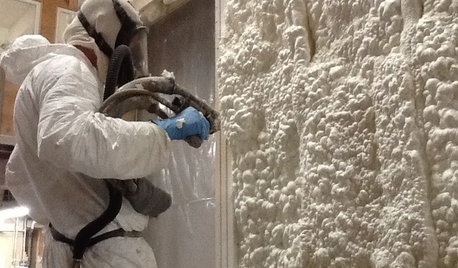
    Icynene may be the way to go. It is sprayed into place. It can fit anywhere! The just slice off the excess. IT seals up everything! More expensive than others but is a great product. Check it out or other spray insulations on google. Spreix is another. Dont know chemicals so check that out also.

  • 20 years ago

    Even better than formaldehyde-free Johns Manville Comfort-Therm encapsulated fiberglass batts is Owens-Corning Miraflex encapsulated long fiber spun fiberglass.

    The Miraflex looks and almost feels like dacron polyester insulation. The long fibers have a twist to them, and theis enables them to be used without binder. It also means that they don't shed fiberglass shards like tradtional products. They will shed a little, but it's far less. Consequently the itching and respiratory issues are much less.

    The downside is that Miraflex runs about twice the cost of competing products. But it's what I chose to insulate the floor of my attic and under the main home floor in the vented crawlspace. I like the fact that if I have to go in and do electrical or plumbing work, that the insulation will be much less nasty to move around and reposition.

    I am wondering why you want to put insulation directly under the roof, but perhaps that's an issue for a different thread.

  • 20 years ago

    Thank you all for the additional information.

    Kevin...I have one room with that cheap paneling I know what you mean. Thanks for sharing your experience.

    nflifer..I am very concerned about the chemical sensitivity of family members even more so than how well it will insulate.

    rich....TWICE the cost of other insulations?? Wow! That is a tough one to swallow. I will check it out though and price it.

    I would like to know what your concern about insulating directly under the roof is? We have a small cape. The front of the cape is just roof and the back has a dormer.
    The space that needs insulation is the front which is a storage area. Where else would we insulate?

    Adam

  • 20 years ago

    I looked up more on enviornment concerns.

    " The Icynene Insulation Systemà is suitable for use in installations designed for environmentally hypersensitive individuals."

    Also talkes about not containing ozone-depleting chemicals.

    and sealing out dust, polen and other allergens.

    Might be your best option if that is your #1 concearn.

  • 20 years ago

    I'm no expert (lol all bad advise comes after that comment) but I've been searching for myself on insulating options, so I'll share with you what I did. I have a finished floor in my attic but it is not a living area. I need more insulation on top of the 6 inches I already had there, so I put down 2 inch rigid board insulation X 2 layers for an equivalent of approximately 28 R-value. Since I would walk up there once a year, if that, I also applied a thin layer of plywood on top of the insulation.

    Also, you should insulate all walls that are connected to a living space. I don't think the roof should be insulated if the room below it is not a living space. You need the attic to be as cold as the outside for best results. You also need to make sure your attic is well ventilated.

  • 20 years ago

    If you insulate the rafters, you are choosing to heat your storage area, and heat is not free. If your belongings don't need to be kept warm, and you don't mind putting on a coat when you go up there, your heating bills will be lower if you insulate the floor instead, as cissado did, and as I did as well (assuming you can get equal R-value of insulation at the floor as you could in the rafters).

  • 20 years ago

    KevinW1 is correct - Rockwool is not asbestos. However, that doesn't mean it's not dangerous, if not handled properly. The WHO and the International Agency for Cancer Research (IARC) classifies Rockwool as a Class 2B carcinogen. If disturbed, surely there'll be airbourne fibers that could get inhaled. Some studies have also linked Rockwool fibers to lung disease and cancer (just do a Google on it). Use normal precautions.