Software
Houzz Logo Print
tuxedord2

Undertone for Botany Beige????

13 years ago

Hi,

I have "Botany Beige" on my walls. I think it was a Duron paint and I think it was 8221W from looking around online.
Want to find the "formula" to determine the undertones. Called Sherwin Williams but they had never heard of it?

How do I go about finding it's formula? Any help would be most appreciated!

Comments (7)

  • PRO
    13 years ago

    You're on the right track wanting to find data on your paint color in order to help you identify certain characteristics. However, you can do better than the formula and "undertones".

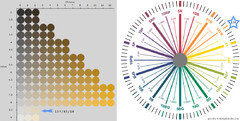
    The professional color systems that paint and color experts rely on use color notations organized in a hue family framework. Luckily, Botany Beige is from one of those systems. Its notation is 1.5Y / 8.5 / 1.4.

    The blue arrow in the image on the left points to the approximate color order (or coordinates) of Botany Beige. Y in 1.5 Y means yellow, 8.5 is where it falls on a value scale and 1.4 is where it falls on a chroma scale.

    The blue star in the image on the right indicates where Botany Beige falls within the hue family framework. You can see that at 1.5, it's rather close to YR. YR is yellow-red also know in other color systems as orange.

    Yellow to Yellow-Red/Orange is Botany Beige's hue family. Again, the whole undertone thing doesn't apply to architectural paint and/or professional color order systems, rather it's about hue families.

    Hopefully that's the info you were looking for in answer to your questions. Here's more info about formulas and undertones just in case:

    Having the paint formula is of no value. Paint color formulas do not contain any useful information other than it being the recipe for making a specific color.

    Even if one works with formulas, the same bases and colorants daily so much so that they understand the colorants and their underlying signatures extremely well, it is still a challenge to predict exactly what will happen when arbitrary and varying quantities of two or more colorants are mixed into a can of base paint.

    Analyzing individual colorants won't get you anywhere because characteristics of colorants are not uniform and neither are cans of base paint. Particle sizes within the colorants can vary and some are more transparent than others. Some colorants are simply stronger than others and will dominate in the mix. But you can't know or predict which colorant - or what part of which colorant - will end up dominant or what will be completely overpowered and neutralized until you mix the color, let it dry, and then *look* at it.

    So, whenever someone waxes poetic about paint color formulas and hue bias of paint bases, don't buy into the hype.

    A dry paint color is the end of the color making pipeline - and it's the only thing that matters when it comes to choosing paint colors.

    Not surprised Sherwin Williams didn't have any info on the color. And "undertones" isn't an aspect that exists in the realms of paint and color experts because it's totally subjective and not rooted in established theories or professional color systems.

    This post was edited by funcolors on Thu, Oct 31, 13 at 2:38

  • 13 years ago

    WOW!!! Thank you so very much for taking the time to respond. Your post is so informative and MORE than helpful!

  • 13 years ago

    Where do you find the data for a color, Funcolors? I also see that colorcharts.org has been down for some time.

  • 13 years ago

    I do think it would be useful to see the color family; as well as value and chroma to compare other paint colors to. When you are close but not quite there, having something to compare to could be helpful, to scale up or down some. When looking at whites/creams, I seem to be landing too much in the Y area when what I think I am looking for is more YR. So it could lead me in the right direction without drowning in all these blasted color chips. The sample pots just don't seem to work out for me. Frequently they don't even match the chip, so what's the point?

    I would like to mix my own paint color. Using the color I have, a little lemony, to take it down a notch to be more mellow, maybe some amber tones rather than the bright lemon chiffon thing. This seems to be mostly at night with artificial lighting. Without committing to the whole room, I'm not sure what I have on the whole, but I see this light lemon thing going on so am stuck. There is some red in the formula. But I want warmer more golden highlights and a bit more muted without getting gray. More neutral than a sometimes yellow.

  • PRO
    13 years ago

    That pretty much sums up why artists use the Munsell system for mixing color with all different mediums, watercolor, acrylic, oil, even universal tints like the paint stores.

    Googling Munsell and fine arts color mixing might be of use to you if you're serious about mixing your own.

  • 13 years ago

    I will check out Munsell. Thanks.