Software
Houzz Logo Print
kngwd

Transporting Soapstone - A frame???

15 years ago

So, I couldn't sell DH on soapstone for the whole kitchen. But we are doing cabinetry/bookshelves around the FP in the family room. We took a trip to M. Tex and found a Julia remnant that we got for $15 sq/ft!! They cut it to size & DH is going to get it Friday morning. But they said to build an A-Frame to bring it home & not to lie it flat. Does anyone know why??? He was planning on laying it flat, covering with a blanket, and laying the 2nd piece on top of that. Each piece is 46x25. Has anyone ever transported their own soapstone and left it flat????

TIA!!!

Comments (17)

  • 15 years ago

    kngwd, I did not transport mine. Good grief, I drive a Mini Cooper, wouldn't that be a sight! But I can post a pic when my guys pulled into the drive way. Every piece was standing up and strapped in. HTH.

  • 15 years ago

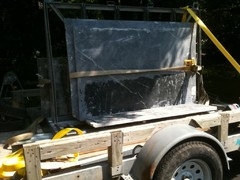
    Any bump you hit with it laying flat will cause it to crack. We built an A frame that went in the back of our pick up truck between the wheel wells with a vertical support in the center. We set a few slabs on each side and strapped them in. They can take the forces if they are in there vertically. Not so much so if they are laying flat. Same with carrying it around for install. Best to carry any larger piece on its edge rather than flat. Think of it like glass. They truck it on it's edge.

    Ne

  • 15 years ago

    Exactly - think of it just like glass. It's so rigid lying flat that the slightest jar will crack it, but put it on its edge and it has amazing strength. (Shear force? Tensile strength? I'm confident some engineer will stroll along soon and explain in great detail.)

  • 15 years ago

    I transported my slabs from M. Tex in NJ to central Ohio in the back of my SUV laying flat. BUT!!!, I built a very robust platform for them to lie on. Two sheets of 3/4 inch plywood screwed to 4 4x4s.

    I didn't have any problems but I must admit the pucker factor was there every time I hit a bump (every 20 yards on I80).

    That being said, the best way is to construct an A-frame carrier.

  • 15 years ago

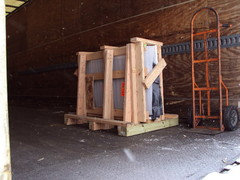
    Here is how ours came (shipped from NJ to SD)

    The brace peices were screwed on after the stone was loaded, this way there was no "impact" from pounding in nails.

  • 15 years ago

    circuspeanut: yes, tensile strength, or lack there of is what would cause it to crack. similar to concrete, which is why concrete (and sometimes stone) is reinforced with rebar (rods in counters) on the underside.

  • 15 years ago

    Actually - "tensile" strength is the measure of a material that's getting stretched... Tensile measurements are most important for expansion and contraction - like when a piece of stone sits out in the sun all day and all night. The heat from the sun hitting the stone all day long will make it
    "grow" limited by it's ability to stretch.... (just a fine point to clarify there.....) when it stretches PAST it's tensile strength - it breaks... Usually - Tensile strength is more apt to be seen (and measured) in caulk that's used when the caulk joint gets wider - it's "tensile strength" is measured. When the caulk joint gets squeezed together - the caulk's "compressive strength" is measured. Does that make sense???

    What ALL slab tops are subject to during transport (using an A-Frame to minimize it's effect) even more than tensile = is FLEXURAL, IMPACT & COMPRESSIVE STRENGTH VALUES

    We "rod" all 2CM tops that we ship to ADD to the flexural strength because the steel rods are helping to "bind" the top together - like Advertguy refered to in concrete using re-bar.......

    Bottom line here KNGWD is that YES = the stone needs to be stored and moved ON EDGE = NOT LAYING FLAT. an "A" Frame will help you IMMENSELY!!!!

    hth

    kevin

  • 15 years ago

    Hi,
    I brought my slabs home from the quarry in VA (about 150 miles) laying flat in the back of my pickup, on the pallet they provided. Somehow, it survived unscathed! And it survived my lifting it with levers and blocks up into place (by myself). And it survives me standing on it to wash windows. It's not particularly delicate, as long as you don't drive like the Dukes of Hazard.
    Casey

  • 15 years ago

    Casey -

    so..... what are you saying - "never mind the a-frame - lay it flat cuz mine did not break and it survived...."? How thick is your stone? 4 Inches?

    IMHO - you got REALLY - R E A L L Y L U C K Y Bro !!! ....

    AND...If you keep on standing on your tops every time you want to, I would put money down on a bet that you will be asking for advice on how to fix a crack - sometime in the future - LOL......

    Seriously dude - if you move stone around for a living - you wont be in business long if you continue to lay it flat for 150 miles .... I'm just saying......

    Most professional stone Fabricators store and move their slabs and pieces on A-Frames and VERTICAL racks.....

  • 15 years ago

    That might well be, Casey, but I always think of an old cast-iron bathtub -- the thing weighs 400lbs and is as strong as, well, cast iron -- but drop it at just the wrong angle and it will shatter like glass.

    Don't even ask me how I know.

  • 15 years ago

    Thermal expansion/contraction has to do with stress/strain both tensile and compressive. But thats looking at the material at the microscopic level.

    Flexural strength, broken down is basically a tensile stress/force and a compressive stress/force. Assuming a slab placed flat between a couple of supports and loaded from above, compression would be on top, tension on the bottom (hence the rods).

    The purpose of having the slabs on end for transport (structurally speaking) is because it increases the distance between the compressive stress block and the tensile stress block. This increases the amount of flexure that the slab can take (loaded vertically). This is similar to trying to bend a 2x10 vertically or horizontally.

    Anyways, the answer to the original posters question is to built an A frame. You might get by without it, but it might just be the best $20 in lumber you ever spend.

  • 15 years ago

    Thank you all so much! My $15 sq ft bargain would be shot if we cracked it before it got home!! We will work on putting something together tonight before he heads up in the morning! Pics coming soon!

    Thanks again!

  • 9 years ago

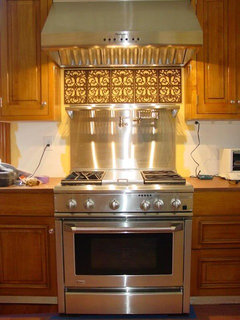
    @sombreuil_mongrel aka Casey, That is quite a unique kitchen! I have never seen it done that way and have been in the kitchen cabinetry business for over 30 years. Do you have photos of the rest of it? I see a nice metal? scroll on the top right. What is that?


  • PRO
    9 years ago

    Hi,

    Old thread, but I'm still around, haha. The scrollwork is a group of cast iron trivets I found at Linens & Things(or bed, bath & beyond?) that happened to exactly fill the space between the backsplash and thermador hood.Crazy, huh?

    All the project's pictures are here: http://s82.photobucket.com/user/Sombreuil/library/

    I am a restoration/preservation carpenter, and it was all DIY. Cabinets were from Conestoga, unfinished/un-assembled. Was not my 1st kitchen, was not even my 12th. However it was the first one "for meeeee"

    The prep sink was to keep the tall Victorian window in a "clever" way.

    Casey

  • 5 years ago

    I need to transport a 9’ soapstone windowsill. i drive a ford ranger extended cab. Diagonally with tailgate open, is only 8’

    any suggestions?

  • 5 years ago
    last modified: 5 years ago

    Rent something larger