Software
Houzz Logo Print
theresse_gw

Q. for those w/ tile-installing experience:

16 years ago

Or I should say more specifically, for those experienced with installing backsplash, e.g. subway tile:

The stainless countertop we ordered and had installed has problems (long story) and they're going to be replacing it with a better fitting one. Beyond the fitting issues, I'm now also wondering if I should have one thing be different in terms of function...

On the first one, I was advised to have a very short lip, or cove I believe it's called, extend upward at the back of the counter, against the wall that's to be tiled. Because it's a period-ish kitchen, I don't want the countertop to have a cove that can be seen (I want tile all the way down to the counterop) but I was told the tile could be installed in front of this short cove so that if water should get back there, it won't rot anything behind or underneath. Yes the tile will still have to be cleaned and maintained occasionally but so does everyone's who doesn't have a high cove.

My questions are, can tile truly, easily be attached well to this short cove and:

-- Will it stay on well, if the bottom portion of the tile is stuck onto metal while the majority of the tile (tiles are 2x6") will be stuck to the wall just above and behind the metal cove? Will that bottom tile be at risk of breaking off due to metal not being so easy to stay stuck to or something like that?

-- If the bend or precise angle of the cove is ever so slightly off and results in the tile not being perfectly flush with the metal, is that a problem? I don't expect it would be much off but just asking. Should I give the metal fabricator a piece of tile to work with or is knowing the thickness of the tile helpful for them re. the cove?

-- If the first tile sticks out more because the cove sits behind it (even though the metal's not very thick) and the rest of the tiles above it are stuck fully to the wall, AND I want all my tile to appear nice and tight and flush/even throughout, how can this happen? If it's by putting more goop on there to minimize the difference in depth, does it matter that my tile isn't the rustic or chunky kind, but rather has very straight, sharp edges and is very flat tile with no bevel (that I want there to be very little grout line between each tile (about 1/16")? Should these details factor in to my decision about tiling over that cove/having a cove?

Thank you so much, as always!!

p.s. - The cove has a space behind it in the pic (a space behind it and the wall) because the countertop had to be pulled away in order to make an overhand (they miscalculated while measuring). That's why it looks so far from the wall. If I have a cove made on the replacement countertop too, it *should* be flush up against the wall.

Comments (17)

  • 16 years ago

    Ok if this site would allow us to edit when we've written too much, I'd edit all that verbosity above!!!

    But anyway... I still need to know the answers so... BUMP. ;)

  • 16 years ago

    I don't understand the need for the upturned cove at all. Perhaps the fabricator needs a right-angle for rigidity on the back edge of the stainless, but it does not serve any sort of sanitary purpose. We install backsplashes over coveless slab and tile decks all of the tile without the house being endangered.
    What I am concerned with however is the gaping hole in your underlayment around the plumbing assembly. How does the person who cut this hole out expect you to now install tile over the patch if there is nothing to support the edges of the patch? Since the stainless is coming off, can you insist that they replace the hacked cement board with a fully supported panel? The plumbing mixer should be left off while the tile is being installed anyway. I suggest using "sharkbite" solderless caps over the plumbing nipples as temporary closures since you've already got them trimmed to the correct length. Just slip the sharkbites on, install your tile, slip off the sharkbites after grout and reattach the mixer assembly.
    Shaughnn

  • 16 years ago

    theresse, what size tile? Approx. E.g. Several inches by several inches? 3/4" by 3/4" Bisazza? Thin strips 1/2" high?

    theresse, when nickel was first used to make counters, nobody was anti-cove. Also, nobody invented coves recently. They've been around since before the Romans built their city on seven hills. In a period-ish kitchen, a cove exposed will be as fine as a cove hidden behind the tile.

    hth

  • 16 years ago

    Shaughnn - the faucet's going to be adjusted prior to tiling and before the tile goes on that hole will of course be closed up. :)

    I don't know that the countertop guy was thinking the house would be truly endangered...he thought it might be a good idea because if caulk isn't maintained well (I told him I hated replacing caulk - I wonder if that had something to do with it), water could in theory get behind it and loosen up the tiles at the bottom maybe? Honestly, I've never heard of it either - that's why I'm asking here. Maybe it has something to do with the material being stainless? I'd ask him but I always prefer to ask people not involved just to know I'm getting unbiased advice or a second opinion, you know?

    Thanks!

    Davidro1 - tile is 2x6" and 2" high (I wrote that above but it's buried in all my jabbering. Hey - buried in verbosity - there's some alliteration for ya!).

    Well, my period-ish kitchen isn't after the pre-Roman period look - haha. It's after the 1913 craftsman look which - according to several super cool old photos I've found online - had no coves. Backsplash, yes, coves, no. Just being historically accurate to THIS point, not all points. It's a pretty modern looking thing, coves, in my experience. Regardless of weather or not it may have preceded the invention of the wheel. ;)

    Thank you!

    Here is a link that might be useful: Check out these old kitchen photos...

  • 16 years ago

    If he installs it the way bathtub enclosure tile is installed over the flange, a bead of flexible silicon caulk connects the bottom of the tile and the top of the flange - not thinset.

    That way if there is any flexing, it doesn't crack and leak. Tile and tub are not connected by a rigif material.

  • 16 years ago

    Thanks lazygardens. I don't know whether it's the same idea or not.

    Has ANYONE heard of doing this w/ countertops? Strange...

  • 16 years ago

    what is the height and thickness of the flange?

    If its very thin you may be able to get away with making everything flat by laying the tiles on a bed of thinset that is greater than or equal to the thickness of the flange. However if the flange is too thick (more than 1/16 i would guess) then playing will thinset will make tiling a major PITA. In that case you almost have to start considering adding another layer of underlayment say 1/4 (or 1/8 if you can carefully split the 1/4 cement board which I've done before) cement board to bump the wall in front of the flange.

    Either way what you don't want is for the first row of tile partially resting on the flange to not align with the rest of the backsplash.

    Also having the flange to prevent water from getting behind the wall seems like overkill to me. What I did in my kitchen was that I caulked the counter to the wall with high quality silicone caulk and then caulked the tile to the counter again when I was done tiling so I have 2 layers of protection.

  • 16 years ago

    Thanks Padola07 (and everyone)...that sounds reasonable. Hmmm - the flange (is that the name of it? I have no idea what you'd really call it!) is 3/8" high and yes it's 1/16" thick, exactly.

    Again though, I wonder if the countertop being metal is a factor...

  • 16 years ago

    My tub had something like that when I did my bathroom and it was called a flange.

    Ok so since it is 1/16 I believe thinset under the tile should be able to make up the difference and level everything. Usually a 1/4 x 1/4 trowel will result in an 1/8 bed but for your tile you'd probably be using something smaller may be a 3/16 trowel.

    And since it is only 3/8 high and your tile is a 2x6 you will have more than 3/4 of the tile supported with thinset so that should be able to stick good.

    I think you're fine.

  • 16 years ago

    Since it's a backsplash, not a shower wall, tiling can be done with a gentle product called Mastic (which is ready mixed) instead of thinset (which is mixed from cement on site). All the information above regarding thicknesses still applies, but you don't need backerboard so you don't need to split backerboard. You can mastic (or thinset) onto a painted wall or onto bare sheetrock walls. Not onto the patched portions of the wall. There it needs paint. This is adequate for a backsplash, in many people's view.

    Since it's Stainless Steel, you do have the problem that not much sticks to it.

    Calling it a flange is good too. Search using keywords "bathtub riling flange" to see diagrams of how this works to make it disappear behind the tile.

    I'll bet that the flange / cove was a Good Idea and a Good Thing to Have. Without it, the large surface area of your counter might warp a bit like a large sail. One day someone will stand on the counter, and you probably want the counter to remain flat after that person gets off the counter. With the flange, it has additional support to keep its original shape and flatness, to the Nth degree.

  • 16 years ago

    One way or the other, I don't know that I'd be comfortable with part of the countertop going up behind the bottom course of tile.

    I'm sure you've seen all the advice about caulking the bottom of the tile to the countertop? There's a real good reason for that, and it's not to make it waterproof. It's because there's usually alot of movement in the bottom cabinets and countertop, because of all the activity that occurs on and around it. Between people working on it, bumping into the cabinets, dropping things on the countertop, etc., there's way more movement there, than I'd like to see behind the bottom of the tile. I'd be afraid that you'd end up snapping the bottom of the last course of tile sooner or later.

    If you HAVE to have that little upturn there, I'd want it to be flush with the face of the finished tile backsplash, so that the tile starts just ABOVE that lip, instead of covering it, and then you can caulk the tile to that lip.

  • 16 years ago

    Padola07 - thank you!

    Davidro1 - interesting point about potential warping. It's 14 gauge steel so I hope not but yes it's still possible.

    Bill Vincent - I hadn't thought of that. Great. Thank you.

    I wonder all in all how stainless steel makes this a different ball game than if it were a different material (thicker, less shiny, etc.).

    Thanks guys!

  • 15 years ago

    Theresse, just a note to ask if I somehow missed any updates on your kitchen. I'd love to see how it is coming along since you got the new stainless counters (round two) and installed your marble backsplash. Or, perhaps you are waiting to delight us all with the Grand Reveal?

  • 15 years ago

    francoise47 - thanks so much for asking! :)

    It's been ridiculous...this whole kitchen experience. I decided it was safest to get a tile specialist so I found a local guy that a high-end tile store had at the top of their installer list and he's put me off 3x now. He's supposedly going to start next week - but the short answer is no, nothing's changed!! Can you believe it? And I can't get the outlet plates and disposal hooked up and lights put in till the electrician comes and he doesn't come till the tile's installed!

    So PLEASE cross your fingers for me. I've actually gotten super discouraged and frankly, truly depressed over this (I mean like I've given up, feel lethargic, have headaches, feel like this has cost us more money than we can afford so it's put us at-risk, etc. etc.). I just want it over with but God forbid it look good (better) when it's done...

    If he puts me off again, I'll find someone else. He said I'd hear from him by the end of this week.

    Thanks again for caring!

  • 15 years ago

    No advice, just sympathy and I wanted to tell you again how very much I like your kitchen. :) Your floor, those wonderful old cabs with their hardware, the new cabs too, the countertop -- honestly, if you just said "bag it, I'm done" and painted your backsplash I think your kitchen would be lovely: unique and with a great vintage vibe. With the tile it'll be really special! Best of luck and I hope you will see a light at the end of the tunnel soon.

  • 15 years ago

    I see a bunch of people already chimed in, but I will throw my take into it as well. Assuming the backsplash is tiled as someone would do a bathtub flange there should be no connection between the tile and counter besides a bead of caulk. Assuming that is the case I could see where this system would give an extra layer of water protection to the wall.

    Personally however I would be more worried about having my plumbing installed within an outside wall. I hope you live in a southern climate that does not see freezing temperatures too often.

  • 15 years ago

    northcarolina - you are so sweet, thank you! I appreciate the support - I really do.

    Enginerd - I don't know what's wrong with me but I need clarification. Are you saying that the system of having that back cove (where the countertop starts to turn upward at the back of the countertop) is what would give an extra layer of protection, beyond just a bead of caulk? Sorry for not totally getting it! It is an outside wall, and we live in the Northwest, but it's insulated in the walls and we don't get freezes as often as say the East coast. *Hopefully* it won't be a problem but I do appreciate the advice! In fact you've got me wondering - hoping - that the contractor and/or plumber did in fact put the insulation back in place before sealing up! The original insulation was blown in (not original-original but blown in sometime in the 1980's, if memory serves - based on what the elderly woman who owned the place before us told me). Thanks!

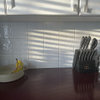
    Here's the latest pic of where we are in the process. Not much has changed but at least the hardware (finally) got put on the new lower cabs:

    Flickr">