

Major mistakes
My kitchen is finished... finally! Now that I've used it, I'm finding that the reach into my undermount sink is uncomfortable, I'm 5'2. My gas stovetop reach to the front burners is also further than I'm accustomed to, nine inches to the rim of burner. (had to move stovetop back to meet exhaust fan) the exhaust is behind the cook top. It is not a hood. It is installed below the cook top behind the oven. If the granite edge were beveled, leaning over the sink and stove wouldn't be as uncomfortable. Is there any way to cut the granite after it's installed? I already have a grid installed to raise dishes and mats to raise me in front of the stove. As you can probably tell, Im ready to jump...!
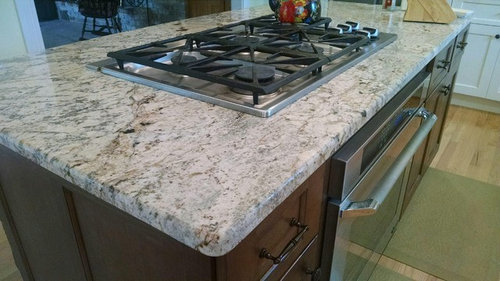
This post was edited by ssmith50 on Wed, Oct 15, 14 at 12:41
Comments (37)
 12 years ago
Edit: It should be noted that the OP edited her post 4 days after its initial post, and added a photo at that time. My response here was responding to her original post which was written in such a way to make it seem that the exhaust was over the cooktop. The OP also did not mention her cooktop was on an island. Please read my comments below as responding to a problem of a cooktop with an exhaust hood over it (i.e. not a downdraft), and not on an island.
Regarding the OP's comment about the stovetop pushed back to meet the exhaust fan - for people who haven't yet installed their stovetops and exhaust hood - what the OP should have done is kept the stovetop in its normal front position, and installed a filler piece or pieces behind the hood to push the hood forward. You put a couple of flat 2x4's behind the hood and it is pushed forward. On the Appliances Forum, Kaseki and JWVideo have posted about this topic.
Ssmith 50 - regarding your uncomfortable reach into the sink - do you have a high arch faucet? If so, one thing you could do is switch that faucet for a pull-out faucet. A pull-out faucet will reach farther toward the front of your sink, while a high arch faucet is toward the back of the sink. Every time you use the sink, those extra inches toward you of a pull-out faucet will help. For others who have not yet installed a sink and are worried about discomfort with reach, they should consider an apron front sink so that your body is directly against the sink, and there is no countertop piece between you and the sink.
This post was edited by akchicago on Thu, Oct 16, 14 at 8:29
 12 years ago
I'm short and always have to replace the faucet for one with a longer spout. I found that was what was bothering me and not the depth itself. (In my exhaustive searches for longest spouts, it seemed that the pulldowns were actually longer reaching...probably due to their overall massiveness.)
But the granite can probably be eased in place--maybe one of the granite guys will advise you on that.
Related Professionals
McAlester Kitchen & Bathroom Designers · Bemidji Kitchen & Bathroom Designers · Odessa Kitchen & Bathroom Designers · Southaven Kitchen Remodelers · Charlotte Kitchen Remodelers · Muskogee Kitchen Remodelers · Chattanooga Kitchen Remodelers · Fredericksburg Kitchen Remodelers · Flagstaff Kitchen Remodelers · Salem Kitchen Remodelers · Emporia Custom Countertops · Aberdeen Custom Countertops · Sugar Land Custom Countertops · Trenton Custom Countertops · Carson City Custom Countertops- 12 years ago
It would be just a bit, but maybe one of the anti-fatigue mats would give you a bit more height. In a quick Google search, I found that there were mats up to 1" thick, although something closer to 1/2" seemed more prevalent. Below is one place I found that seemed to have a wide selection and a variety of thicknesses.
P.S. If you get an anti-fatigue mat, get a color that most closely matches your floor.
Here is a link that might be useful: anti-fatigue mats
- 12 years ago
The only reason I can think of, that would require relocating a cooking appliance "further back", would be because the venting appliance purchased, was insufficient in CFM to effectively vent the cooking appliance, and beneath that recommended by the cooking appliance mfg.
A couple of 2x4's to build-out a hood, I mean, thats some jack-leg-labor's solution, after the expense of a remodel?
You can't be serious!
- 12 years ago
"I'm short and always have to replace the faucet for one with a longer spout."
I'm short also. In looking for a new faucet the reach is one of my top priorities. It does limit the options.
 12 years ago
" ... You put a couple of flat 2x4's behind the hood and it is pushed forward ... "
If the range hood fits underneath a cabinet, how would that work? Wouldn't the venting also be pushed out by the 2x4's? I can't imagine that this solution would look good at all.
 12 years ago
Perhaps contact your stone provider to discuss what could be done with your counters. I don't think it's possible to redo the edge in place, but I could easily be wrong. I do know it would make an unbelievable mess.
With the sink, possibly change to hands free - either with a specialty faucet or by adding a tapmaster so the faucet becomes foot operable. You'd still have to adjust temperature but simple on/off wouldn't require reaching to the back.
Certainly not disagreeing with an undermounted farm sink and Jane's suggestion of the Whitehaven. If your sink cabinet has a false drawer front and it would be a very minor cabinet alteration. If your sink cabinet has doors that reach up near the bottom of the counter, it's a bigger deal.
I'm 5'7" and found that the reach to the faucet controls is a bit too far for me with an ikea farm sink. After living with it for a few years, I'm thinking of changing it out.
I'd like to see a picture of the cooktop/hood too. Perhaps think about whether the cooktop could be lowered.
Here is a link that might be useful: Tapmaster
- 12 years ago
Jellytoast and Snoonyb - wow, you didn't have to be harsh just because you hadn't heard of bumping out a hood. All I was doing was making a suggestion that has been discussed on the Appliances Forum. The Kitchens Forum should allow people to exchange ideas freely to help others in their kitchen reno. I will link a thread on the hood topic.
Here is a link that might be useful: Thread called Bumping out the Range Hood
- 12 years ago
Yeah, hoods are bumped out. It's not weird.
But what can we do now that your granite is in and the cooktop hole is cut? Would you consider redoing the granite entirely? How far are you willing to take this?
In the meantime, the antifatigue mat is probably worth trying.
- 12 years ago
" akchicago"
I've been at this for more than 35yrs. and make it my business to insure that the customer indulges in 20/20 hindsight, against my advice, not from a failure on my part to have professionally advised them of the potential for the shortcomings of some mickey-mouse excuse/solution, because they were ill-informed.
Regarding Jellytoasts concerns;
The simple solution would be to have a deeper cabinet, which would afford the prepunched mounting holes in the venting appliance to be used.
However, what do you do to address the snowball effect of other in-fill and made up additional "fixes."
When the real solution is complete information and verification, in stead of reliance on some sudo-professional.
Prior, Proper, Planning.
It's your money. Put as much effort in spending it, as you did earning it.
- 12 years ago
Regarding the hood - Ssmith50, how deep is your current hood (front to back)?. I wonder if it would have been better for the OP to have installed a deeper hood (deeper front to back) instead of making the counter strip in front of the stovetop be 9". Hoods can be bought in depths of between 20" and 27" (approx.). If the OP switches out her current hood for a deeper hood of, say, 27", can she then get her counter fabricator to cut back the 9" strip in front of the burners? I know it will be expensive (though she could sell her shallower hood on Craig's List and recoup a bit of the money), but if she is so uncomfortable every time she cooks, which will be for years to come, it would be worth it.
Regarding the sink discomfort, I think the OP said she already has a mat. I agree that a faucet switch will help. As others have said, look for a faucet with a long reach toward the front of the sink. The faucet specs are shown on the manufacturers' websites.
As an aside, in my previous kitchen I had my hood bumped out at my GC's suggestion. At the time I didn't know anything about hoods and had chosen one with a 21" depth cause it was pretty. The hood was too shallow for my Wolf range. The bump-out didn't seem to be a big deal. I think the hardest part was covering the plywood piece in sheetmetal, which took the GC about a half hour to cut it and attach it. I never gave it another thought until this thread reminded me. The bump-out was about 3", it was a chimney-style hood with cabinets on either side, and you would have to crane your neck under the hood to notice it. Unfortunately, that won't help the OP, but it might help others reading this thread who have bought shallow hoods but not yet installed them.
This post was edited by Mrs_Nyefnyef on Sun, Oct 12, 14 at 13:24
 PRO12 years ago
ssmith50:
I can't imagine how your cooktop can be installed per manufacturer's instructions and be that far back. Please check and get back to us. A picture would be nice.
Your granite can be profiled and polished in place, especially a bevel. It will be very messy and at least a thousand dollars. I don't think it will have any functional effect.
- 12 years ago
"Jellytoast and Snoonyb - wow, you didn't have to be harsh just because you hadn't heard of bumping out a hood."
My apologies if I sounded harsh, as that was not my intention. I'm just having a hard time imagining that it would look good, and was just stating such. If someone has done it successfully, I would love to see it. My range hood is under a cabinet and moving the range hood out would mean that it would no longer line up with the cabinet in the front, and there would be a big gap in the back, which would result in things looking odd. So that's why I mentioned it, but that's just my opinion, nothing more.
"The Kitchens Forum should allow people to exchange ideas freely to help others in their kitchen reno."
Which means that there will naturally be differing opinions. Again, I apologize if I came across as harsh. Thank you for the link to the previous thread. I can see how it would work in certain situations.
This post was edited by jellytoast on Sun, Oct 12, 14 at 14:05
- 12 years ago
It appears that few remember that, there were not hoods, then a square or round hole in the ceiling sometime connected to a vent then through the roof, then a grate was added at the ceiling and then a fan motor with a switch or a pull chain
A 27" deep hood, with a 300CFM capacity, when the cooking appliance mfg. recommends a 1000CFM, is virtually useless.
While a 16" deep hood with a 1000CFM venting capacity will work just fine.
It's the CFM.
The cooking mfg's are not just speaking, to here their own voice.
- 12 years ago
snoonyb - I disagree - I believe the capture area is more important than the CFMs. The manufacturers recommend more CFMs to sell more expensive hoods. The rule of thumb for CFMs assumes you're running all the burners on maximum most of the time which is rarely true. I have a 600 CFM hood over a pro-style range, but because it's only 20" deep, I get grease on the outside of the hood. I would trade off CFMs for a deeper hood which would capture more of the grease.
- 12 years ago
"The manufacturers recommend more CFMs to sell more expensive hoods."
So, so much for R&D.
"The rule of thumb for CFMs assumes you're running all the burners on maximum most of the time which is rarely true."
While the recommendation is based upon "budgeting for contingency," because what can go wrong, will, what good, then, are the speed controls built into the appliance?
Which allows for the selection befitting optimal use.
"I have a 600 CFM hood over a pro-style range, but because it's only 20" deep, I get grease on the outside of the hood."
You made my point.
- 12 years ago
No snoonyb, I didn't make your point - 600 CFMs is the manufacturer's recommended amount for my 30" range. It's the 20" depth which doesn't cover the front burners that causes the effluent to reach the outside front of the hood, not the CFMs. Even with the hood on high, with only one front burner running, the effluent will not be completely captured by the hood. In hindsight, I should have gotten a 24" or 27" deep hood, but like you, I believed at that time that CFMs were all that mattered.
This post was edited by weissman on Sun, Oct 12, 14 at 23:42
- 12 years ago
So, first it was your assertion;
"weissman (My Page) on Sun, Oct 12, 14 at 20:43
The manufacturers recommend more CFMs to sell more expensive hoods."Which in your case, would not have been overkill, but prudent, as evidenced by;
"weissman (My Page) on Sun, Oct 12, 14 at 23:41
600 CFMs is the manufacturer's recommended amount for my 30" range."And a more expensive option would have been;
"It's the 20" depth which doesn't cover the front burners that causes the effluent to reach the outside front of the hood, not the CFMs."
Or, knowing your food preparation methods, you elected not to budget for that contingency, by selecting a higher CFM appliance.
Keeping in mind that the recommended height of the venting appliance, above the cooking surface, for efficient operation, is 29". Which is generally, 5'6" above the floor.
So, wide projecting hoods, can be a head banger.
Just another CFM consideration.
- PRO12 years ago
Obviously a more powerful hood would capture outside its physical footprint.
- 12 years ago
snoonyb - you're really twisting my words to justify your position. 600 CFMs was the recommended amount for my range and was at the time the maximum available for a hood in the size I needed. In fact, I've since read that except for ranges with grills, 600 CFMs is sufficient for most home ranges. I was told by a salesman that depth didn't matter so I went with a 20" depth hood. He was wrong. He had been in the business too long and had old, out-dated knowledge. It is now common knowledge that effluent expands as it rises which is why these days the recommendation is for wider and deeper hoods. Capture area is important.
This post was edited by weissman on Mon, Oct 13, 14 at 10:52
- 12 years ago
"snoonyb - you're really twisting my words to justify your position."
So, my direct quotes from your post, are not?
"600 CFMs was the recommended amount for my range and was at the time the maximum available"
Interesting! Especially since I've been installing hoods in excess of 1000CFM for over 20yrs.
"for a hood in the size I needed."
You selected this hood, from the multitude of options available.
"In fact, I've since read that except for ranges with grills, 600 CFMs is sufficient for most home ranges."
Published where? Assuredly not in any publication relating to air motion, transfer or replacement or published in any HVAC industry study.
"I was told by a salesman"
Yep!
"It is now common knowledge that effluent expands as it rises which is why these days the recommendation is for wider and deeper hoods."
And "head banging," and life style are irrelevant?
"Capture area is important."
And raising the venting appliance to a safe height.
Which places it above the recommended height for efficient operation, reduces the appliance efficiency.
And the least expensive method of overcoming that is CFM.
Not, as you said, a more expensive appliance or cabinet modification.
But, if you are convinced that a larger capture ares as well as the potential of grease accumulating on the interior of the appliance, because the CFM is insufficient to draw the affluents into the filters, and subsequently dripping into your food preparation area are ideal.
go for it.
- 12 years ago
snoonby - you've obviously banged your head on one too many range hoods - I'm done trying to have a rational conversation with you!
- 12 years ago
Snoonyb - please dial it back. Maybe you don't realize it, but your tone has become offensive. It's too bad, because I've read other posts you've written, and you are very knowledgeable, and a valuable contributor to this Forum. But you've let your temper get the best of you. It's so easy to say whatever flows from your fingers when you are online, versus talking this way to someone in person. I have to say though, having read the posts on the Appliances Forum by Kaseki, JWVideo and others, your views do not seem current. Interior air quality has become a hot topic, and the approaches have changed. Can you see your way to perhaps take a look at some of the posts on the Appliances Forum and see if there may be something new that you might find interesting?
- 12 years ago
People are free to be as thin skinned as is their preference.
I have a moral obligation to invite "thinking things through," coming to an informed decision.
In a kitchen, especially, nothing, is one size fits all.
I've read some of the advice and suggestions on the appliance forum, and frankly, find a good portion of it lacking in depth.
You see, I've built movie theaters and 2 burner and a mini fridge, mother-in-law units, and in over 35yrs. have had 1 call back, and not a single case of 20/20 hind sight, that was not customer, self induced.
 12 years ago
Last night I was looking at a kitchen with two AEG hoods -- about 72 inches of ventilation total -- mounted above a smoothie of some type but with a Gagg deep fryer if I'm not mistaken. These are not sold in the US. (photo below)
However, there also is a review of the hood from an English owner and the only complaint seems to be that the light bulb is hard to change so he's clearly had it for a while.
This hood doesn't adhere to the 'capture' argument at all, nor would other Euro brands -- I'm thinking specifically of Elica, which is sold in the US. Those don't cover the entire cooktop.
I don't think it's entirely cut and dried. I think it depends on the range and the hood. If you have a Blue Star then the hood requirement is very different from someone installing a hood over induction. Then there's what's cooked.
Capture and cfms need to be balanced with the range and cooking style. Unfortunately, in most cases, the hood is rarely given serious consideration. For most, a salesman says 'you need such and such." Then, considerations are 'quiet' and 'price.'
There was a thread here not long ago where many of the posters didn't feel a hood was necessary, even with a powerful gas range. I don't understand that at all but people post that they've lived in a kitchen without a hood for 25 years. I just don't want to be the next owner of such a house because I'd likely be removing the ceiling.
This is an 'application' issue which should require some hvac math but in most cases doesn't get it.
snoonyb -- not every conversation on Appliances is expert but there are some pros over there -- Kaiseki comes to mind -- who know their stuff.
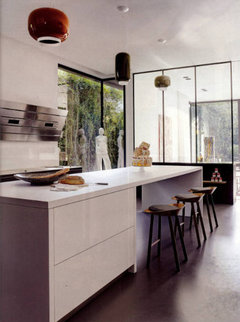
Here is a link that might be useful: High Tech Hood Kitchen
- 12 years ago
"rococogurl "
My sentiments exactly.
A salesman and a kitchen designer, not all of either, will, given the opportunity, sell you your own apron back to you.
Ethics and integrity demand free disclosure of information.
Not just the flavor of the moment.
ssmith50
Original Author12 years agoAfter reading your comments, I realized I need to clarify that my exhaust is not a hood it is behind the cook top...installed below the cook top.
Thank you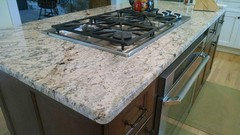
- 12 years ago
Wow, thread really went off the rails, given that you were pretty clear in your original inquiry that the vent was behind and not over your cooktop.
Did you agree to that placement? Is it because the oven is so deep?
I'd also be really unhappy with that reach (I'm also 5'2"). I don't think a bevel would do the trick, though. Frankly, if it's because of the oven, I'm not sure you have a lot of options, except get a ceiling mount vent so you could pull your stove forward (which of course would mean a new piece of granite, too, I guess). But I'm no expert.
Good luck.
- 12 years ago
Does the vent have to be attached to the cooktop? Can the cooktop move 5-6 inches forward over the oven with perhaps a piece of black soapstone placed between the downdraft and the cooktop? I think in this case the reduced ventilation may be necessary for ergonomics, it's a tradeoff of which woe is less tolerable. The granite would of course have to be recut.
- 12 years ago
It's now clear as mud.
I had assumed that you had an overhead exhaust vent, in part, because the downdraft vent appears as cooktop trim.And while there are DD vent, cooktop, oven combinations that are in the configuration, yours is not one of them.
Generally, a DD vent either rises when activated or remains in the configuration depicted, and that is where they are the most efficient.
As mentioned, if the DD vent is a separate appliance and is only connected to the CT by a plug-in cord, The CT should be able to be moved closed to the edge and an in-fill placed in the separation.
There can be some lose of efficiency, which if it becomes troublesome, can be overcome by employing a higher CFM, remote blower.
- 12 years ago
I am not sure why all the bickering...take it easy, jeez
Looks to me like the KD/contractor did not properly plan for the venting of the downdraft....that cabinet below the cooktop must be a mess inside?
What is on the backside of the island?
- 12 years ago
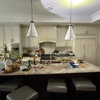
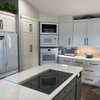
Wow, now that a photo has been posted, what a disaster! You didn't even mention the oven handle that you have to stand in front of that makes the reach to the front burner even longer!!
Possibly you could reconfigure the cabinets in the island...move the end cabinet and use it under the cooktop. Move the oven to the end of the island. Get a new top made for the island and with the cooktop repositioned forward.
Or ditch the cooktop & oven & get a range to replace. Probably have to get granite or maybe have a piece of SS custom fabricated to bridge the area between the range & vent.
This is a really major boo-boo and needs to be fixed. Going to be expensive but cheaper than getting back surgery that you will surely need if you don't fix it.
- 12 years ago
Crcollins said "given that you were pretty clear in your original inquiry that the vent was behind and not over your cooktop."
Actually, the OP edited her post 4 days after its initial post. Her original post also did not provide a photo until 4 days later. So the thread that got heated was responding to her original post which was written in such a way to make it seem that the exhaust was over the cooktop. She never mentioned it was an island cooktop, and the way her post was written would lead us to think the cooktop was against the wall. Consequently, the discussions about her exhaust were based on a misleadingly-written post. I am glad she has cleared things up, because she can get more applicable advice now that we know the stovetop is on an island, and has an unusual and not very effective type of downdraft.
This post was edited by akchicago on Thu, Oct 16, 14 at 8:31
- 12 years ago
ssmith50 - the title of your post is very accurate. Emphasis on MAJOR.
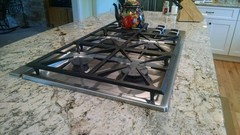
Just for clarity, it appears you have a downdraft exhaust system behind your cooktop. That's what it certainly looks like to me. Whether or not that is powerful enough to capture cooking effluvia and pull it all down into the vent is not clear. For that we would need to know the CFM (cubic feet per minute) draw of the downdraft. That can be something like 400 or 600 etc. Do you have that info in your kitchen files -- would likely be on the spec sheet or the user manual.
However, that's not the major issue I see. The issue is that whoever "designed" your kitchen or did the planning installed the oven below the cooktop.
That's one thing that's pushing you away from accessing the cooktop because it's causing you to stand at least 3 inches away to begin with.
It also appears that the cooktop was plunked down in the center of the counter so it didn't conflict with the front of the oven. The cooktop should be installed near the front of the island on the working side. Mine, f.ex. is installed 2-3/4" from the edge of the cabinet.
It's an impossible installation.
I'm sorry to say this -- heck I'm sorry to see this -- a major change would be needed on the island to make that workable. I'm 5'7" and would have a hard time with that set up.
This post was edited by rococogurl on Thu, Oct 16, 14 at 14:09
- 12 years ago
My bad! I guess I didn't see the pre-edit post. Timing makes all the difference.







rococogurl