Software
Houzz Logo Print
dougald_gw

Ceiling Drywall DecorProblem

14 years ago

I have a home that was built in the 1970's ... at that time standard wall height was 8 feet and it was common to stipple drywall ceilings. The kitchen is about to be remodelled and the walls which demarcated it removed to enlarge it and open the plan.The existing kitchen ceiling which is dropped to 7 foot to house recessed flourescent lights will be removed and raised to 8 foot with more modern lighting installed.

But, new ceilings are generally finished flat. How should that be handled where the new ceiling meets the old stippled ceiling?

Regards ... Doug

Comments (12)

  • 14 years ago

    I'd personally remove the popcorn from the rest of the home's public spaces while all of the rest of the reno dust was going on. A smooth ceiling is so much better looking!

  • 14 years ago

    I agree with LWO. Get rid of popcorn or whatever other texture there is on walls and ceilings while the crew is around and dust is in the air.

    Nothing like smooth flat walls and ceilings.

  • 14 years ago

    By "stippled" do your mean it has the "popcorn" on it? The stuff that scrapes off in bits? If you have it, removing it from the rest of the ceiling and finishing both with a smooth surface wold be best.

    If it doesn't have popcorn, the new one can probably be matched to the old by the drywall finisher.

  • 14 years ago

    In our 1971 house, our kitchen ceiling was smooth to start with, but the attached dining area was popcorn. The two areas of ceiling were separated by cabinets over the peninsula and a stub wall. We got rid of the cabinets and the stub wall, scraped off the popcorn, and re-textured the whole thing with Behr Texture Paint to just a little bit of texture. It came out great. If you actually have a wallboard person doing your work though, I'd ask him to make the whole thing flat.

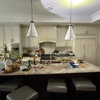
    Here's where our 2 ceilings meet after the first try with the texture paint. Look for a line just on the near side of the 2 rectangular openings for the pendants. After a little practice and a little more work, in our finished kitchen you can't see where the 2 ceilings meet at all. Don't actually have a picture of that, sorry.

  • 14 years ago

    Just one caveat: If your home was built in the 70s, have the popcorn tested for asbestos before you start scraping. It's not expensive, and you don't want to be breathing that in if it has asbestos in it.

  • 14 years ago

    The popcorn is not difficult to DIY scrap off. A nasty messy PIA job; but not difficult. If funds are available, well worth paying someone else to do...it's that annoying of a job.

  • 14 years ago

    If the popcorn hasn't been painted, it's not a horrible job to scrape it off. But most of the 1960's popcorn ceilings in our house have been painted, some several times. The paint prevents you from being able to easily wet the popcorn, which is the most recommended way for removal. We had to scrape off the tips, wet, scrape, wet, and work like heck. We've completed two small rooms ourselves (draping the room completely off with plastic, working wet, wearing masks, etc due to the potential for asbestos.)

    We are honestly rarely daunted by DIY tasks, but our particular popcorn was truly awful. In other rooms we're looking at getting bids for having new (thinner) sheetrock applied directly over the popcorn.

    I agree, the smoother ceilings look much more updated, higher, and cleaner.

    We have the exact same ceiling situation in our own kitchen (7 foot ceilings around a large flourescent light area.) If you have the time and energy, I would love to see photos of what you do.

  • 14 years ago

    Stipple isn't popcorn.

    My '50s house was textured and we had the new textured to match the old. If this can't be done, a smooth ceiling over the kitchen area isn't unusual in homes with texture, even if it just means a line of texture/smooth in the middle of the ceiling.

    If you like your texture, don't get rid of it just because it's trendy to be smooth. There's nothing wrong with it. Old houses have smooth plaster. New McMansions and their uninteresting contemporaries have smooth drywall. 20th century classics have texture.

  • 14 years ago

    I agree with Fori, and if it is not the heavy popcorn type texture, I'd sure consider just having the drywall guy match the old texture on the new drywall.

    I probably wasn't clear in my previous post...personally I think either smooth or a subtle stipple texture (like in suzannes1 pic above) can look great. It's just the big cottage cheese/popcorn stuff I'd rather not live with!

  • 14 years ago

    Lots of ideas here ...

    The stipple is the lighter texture not the popcorn. And the floorplan for the house is verrrry open with 18 foot ceiling stretching between both the ground and second floor and between second and third floor. I really don't want to scrape all the painted stippled ceilings just because they are all joined together.

    The revised kitchen could abut the stippling ... I am going to talk to drywall contractors to see what they suggest - I was just seeking ideas going in.

    This forum has already helped me a great deal a month or two back with my floor plan. I expect engineering drawing tomorrow on removing bearing walls and replacing with a steel beam built into the floor joists ... and then to get a building permit so actual construction can begin. Pictures will follow in due course.

    Regards ... Doug

  • 14 years ago

    We just did pretty much the same thing to our 70's kitchen
    - raising ceiling which housed flourescent lights and removed walls. Our ceilings were also stippled. My husband is a DIY and tried to match the stiple. We found out that it is almost impossible to do so.

    We ended up hiring a person who does drywall and he sanded down the stippled areas (not completely smooth) and reapplied mud and stippled the entire area. It looks great. I really don't mind having the stippled ceiling instead of smooth. In fact never really gave it much thought.

  • 14 years ago

    Interesting problem. Soon, I will need to remove a heavy stomp texture. From what I've read, the only remedy is to scrape it off with a broad knife (if it comes off easily) or sand with a large pole-mounted drywall sanding pad until texture is gone or reduced enough to allow a skim coat.

    Are there any other remedies anyone knows of? This stuff is not pop-corn that comes off with water.

Sponsored
Hope Restoration & General Contracting
Average rating: 4.7 out of 5 stars35 Reviews
Columbus Design-Build, Kitchen & Bath Remodeling, Historic Renovations