Software
Houzz Logo Print
theripetomatofarm

Aphid central.... At my wit's end...

11 years ago

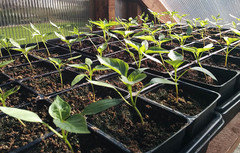
Every single over-wintering pepper I have is inundated with the green bastards. Currently, my farm is under review for organic certification. Because of this, I cannot use conventional spraying methods.

So far, I have tried diatomaceous earth and a homemade concoction of garlic, dish soap, and ground habanero sprayed in onthe plants. No success. Aphids everywhere. And with my new seedlings coming on, I'm worried that this could ruin my year.

Any thoughts?

Comments (21)

  • 11 years ago

    TheRipeTomato, I am willing to bet that those pepper plants will survive a lower temperature than those aphids can.
    I do not know how feasible or practical it will be for you to 'expose' the pepper plants, to a temperature low enough and long enough, to kill off the aphids without harming the plants.

  • 11 years ago

    Diatomaceous Earth will do little to control Aphids. Understanding about the life cycle of Aphids can be of some help in control as can an understanding of conditions that favor their growth.
    Aphids produce live young so knocking those you see off the plants with a sharp water spray means the next generation moves into the vacancy. Aphids are also attracted more to lush, green growth (excessive Nitrogen) so knowing what nutrients are available in the soil could be a help.

    Here is a link that might be useful: Aphid management

  • 11 years ago

    Perhaps if you used a commercial insecticidal soap, you would gain some control over the aphids. You don't have to use kitchen ingredients to achieve a Certified status.

    Have your water tested professionally so that you know what the pH is. Insecticidal soaps are most effective when mixed with a mildly acid water.

    The successful organic grower has to be informed and educated. It takes a lot of knowledge to grow healthy, pest free plants using organic means. Grabbing pantry items to make concoctions just won't do it.

    Explain your operation to us. Outside, inside, field grown, containers?

  • 11 years ago

    I have no idea why you'd try diatomaceous earth to control aphids, and if you're just randomly mixing your own spray concoctions that include "dish soap" (highly unlikely to be organic), I hope you're never certified!

  • 11 years ago

    Party, you don't much believe in educating, do you? It's not the least bit helpful to be so mean. I'm ashamed of your response.

    Our OP needs to be welcomed here, and free to come back for good advice and conversation without fear of unnecessary bashing.

  • 11 years ago

    rhizo, sorry, but I believe that a person who is currently going through the process of being certified organic should already be educated in what it is they're trying to do. Imagine a scenario where an inspector asks: "Have you used anything other than organic substances in your gardens?"... with what the OP has said, I believe their answer would be "no". :(

  • 11 years ago

    THeRipe,
    Go buy yourself some ORGANICIDE.
    You dilute it real good.
    Can be used for edibles.
    Kills whatever ails the plant.
    Safe, safe, safe.
    You can buy it at any big named store, like HD.
    Read the instructions, you will love it.
    It smells a little, but works great.
    Your welcome and good luck to you!

  • 11 years ago

    Thanks for the tips guys, I'll try the insecticidal soap.

    As for "party", LOL, do your research. I called COABC, the governing body for certification and THEY suggested the USDA Certified Biobased Product that I used. Thanks for coming out.

  • 11 years ago

    Rhizo, thanks for the info. Being in Canada, it is quite cool here now (6 degrees C) and everything is grown indoors. My indoor facility with all the seedlings is unaffected at this point, its just my 18 yearling pepper plants that have the aphids. All are in 3 gallon and 5 gallon buckets and can be moved outdoors, no problems.

  • 11 years ago

    Thanks butterfly. I contacted my COABC office again and they gave me a link to a product by Safer's that's actually OMRI-listed. I ordered 500ml of the concentrate, should be here tomorrow. Good stuff.

    Thanks again.

  • 11 years ago

    I have found aphids overwintering in fallow 'unheated' greenhouses amongst the weeds in the gravel. You would be surprised at how low a temperature an aphid can endure. It may decrease their rate of reproduction, but you will find they survive quite well in temperate zones and come back rebounding in spring. So, do not try to 'chill' them off a heat loving plant like peppers. There are organically approved pesticides for aphids. Just a head's up however to the O.P. I seldom had problems with aphids in winter because I started the 'closed up' season with scrupulously clean greenhouses. Totally vacated for the cleaning process, every trace of weeds removed, and close and careful scouting under the leaves and around the tender new shoots, where you'll see them first. They are a lot easier to address long before you reach the 'polluted' stage, if you find them just as they begin in one spot. Often just removing one plant out of the population and treating it will go far in stopping their spread. This also means inspecting all plant material coming into a greenhouse when you move them back in. So many growers have stock material or pets that are harboring the cooties and infecting the clean, new material.

  • 11 years ago

    Ladybugs love aphids, it's their favorite food! Ladybugs are one of the beneficial insects that help us control unwanted pests in our garden. My favorite hydro store sells 1500 for $8.95, I have provided a link to their website below.

    Here is a link that might be useful: Ladybugs

  • 11 years ago

    Sabrina, you must work for the company, right?

  • 11 years ago

    Thanks calliope, my only problem is, living in Canada, there is no "off season" for my greenhouse. I garden 365 days a year and the greenhouse in the winter is one of the liveliest places around.

  • 11 years ago

    If one were to read the article about Aphids I linked above one would learn that Aphids can, and do, survive cold winters.

  • 11 years ago

    Yup, that's for sure. I'm in Canada and they are surviving just fine.

  • 11 years ago

    Surely there is a time sometime in the year, when the greenhouses can go fallow? At least long enough for a scrub and complete weed eradication? I raised Poinsettias and that meant Easter lilies were cranking and being spaced out as Points were shipped, and then into bedding plants. No empty space in greenhouses for months on end, but dead summer anything in the g'houses went out to the shade house and I did a massive cleaning before mums went in to start spacing for fall. They're aphid magnets, with lots of foliage where bugs hide. Somewhere in the year, it really helps to immaculately empty and clean a structure and inspect everything (even newly shipped in plant starts) for infestations. IOW, I did winter crops too, and to keep them clean I couldn't allow any left-over bug issues to break out. You need to catch aphids before the g'house gets lousy with them, oh gosh it's easier to deal with then.

  • 11 years ago

    Calliope, you are always such a wealth of great, practical information.

  • 11 years ago

    That one came from the school of experience, Dorie. LOL It's false economy to think that you can't spare production time to not address sanitation. It's a time and money saver, right up there with daily scouting. Growers need to recognize the first signs of infestations, whether it be ants on their benches, sticky foliage, curled leaves and deal with it right there and then. No greenhouse gets lousy with aphids if they're found early and dealt with immediately. Oftentimes it means simply removing a couple plants and treating them, or pinching off a growing tip or some bottom leaves and then set aside in quarantine away from the crop until you're sure they're clean. It's almost impossible to spray crowded benches too with soaps or oils and get the 100% contact that is needed. Even fogging sometimes fails and systemics are not really an option for food crops as far as I'm concerned, especially if you're growing organic. I got militant about it going into winter season with the lily crops, because they hide inside the unopened bloom where you cannot see them, let alone treat them. They suck the life out of the crop, vector viral diseases and distort the blooms before they mature. If you've ever hand washed a thousand lilies you never want to do it again.

  • 11 years ago

    Yup, light spraying and removal of 2 plants, I am at full production now!


Sponsored
Peabody Landscape Group
Average rating: 3.5 out of 5 stars8 Reviews
Columbus' Reliable Landscape Design & Contracting