Software
Houzz Logo Print
bcfromfl

How does Bonnie grow 'em chunky?

11 years ago

Hi everyone --

Sorry if this question has been asked before.

I'm getting ready to start my seeds for 2015, and wanted to know how Bonnie Plants gets their tomatoes so chunky, with deep, blue-green leaves? The inter-nodal length is short, too, even comparing the same variety with mine, and their plants sucker/branch much better.

The reason I'm starting my seeds so early is because our season is so miserably short, that I want to have plants that are close to producing by the time I set in my tubs the first of April. What has happened in the past is that I have tall, leggy plants...that are strong and healthy...but don't bloom well and set fruit early. Doesn't matter how much light I give them, or what kind of fertilizer. I can never get them to look like Bonnie's, which would be perfect.

Last year, despite me loading them up with bloom-booster fertilizer (12-55-6) after they were big enough, I got very little fruit set before the plants began getting ugly in July.

Thanks for your input!

-Bruce

Comments (40)

  • 11 years ago
    last modified: 11 years ago

    Stout plants are great. Bonnie has many people growing for them, so practices probably vary somewhat. If you are observing deep green leaves for anything that is not obviously a seedling, I'd take the flying guess that they are rooting them from plants that have been grown in full Sun. If not, they would justy have intense light ... so the plants don't go reaching for more. It is the light that will determine the deepness of green for a given variety, as well as how stubby or long it grows. A rooted cutting gives you a plant they has that sort of leaf if grown from a healthy mature plant, and maybe even flowers too.

    PC

  • 11 years ago
    last modified: 11 years ago

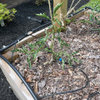
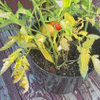
    Here are some sprouted from Supermarket tomatoes.

  • 11 years ago
    last modified: 11 years ago

    Ahhh.....I never thought of that. So they might actually be started from cuttings, which would explain the advanced behavior from a relatively smaller plant.

    Nice stem on your plant, garf.

    =Bruce

  • 11 years ago
    last modified: 11 years ago

    Bruce, This may sound silly, but I'm being serious. Do you pet your seedlings? By petting, I mean running your hand back and forth over them. I have found that petting them makes them stouter and stronger. I do this after I wake up in the morning, and of course check for water at the same time, and a few times during the day and of course before bed.
    Some people run a fan or might say it is the same, but it isn't. With a fan, it is only one direction, it can lower the air temp, and it can lead to neglect as you don't have to check on them as often. Plus you are wasting electricity.
    Remy

  • 11 years ago
    last modified: 11 years ago

    Thanks for the tip, Remy. At this point, I'm open to any and all suggestions! I remember once reading about someone who pinches the tender stems to bruise them slightly, to reach the same effect. I think I like your idea better!

    Nice plants...nice plants.... ;-)

    -Bruce

  • 11 years ago
    last modified: 11 years ago

    Lol, the talking won't hurt either :)

  • 11 years ago
    last modified: 11 years ago

    Remy - I have to say the petting is a new one on me! Admittedly, I always talk to my plants - but then, I always talk to just about everything...except some people if I can help it. :) And I do often stroke some of my plants and trees while I'm talking to them, but I figured that was just me being me. Like when I thank the broccoli and send it feelings of love for its sacrifice as I chop it's little head off! Is there some scientific reason for the petting? I can sort of see it, but I'd like to hear a more detailed explanation if you know it.

    - Alex

  • 11 years ago
    last modified: 11 years ago

    It has been posted before on other sites that they use both cold treatments and growth inhibitor and, obviously, a lot of fertilizer. One person who posted that information said he knew someone who grew tomato starts for Bonnies.

  • 11 years ago
    last modified: 11 years ago

    I don't think they start from cuttings. It is not an economical way to do it a mass production.

    I would say that firstly they know the tricks of the trade. I guess that at some point keep the temperature down/low while providing a lot of light. Secondly, grower use a lot of fertilizer and push their plants.

    Seysonn

  • 11 years ago
    last modified: 11 years ago

    Alex,
    Touch does stimulate them in a good way, makes the stouter and stronger. I started doing it many years ago as I thought they needed movement to be stronger. Petting them would be like them being outside I though. I didn't like the idea of a fan for a few reasons. Fans first off waste electricity, they lower the temp of the air, they just blow the air one way on them, and they can lead to neglect (I know some people are thinking how could anyone neglect their babies?! lol) I just felt it was a good cheap way to keep them from getting leggy and also visit them often every day. If you are visiting them often, you will notice if they need water/have too much water too. (I just realized I repeated a bunch of what I said in a previous post, oops.)
    Anyway, come to find out it has been scientifically studied! Plants do respond to touch. It is called Thigmomorphogenesis.
    Remy

    Here is a link that might be useful: Study showing beans seedling will be shorter and thicker with touch

    This post was edited by remy on Sat, Dec 27, 14 at 15:00

  • 11 years ago
    last modified: 11 years ago

    Remy - thanks for the link! That was pretty interesting, and I am sharing it with other gardening friends. :)

  • 11 years ago
    last modified: 11 years ago

    You're welcome :)

  • 11 years ago
    last modified: 11 years ago

    Thanks to Fusion for the GREAT growing tips!

    I'm not sure that I would want to lose 10 days of growth with my shortish growing season, but I might try it with one or two seedlings.

    Linda

  • 11 years ago
    last modified: 11 years ago

    Fusion, I always go light on the water. I knew it was better than too much water, no harm done if they get a little dry. I did not realize that I was actually helping the plants in the long run!
    you learn something new every day :)
    Remy

  • 11 years ago
    last modified: 11 years ago

    Linda, no problem, just start your seed 10 days earlier. It is well worth the effort once you see how much production is increased.

    Remy, overwatering kills more tomato seedlings each year than all other causes combined. Keeping tomatoes what we humans think of as "well watered" encourages phytophthora and rhyzoctonia and other fungal bad guys to take over and kill the plant. Under watering keeps the plant roots healthy and expanding and deprives phytophthora of the moisture it needs to live.

    This post was edited by fusion_power on Sun, Dec 28, 14 at 17:34

  • 11 years ago
    last modified: 11 years ago

    Excellent info Darrel. It is easy. Unfortunately the 2 most important factors needed, dedicated cool temp control and a great light supply isn't possible for most who start their seeds at home unless they have a greenhouse.

    But that doesn't mean they can't start some quality tomato plants from seed. You just can't do it using window light and in a warm room.

    Dave

  • 11 years ago
    last modified: 11 years ago

    Excellent info, Fusion and Remy! And thank you, Bruce, for initiating this thread.
    - Alex

  • 11 years ago
    last modified: 11 years ago

    Fusion, thanks for great info!
    Have done most of it out of necessity... I have been banned to glass porch with my seed starting, which is not heated... once I got stocky short thick stemmed seedlings I said to myself "gotcha!" and yeah, couple of occasions I got them pretty wilted, it is important to catch it as they just go into wilting stage, and once seedlings at cold treatment stage- watering very sparingly is most important as damp off is right there waiting... No thermometer here either- door is open to living room on really cold nights and people/ dogs are moving past shelves all the time too...I would probably be more scientific with it if I had grown for market though...
    Have to add that expecting full productive potential in short summer areas like mine may not be possible so I settle for seedlings that slightly over 12" when planting and if they have started fruiting I do not remove it. Short summer- get anything you can motto, does seems to work well.

  • 11 years ago
    last modified: 11 years ago

    Thanks, fusion, for the great tips! I'd like to ask a bit more about the rootbound issue. Out of necessity, because of a possible late-March frost, I'll have to keep my plants in pots until transplanting into tubs...but I'd like to get them as far as they can be by that point. Would it be a bad thing to have a two-foot tall plant in a six-inch pot?

    I think I'm recognizing some issues I've had in the past by reading your excellent post. Most notably, keeping my plants probably a bit too much on the warm side. I'll definitely try the stressing techniques you suggested!

    -Bruce

  • 11 years ago
    last modified: 11 years ago

    Very good info and tips. Thanks Darrel.

    On the feeding/fertilizing I am not quite clear. Some new theories have emerged that say a fertilizer with a 3-1-2 ratio is near perfect for most plants.It also says that Ca and Mg should be present. If you look at MG fertilizers composition, you will see that they are in 3-1-2 ratio. The logic behind it is that plants use 3 times as much Nitrogen than Phosphorus. and twice as much as Potassium. There goes the old concept of 10-10-10 as being All Purpose fertilizer.

    Seysonn

  • 11 years ago
    last modified: 11 years ago

    A 6 inch container is too small for a 2 ft tall plant. I grow large plants in 1 gallon containers and try to get them to 18 inches tall by transplant time. This takes about 12 weeks from seed planting.

    I've been successful using several different fertilizer formulations, but have found that seedlings go off kilter if too much nitrogen is in the mix. I would avoid 3-1-2 ratio fertilizer for this reason. The problem comes in with the seed start mix being used. If it is a pre-fertilized mix such as Pro-Mix, then only minimal fertilizer is needed hence the 1/4 teaspoon for 48 plants that I mentioned above. If you are growing in coir, then you will need a balanced fertilizer with micronutrients because coir absorbs nitrogen as it decomposes and it has very little in the way of boron or magnesium.

    The best seedlings I've grown were a mix of 2 parts worm castings, 2 parts peat moss, 1 part perlite, and were fertilized with manure tea made from bird guano. The guano is high in nitrogen with a 12-12-2.5 ratio. The reason it works is because the worm castings are low in nitrogen and the peat moss absorbs excess nitrogen as it decays.

  • 11 years ago
    last modified: 11 years ago

    Thanks much.

    The ratio (3-1-2, 1-1-1 ..)is a different issue that the amount supplied. So when I use a 1/4 -1/3 strength of a liquid 12-4-8, every two weeks in seedling stage, there wont be a killer amount of N.

    On the mix : I use my own soil less mix. So I add calcium and Magnesium ( in small amounts). I get Mg from Epsom salt and Ca from egg shell ( eggshell + vinegar >>> Calcium Acetate + H2O + CO2). I do this because liquid fertilizers that I know/use do not have Ca and Mg.

    Sorry for going off the topic.

    Seysonn

  • 11 years ago
    last modified: 11 years ago

    Thank you Fusion, excellent tips! Love that seedling recipe and hope to try soon.

    Great question Bruce and you had great answers, I am sure a lot of us learned from it. It comes in handy especially for us living in FL and starting the seedlings....

    Silvia

  • 11 years ago
    last modified: 11 years ago

    Silvia, if you use the mix I mentioned above, please be aware that it has to be steam sterilized. I tried repeatedly with unsterilized mixes and failed miserable about half the time because the worm castings are loaded with phytothora. The way to steam sterilize is fairly simple. In a large stainless pan, put about 1 inch of water, then put a pie plate upside down so the water is beneath it. Then fill the pan up with the seed start mix, put on a lid, and turn on the heat. Get it to the point of steaming and keep it just above boiling for 30 minutes. This will sterilize the mix and it will produce healthy seedlings.

  • 11 years ago
    last modified: 11 years ago

    Thank you Fusion for taking the time to explain all the details, I admire very much people like you who take their time to share their knowledge.
    I guess the recipe was a little more complicated that I thought, but if I try I will do according to your advice, thank you again.

    Silvia

  • 11 years ago
    last modified: 11 years ago

    Wow... what a wealth of information in this thread.

    Two questions.

    1. Is there any benefit to using slow release fertilizer over liquid with seedlings?

    2. I know that hardening off is essential, but what is the best method to use to maximize plant growth and production and to minimize plant stress?

  • 11 years ago
    last modified: 11 years ago

    Bright full-spectrum lights very close to the seedlings. And possibly lights on the sides.

  • 11 years ago
    last modified: 11 years ago

    And yes there is the movement thing. One year, I set a occiilating fan to blow on my tomato seedlings AND brushed them several times daily. Movement of the seedlings thickens the stems. Best I ever had. But it takes a lot of effort. And I think they get enough of that when transplanted outside to make up for it.

    But I'll give mine some shakes and brushes this year just remembering about that. Sometimes you forget good habits.

  • 11 years ago
    last modified: 11 years ago

    Smithmal,
    1. Seedlings do not need fertilizer. They have everything within the seed they need to get growing. I do not fertilize them. Sometimes after they've been growing for awhile, maybe a month, some people see a need for a very weak application of fertilizer, but that's only if the seedlings show signs of a deficiency.
    2. Not sure what you mean. You do need to do it slowly for best results, but are you seeing conflicting info somewhere?
    Remy

  • 11 years ago
    last modified: 11 years ago

    After a week, seedlings expect some nutrients...

  • 11 years ago
    last modified: 11 years ago

    Well, we can respectfully disagree. I've been doing this for a very long time, and I have never had to fertilize my seedlings. (I'm talking about while they are still small inside.) I always tell people you can with a very weak solution if they show signs of needing it. If they look good, don't do it.
    I believe more damage is done to seedlings by over watering and fertilizing when they do not need than neglect.
    Remy

  • 11 years ago
    last modified: 11 years ago

    About Fertilizing Seedlings:

    We know that seeds have some supply of the nutrients, for the sprout grow few leaves and some root. At that point they are set to start the process of photosynthesis and absorbing nutrients through the root system. Most seed starting media (MG, Jobs ,..) already have some nutrients, though very weak. That is why there is no need for fertilizing right away. BUT i make my own mix ( pine bark fine + perlite). They have ZERO nutrients. So what I do is to add very very light fertilizer (1/4 to 1/3 strength) to the soil that I transfer seeds from paper towel.

    So when you use potting soil, garden soil, starter mix,.. you don't have to fertilize your seedlings.
    That is my take on the subject, anyway.

    Seysonn

  • 11 years ago
    last modified: 11 years ago

    OK, 2 weeks. I meant after they were up and growing. And I water mine with fishtank water which is a weak urea (nitrogen) fertilizer and probably a few minor nutrients.

  • 11 years ago
    last modified: 11 years ago

    Smithmal, as mentioned above, commercial mixes are likely to have slow release fertilizer in it anyway. Providing all things done right you should not need much at all.
    I use promix which contains trace of nutrients. Seedlings do not need much of ferts, few drops go long way. From about period when you have first true leaves set till planting you can use liquids, which are better for immediate intake IMHO. Very small amount is to be used, literally drops. There is science behind it, and commercial growers can give all proper calculations, am just home grower.
    I like Neptune products, have used Dr Earth and Foxfarm.
    Lately I am into mixing my own, from Neptune Fish fertilizer and kelp, with molasses, sea salt, humic acid, worm castings, efficient microorganisms EM. I have taken Phil Nauta gardening academy and much enjoying tinkering with my alchemy LOL

    Here is a link that might be useful: organic fertilizers

  • 11 years ago
    last modified: 11 years ago

    If you start with a commercial mix like Pro-Mix BX that is pre-fertilized, then no additional fertilizer is needed for at least 4 weeks. The reasons include that the pre-fertilized soil mix is also PH balanced and if you fertilize, you will most likely acidify the mix which reduces plant growth. Once the seedlings reach 4 weeks from seed planting, I encourage a very week fertilizer application to boost final growth. As stated earlier, I use 1/4 teaspoon of fertilizer to feed a full tray of 48 plants. This is more than enough but not so much that it triggers nitrogen imbalance.

    If you start with an unfertilized mix such as Seysonn mentions, then it is imperative to add some fertilizer right from the start. Most fertilizers also acidify the soil so a bit of lime should be added too. The way I do this is to mix 1 cup of dolomite lime with 10 cubic feet of loose soil mix.

    The fertilizer is best applied as a liquid to the soil mix to wet it for plants. I prefer to do this by mixing 1 level teaspoon of fertilizer per gallon of water, then apply 1.33 quarts to each tray of seed start mix. I am using standard 11" X 22" cell trays (1020NH from Morton Products). Coir and pine bark fines are two very common starting materials for seed that do not contain any appreciable amount of fertilizer.

    It is important to me to apply the fertilizer in the bottom of the tray and let it wick up into the soil mix. This does 3 things that are important for the plant. First, it encourages the plants roots to grow downward into the denser nutrients at the bottom of the tray. Second, it avoids exposing the seed to excessive quantities of nitrogen which can sometimes cause problems with germination. Third, it keeps nitrogen off the surface of the soil mix where it can cause algae and fungi to grow. The algae and fungi are not necessarily a problem, but I've found that pepper seedlings really don't like to grow in soil mix that has a lot of other things in it.

  • PRO
    11 years ago
    last modified: 11 years ago

    I'm going to go back and read up on all the great tips. But I wanted to put in my two pennies too.

    I usually get rather healthy seedlings.

    I start out with a 2x2 pot. Then when the first true leaves really show, plant deep into a 4x4 pot. Then when they start chunking in that, transplant deep again into homemade pots that are half gallon juice jugs with the tops cut off. I try to encourage a lot of root formation.

    While all this is going on, I have them in my solarium, which during the spring growing, hits those nice chill temps, but not too chilly. If it promises to get too chilly, I put them into a mini greenhouse with the bottom lined with milk jugs full of hottest tap water. I have a fan on a timer so they get a few hours on and off breeze during the day- but not all day or no breeze at all.
    When I go to harden them off, I put them on the porch where they get a little screening from the deep eves from the full sun to prevent scorch, and some protection from the wind which might be more powerful than my fan. I bring them back in at night for the first few days... and of course if really bad weather is supposed to hit. Then I put them out for a few more days off the porch to get regular elements. Then I finally plant em deep in the garden.

    The fertilizer I use is the couple gallons I drain off my aquarium when I do it's weekly cleanings. And my regular tap water, since I live in the boonies and have untreated hard water. And sometimes water from my indoor pond in my solarium- which is just run with a pump, no chemicals or other treatments in it.

  • 6 years ago

    @fusion_power you seem to really know your stuff. Any thoughts on topping vs not topping pepper plants and to prune or not to prune tomatoes?

  • 6 years ago

    Not sure if you are asking a legit question or if you are just trying to generate traffic on the site. Regardless, topping pepper plants should only be done when preparing them to overwinter indoors and then only if they have time to grow several new stems before cold weather sets in. There are generally no other conditions where topping a pepper plant is useful.


    Pruning tomatoes is useful if growing on stakes where a single leader will be trained up the stake and allowed to produce fruit. For most other culture methods, it is better to let the plant produce as much foliage as possible so it can support a heavy fruit load.

  • 6 years ago
    last modified: 6 years ago

    Well, I'm loving this thread. I have tried the seedling thing inside in January here in our mild climate, but they are all spindly and bad. What I want is very large plants to set out deep with a handful of rock phosphate at the bottom of the hole, and keep adding soil as they grow, which encourages more roots.

    Previously I have planted seeds in the ground late March, so no way can I plant them deep. This year, in September, I'll try rooting some cuttings in water, then growing them in containers that can go outside during the sunny times, and inside at night. We practically have sun all year, so unless it's a freeze, I'll take them all outside so they get real sun. Always fun to experiment.