

Do I have natural original Chlorophytum comosum?
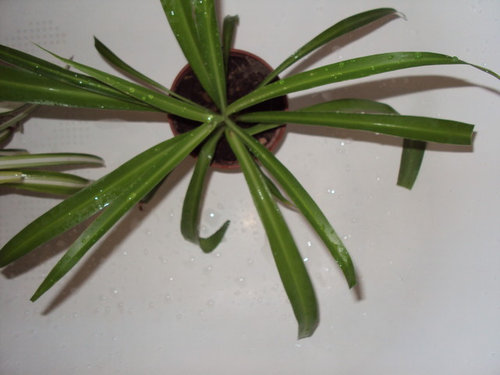
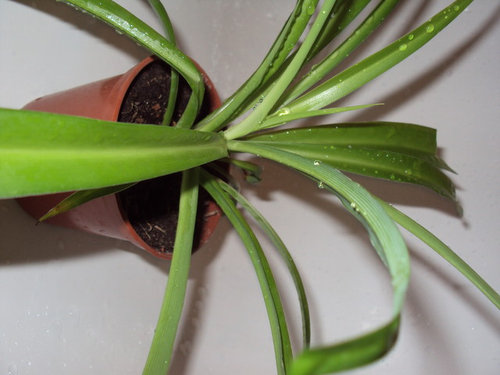
I have bought Chlorophytum comosum but I don't know this is natural original Chlorophytum comosum? I mean, is this original Spider Plant (Chlorophytum comosum) that grows in Africa or not?
Comments (16)
 11 years agolast modified: 11 years ago
It appears to be the solid green ancestral form, but one can't always know what genes a plant carries just by looking at it. There is a solid green variety that has leaves that curl strongly in direct sun. Without enough sun to curl the leaves, it looks just like the ancestral form. Yours is probably the normal green form, but you can't be sure.
dert17 thanked kwie2011 11 years ago
Doesn't (correct me if I'm wrong) the original spider plant have yellow green lines running down the middle of the leaf?
Like kwie said yours looks like the normal green... Which is hard to find well at least for me but I have an endless supply of them from my plant.
dert17 thanked MrBlubsRelated Professionals
Wilmington Landscape Architects & Landscape Designers · Longview Landscape Architects & Landscape Designers · Norfolk Landscape Architects & Landscape Designers · Lancaster Landscape Architects & Landscape Designers · Montréal Landscape Architects & Landscape Designers · Lafayette Landscape Contractors · Cincinnati Landscape Contractors · Jackson Landscape Contractors · Virginia Beach Landscape Contractors · Rockford Landscape Contractors · Poughkeepsie Landscape Contractors · DeRidder Interior Designers & Decorators · Raleigh Interior Designers & Decorators · Erie Interior Designers & Decorators · Modesto Interior Designers & Decorators- 11 years ago
The ancestral form is solid green, but under some conditions the central rib of some leaves can appear lighter than the rest of the leaf. It is very subtle, and IMO, a trick of the light that appears in some photos. Some of my own have appeared that way in photos when in fact they are entirely green.
dert17 thanked kwie2011 
dert17
Original Author11 years agolast modified: 11 years agoThank you for your answers. Your answers was important for me.
Ok, maybe it's solid green ancestral form. I have bought this plant in Saint Petersburg Botanical Garden. I don't think that it's something like "solid green variety that has leaves that curl strongly in direct sun".
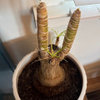
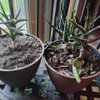
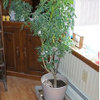
But I'd like to know about original spider plant in Africa. Let's see this photo. This photos are from Africa.
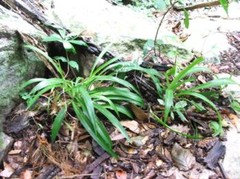
1. This is original spider plant but But I do not know where this plant grows (country)
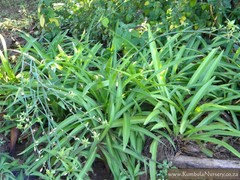
2-3. This original spider plant (Chlorophytum comosum (Thunb) Jacq). This plant grows in Zimbabwe. I'm sure in that. Do you see difference between my plant and this plant?

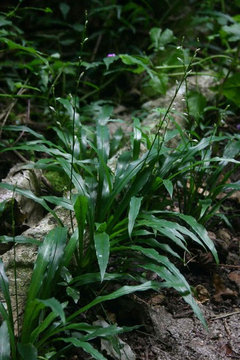
4. This original spider plant. This plant grows in Southern Africa. Do you see differnce between my plant and this plant?
I have some questions.
1. Why do not Chlorophytum comosum in
Zimbabwe look like Chlorophytum comosum in
Southern Africa? I mean I see the difference between them.2. Does my Chlorophytum comosum grow in Africa today? I mean if I want to have 100 percent original African Chlorophytum comosum, do I have to buy African natural Chlorophytum comosum or my Chlorophytum comosum is 100 percent original African Chlorophytum comosum?
3. We have Chlorophytum comosum var. Vittatum. Was Vittatum made from Chlorophytum comosum in Zimbabwe or from Chlorophytum comosum in Southern Africa?
4. Do you see difference between my plant (Chlorophytum comosum, solid green form) and plants on photo 1,2,3,4?
5. "I don't know whether it's true, but there is an Internet rumoe that
chlorine, boron, and other chemicals in tap water are toxic to spider
plants. Brown tips are what they usually blame on it, but...maybe. The
problem I have with reading something like that on the web is that it
gets published in one place, and everyone else copies it whether it is
true or not, so just because it's repeated in many places doesn't mean
it's true. I'd have to see original research to trust it, but if your
problem spreads or continues after reporting, that's something to
consider". kwie2011 wrote it.Does sometimes natural original African Chlorophytum comosum (I mean plant that grows in Africa) have Brown tips? If yes why?
 dert17 thanked Tiffany, purpleinopp Z8b Opp, AL
- 11 years ago
I can't answer all your questions, but I can tell you that the 2nd and 3rd photographs are not C. comosum. There are many species of Chlorophytum, and that looks like it probably is one, but it isn't comosum.
The first photo certainly looks like C. comosum. I can even see stolons connecting plantlets. The 3rd photo could be C. comosum, but then, it could also just be grass. The quality isn't good enough for proper identification on my small screen, but I doubt that is a photo of it in habitat, or even in Africa. I see what look like Birch leaves on the ground around it - not native to Africa, and I can't be sure, but I think that's a little bit of Virginia Creeper growing behind it - also not African. I'm less sure of the photos above it, but the fern looks alarmingly similar to Western Sword Fern, and the downed tree also looks like Birch. I suspect all those photos were taken in the US, but I'd need larger images for better ID of adjacent plants.
Photographs aside, you will find that growing conditions make a big difference in how C. comosum looks. It can have very skinny leaves, relatively wide leaves, various shades of green (or white/cream in variegated varieties), and be anything from small to very large, flat to upright. It makes it difficult to distinguish between cultivars. To further the difficulty, people often call any species of Chlorophyrum a spider plant, but they shouldn't. Chlorophytum amansiense 'Fireflash' is one common houseplant often called a spider plant when it isn't. It's growth habit is something like that of your first two photos, but wider, and of course, orange. Only C. comosum should be called a spider plant because it was named for all its "legs" (stolons with plantlets). I think it is the only species that reproduces this way.Yes, C. comosum still grows wild in Africa (Zimbabwe is in Southern Africa; it shares a border with the country of South Africa). And no, you can't tell the entire genome of your plant by looking at it. Even if you could, you likely still wouldn't know its ancestry because variegated spider plants are chimeras, that is to say they carry more than one set of genes. The variegation isn't carried over into seedlings. Seedlings are green even if they come from variegated cultivars. This is true of many variegated plants, not just Chlorophytum. You won't ever know if your plant came from a variegated cultivar or if it's heredity is directly from the ancestral form, but I can't imagine why you'd care since they're identical in every way.
Many things cause brown tips, including dry roots, so yes, wild c. comosum can get brown tips. Any plant can.dert17 thanked kwie2011 - 11 years ago
My internet is out at home, so I might not be able to post again for some time. Hopefully you've got enough info there. To learn more about chimeras, Google "chimerism in variegated plants" or "genetics of variegation in Chlorophytum" or something similar. It is a complicated subject and you'll need to be ready to learn some real genetics though.
dert17 thanked kwie2011 dert17
Original Author11 years agolast modified: 11 years ago"What is the source of the other pics?"
Sourse here: http://www.zimbabweflora.co.zw/speciesdata/image-display.php?species_id=113340&image_id=7
Synonyms:
Chlorophytum brevipes Baker
Chlorophytum gazense Rendle
Chlorophytum sparsiflorum Baker
Common names:Frequency:
Locally frequentStatus:
NativeDescription:
Slender perennial herb. Leaves basal, narrowly lanceolate, tapering
at the base into a pseudo-petiole. Inflorescence a lax unbranched spike.
Flowers widely spread, small, white with spreading tepals; anthers 6,
yellow.Derivation of specific name:
comosum: with tufts formed from hairs, leaves or flowersHabitat:
In shade on the forest floor of evergreen forest, often in colonies.Flowering time:All year round
Insects associated with this species:
Spot characters:
Display spot characters for this species
Content last updated:
Sunday 5 February 2012
Ok, I see my mistake. Photo 2,3 is not Chlorophytum comosum. It's Chlorophytum brevipes Baker, Chlorophytum gazense Rendle, Chlorophytum sparsiflorum Baker .dert17
Original Author11 years ago"I can't imagine why you'd care since they're identical in every way"
Maybe someone will send me original native Chlorophytum comosum from Africa. I don't know he will do it or not, but anyway I have to explain to him how to find this plant (I need to find very good photo of this spider plant). And I don't have now this photo. I will try to find this photo and I will send it to him.dert17
Original Author11 years agolast modified: 11 years ago"What is the source of the other pics?" Tiffany, purpleinopp GardenWeb, Z8b Opp, AL wrote it
Let's see this: http://www.zimbabweflora.co.zw/speciesdata/image-display.php?species_id=113340&image_id=1
Name: Chlorophytum comosum (Thunb.) Jacq.
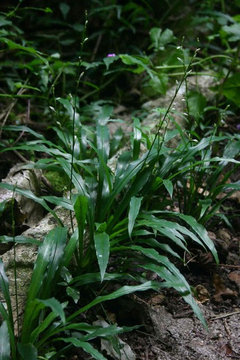
This is sourse
Date:
15 Feb 2005Recorder(s):
MA Hyde
BT Wursten
Photographer:Collector(s):
Determiner(s):
Confirmer(s):
Herbarium:
Habitat:
In deep shade in montane forest by pathLocation:
Castleburn ForestOuting code:
Planted code:
Not plantedCountry:
ZimbabweQuarter Degree Square:
1932B2Grid reference:
VP758858FZ Division:
EAltitude (metres):
1630-------------------------------------------------------
-------------------------------------------------------
Name: Chlorophytum comosum (Thunb.) Jacq.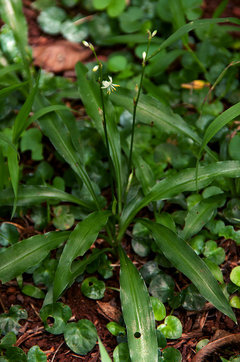
Sourse:
http://www.zimbabweflora.co.zw/speciesdata/image-display.php?species_id=113340&image_id=7
Record details:
Date: 25 Dec 2011
Recorder(s): MA Hyde
BT Wursten
P Ballings
Photographer: BT Wursten
Collector(s):
Determiner(s):
Confirmer(s):
Herbarium:
Habitat: In shade of large Ficus
Location: Camp site, Chirinda Forest
Location code(s): 6
Outing code: 10
Planted code: Not planted
Country: Zimbabwe
Quarter Degree Square: 2032B3
Grid reference:
FZ Division: E
Altitude (metres): 1160
Notes:
Latitude: -20.410460
Location accuracy code: 32.699600
Location accuracy code: 7---------------------------
---------------------------
I see name "Chlorophytum comosum (Thunb.) Jacq.". Maybe this is real original Chlorophytum comosum or not?
What does mean "(Thunb.) Jacq."? If this is a natural African spider plant, why is it so different from my solid green form?
- 11 years ago
"1. This is original spider plant but But I do not know where this plant grows (country)"
The photo is marked as coming from this nursery in S Africa. Is that any help? http://kumbulanursery.co.za/plants/chlorophytum-comosum
dert17 thanked floral_uk z.8/9 SW UK - 11 years agolast modified: 11 years ago
Again, I suspect that isn't C. comosum. It looks like a different species that the photographer and/or web site identified incorrectly. As you can see, the plant wasn't collected, and the ID wasn't confirmed. It's just a photo of a plant that the photographer, Wursten, saw in a campsite and thought was C. comosum. According the site, no one fact-checked that. See those dark green or black stolons sticking straight up with flowers on them? Most Chlorophytum produce flowers in such a way, but C. comosum has green stolons that also carry plantlets. It's leaf is also more strap-like without the very narrow base/pseudo-petiole, BUT growing conditions make a big difference. Light, soil type, available nutrients, water, crowding, length of growing season, grazing, and many other things affect the growth of not just C. comosum, but almost any plant. I'd have to see more of that photo to be sure it wasn't C. comosum, but even if it is, the difference in appearance is likely growing conditions, not genetics. Once it's growing in your home, it'll look like any other potted spider plant.
Try a Google search of "Chlorophytum comosum in habitat," but be careful because people make mistakes. You might also try some Google Scholar searches using the genus and species name. Perhaps there will be photos included in some research papers.
It's been too long ago for me remember the websites, and I don't have time to search for you now, but I have seen numerous photos of wild C. comosum growing in habitat and it is identical to the green houseplant.
The annotations you ask about refer to the person who originally discovered/classified/named the plant: a French scientist named Jaques in 1862. The truncated name in parenthesis refers to a previous identification that was probably dropped. I don't know the name, but a Google Scholar search for "Chlorophytum comosum taxonomy" should find it for you.
http://eol.org/pages/1086761/literature
Here are some more places where it grows native:
http://www.ars-grin.gov/cgi-bin/npgs/html/taxon.pl?10301
This is all information you can find yourself on the Internet or in a library.
dert17 thanked kwie2011  11 years ago
From what I understand, comosum comes in...
- C.comosum 'Vittatum' (Green edge)
- C.comosum 'Variegatum' (White edge)
- C.comosum 'Green Bonnie'
- C.comosum 'Variegated Bonnie'
- C.comosum (Original wild species)
There are also some other disputed types, like ocean, but I think that one is just a sub variegatum.
- 11 years ago
Don't forget 'Hawaiian', Rhame. It is both variegated and solid green in a single plant. You're correct about Ocean. It, like Pacific, Atlantic, Silver Surfer, and others are just minor variation(s) of C. variegatum.
 last year
Sorry it took me 9 years to stumble upon this post. I am a trained Horticulturist and in my professional opinion that plant from Zimbabwe looks like a Chlorophytum modestum and if found ouside of its known native range might either be a disjunt population or an accidental introduction as a non native species.

kwie2011