Software
Houzz Logo Print
skyjumper_gw

where to prune these maples?

11 years ago
ugh what happened to GW??

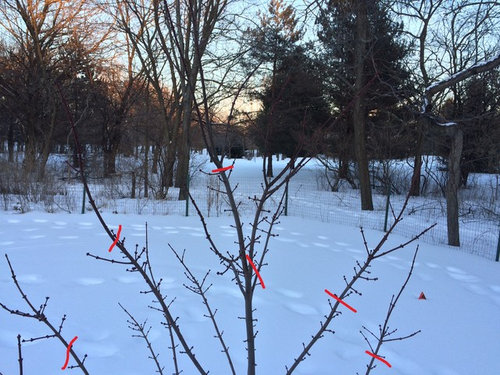
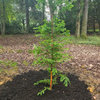
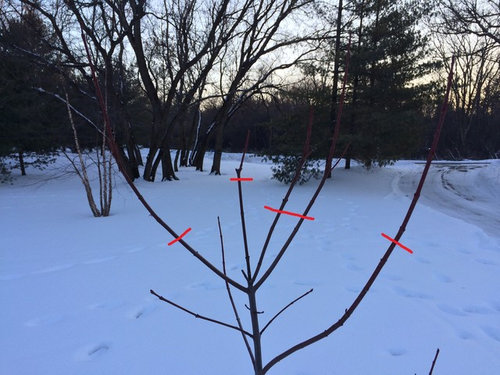
anywho - need some advice on where to prune these maples that I planted from seed when my two boys were born. I put red lines where I think they should be pruned. what do you guys think?

what is the best time of year to prune? this weekend?


Comments (16)

  • 11 years ago

    Why do you want to cut those branches in half, what do you want to accomplish?


  • 11 years ago

    i'm trying to encourage a stronger central leader, at least until they get a little taller. first pic if I don't do something the central branch will get swallowed up by the side ones and that will be where the tree branches out --- 3 feet off the ground.

  • 11 years ago

    What kind of maples are these? I hear with some this can be an uphill battle.


    I would prune the co-dominate leader back and probably the lowest ring of branches. make sure your cuts are good and the proper stubs left just outside the branch collar.

    What is the term guys for a tree which likes to grow w/o a central leader and which maples do that?


  • 11 years ago

    the first is from an Autumn Blaze. the second is pure Red maple. the Red got chomped to the ground by deer when it was 2yrs old.

  • 11 years ago

    i think you are trying to prune them into what you see in larger potted plants at the big box store ...

    first pic.. it LOOKS like you are shortening the leader ????

    i would take a lower branch or two.. and let these extremely small trees.. sort them selves out ...

    in effect.. it looks like you want to top them .. and i dont know why

    most trees do not have a central leader ... but you can do whatever you want.;. to the extent of your ladder and pole saw ... but thereafter.. they will do what they want ...

    ken


  • 11 years ago

    yes, the first pic I was going to take a couple inches off the leader for 2 reasons (which may be flawed) --- first, to head off a co-dominant that looks to be forming, and second I read that pruning will cause a flush of fast growth in spring, and I'd like that leader to take off. If I am mistaken please tell me so.

  • 11 years ago

    No, no, and no. You really need to learn more about structural pruning, leader training, etc. before taking saw to those poor little guys. I know, you want those answers here, right now! I'm not up to the task of explaining this important concept that very few understand, right here and now. But please, don't do those heading-back cuts as you've indicated. They will only make matters worse.

    If you are able, look up Ed Gilman's work at UW-FL. Under the heading of "subordination pruning", you will get the info you need, to start making informed choices. And yes,' Autumn Blaze' is a cultivar which indeed benefits by having nearby a person who understands such matters.

    +oM

  • 11 years ago

    Skyjumper, I might have been a little too quick to respond earlier. I've been at a conference and was sort of flying through the eight or ten gardenweb forums I subscribe to, but anyway, with the exception of the actual center-most leader in the first pic, you could in fact shorten up all others, to achieve the goal you mention. Don't cut the very one you want to assume the leader role. When you cut back branches, they slow down. Since that one, which is as you say being engulfed by the branches around it, is the center-most, you want it to be boosted, not held back. Cutting back the others will help achieve that goal. There's just two more things I want to mention: First, all of the other branches are "temporary branches", that is, when the tree is full-grown, those branches will have been removed. That is the reason-and the only reason- why you can literally stub them back without fear of decay setting in....They're going to be gone someday anyway. If you were working in the "scaffold branches", then all proper technique would be called for, since you don't want to set the branch up for a decay pocket. But these are not those....these will someday be removed.

    The only other thing is, young trees need their foliage, to produce the carbohydrates that the plant lives on. However, in my rather vast experience with AB maples, nothing much is going to hold them back. If anything, they grow too fast, kind of getting away on you. As they continue to grow, watch for the development of V-crotches. This tree is very prone to such branch connections, which in time become inherently weak and poorly attached, with included bark. Your heading-back cuts, but now done properly and always to a branchlet, will aid in preventing or at least mitigating those. And yeah, Gilman's still got the best explanation for all of this stuff I'm trying to describe!

    +oM

  • 11 years ago

    So the tree in the first pic is a seedling from an Autumn Blaze? No telling what form it may take since the parent is a hybrid.

  • 11 years ago

    tom - thanks for the reply. I took your advice and looked up Gilman's pruning guide. some great tips in there. for the first tree it looks like I have no choice but to perform heading cuts on the side branches if I want to subordinate them -- they don't have any laterals at which to do reduction cuts. it's either that or prune them back to the trunk? but to your point all those branches will eventually come off anyway.

    the second tree (red maple) is a bit more complicated. the leader is bifurcated with a V notch, and neither leader is very straight. I suppose I'll just prune back the small one at the split (the one red line in the photo) and leave the larger one alone, even though it's not going straight up.

  • 11 years ago
    last modified: 11 years ago

    Yes, reduce the length of whichever one you select to subordinate. BTW, when there is nothing else to cut back to, it is OK to cut back to a bud. Generally, reducing-but not entirely removing-these temporaries is the best way to go to give more juice to whatever branch you have selected to be the main leader. Sometimes, we think of this sequence as preparing these temporary branches for future removal.

    BTW, this also works with trees in which no particular branch is growing straight and centered. In such cases, simply select the best option and do the work the same as for one in which there is an obvious central leader. And don't worry about crookedness. The way trees grow-this is weird to some people, I know-a new tree actually will grow over the "old tree" each growing season. Of course, this is happening under the bark. Because of this, and the fact that trees, like all plants, are phototropes and are subject to gravity, they will not look crooked at all in later life. Everything will appear as it should. Of course, in the wide world of trees, there are those examples which seem to defy this, but far and away it is true.

    +oM

  • 11 years ago

    second I read that pruning will cause a flush of fast growth in spring,
    and I'd like that leader to take off. If I am mistaken please tell me
    so.

    ==>>> your base mistake ... is thinking that pruning is going to speed up the growth of a tree that could live a hundred years ...

    prune for a goal .. but the goal is never.. to hurry growth.. or expect such as a result ...

    take a look at the pix at the link ... and tell me how that explosive growth is good????


    topped trees


    ken


  • 11 years ago

    well certainly Ken I wouldn't top a mature tree as shown in those photos. mine are mere saplings, 4 and 2 yrs old, respectively. the Red is the older one.

    but the guy down the street had his mature green Ash topped a couple years ago, presumably to remove the outer canopy that was infested with EAB. 3 years later the tree is actually looking pretty decent. when it's leafed out it looks like a normal tree. I'm keeping an eye on it to see how it does long term.

    its interesting I've been poking around and have found various sources of tree pruning guidelines, not all of which agree. the university of Florida seems to condone heading cuts on the leader and side branches to manage a young tree's growth and structure. they even suggest heading the leader multiple times during the same growing season to encourage branching. not saying I'm going to do this, but they seem to be teaching it...

    UF tree pruning

  • 11 years ago

    Not sure that's right, Sky. Now, I haven't been to their various pages lately, but something seems off in that last statement. As to the guy's green ash, there is no reason to think that what he is doing will have any impact-negative or positive-on that tree's susceptibility to EAB.

    EAB is an equal-opportunity destroyer. It cares not whether a tree is healthy or stressed, only that it be an ash (or member of the Oleaceae-the olive family, to which ash belong). But if you re-read some of my earlier postings, heading back a branch-any branch-slows that branch down. Since you are trying to boost one branch-the central leader-you most definitely do not want to simultaneously be slowing it down.

    The other thing, and I'm again repeating something I've already said, few here on this board, maybe nobody, has the years of experience with AB maple that I do. I literally brought that cultivar to my city for the first time. Now of course, they're everywhere you look. they don't have a problem with growing fast enough. They DO have a problem with developing v-crotches, included bark, poorly-angled branch attachments, not great compartmentalizers......I think you get my point. Maintain the tree, don't try to boost it in any way.

    +oM

  • 11 years ago

    i'd assume the guy also started a rigorous program of insecticide application, along with the topping of his Ash. otherwise you are right, it would die anyway, and it appears to be thriving. I had 6 green Ash on my old property (moved last year) and had been treating them successfully with soil drench imidacloprid and bark spray dinotefuran for several years. trees were still healthy when we moved out, although there was clear evidence of EAB activity in them. my daily commute takes me past them, so i'll be able to tell if the new owner keeps up with it. I suspect not.

  • 11 years ago

    Trees respond to the loss of branches/foliage by making a bunch of new branches/foliage. That's what you're seeing with this person's ash tree. Doesn't mean he's doing right by the tree-far from it. Anyone can hack a bunch of branches off a tree and watch it explode in suckers. There are reasons this is not a good practice.

    As to insecticidal treatments for EAB, there are two, and two alone, treatments suggested for this problem. One, a soil drench around tree base with imidacloprid works well and lasts one year. Second, an injection of emamectin benzoate, done in the proper manner, can last up to three year. The additional trunk spraying is not necessarily a bad thing but I've always considered the least possible amount of insecticides used, the better. I don't like to kill off-target organisms if at all possible.

    Finally, well-intended but IMO, misguided voices are urging the powers that be to ban all neonicitinoid insecticides. If that were to happen, bye bye imidacloprid. I don't like to see compounds that are persistent and systemic used on insect-pollinated plants. Ash trees are wind-pollinated and I'd hate for us to lose this tool for this and other mostly tree-related insect problems, such as hemlock wooly adelgid-also a wind-pollinated plant, and fortunately, not yet present ...er...known to be present in WI.

    +oM