Software
Houzz Logo Print
pupillacharites

Container cages

11 years ago
last modified: 11 years ago
I need some design tips for putting a remesh cage on top of a flimsy container!

My worries are: The remesh is only 4.9 feet tall and the container ground level is 14" to 18" high depending on how much I can successfully cover it from wind and debris and have working room for however I water it. The diameter is roughly 12" only, causing stability and much too small diameter problems so I'm hoping for some helpful ideas.

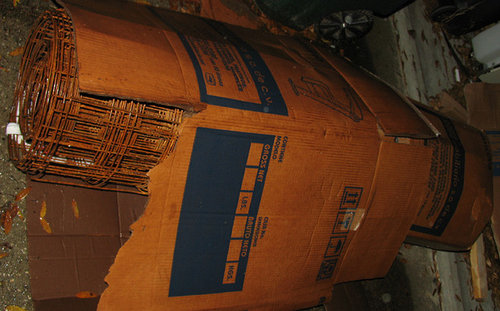
Yesterday I scored off Craigslist some 10 gauge 6 by 6 concrete remesh. My impulse was to buy first and think later since usually these things disappear if you think too long. OK, now I'm thinking I bought a pig in a poke. Help!

Guy had bought a roll for $114 at Lowes last week and used 42 feet for a bar he's opening up downtown and sold me the 106 feet which actually could fit in my car's trunk (EDIT: well, let's say it gave my car a large member sticking out the back, but was stable enough to get home under the radar) with his help packing it ... great deal at $50:

PC, hoping to stick with the tomato crowd and not be sent off to the container forum. I would prefer a 22" diameter cage and to be seven feet from plant's ground level, but I'll settle to find whatever it is I need, since like they say, you can't always get what you want. I'd prefer to keep the 5 foot side as the height so over 7 feet cages are just a fantasy at this point, and that means losing the container height isn't an option by placing the cage on the real ground and the container inside, as it would leave only around 3.5 feet of cage.

Comments (17)

  • 11 years ago

    Will the container be sitting on ground or on deck/concrete? If on the ground just drive 2 stakes into the ground one on either side of the pot and tie the cage at the desired height to the stakes. If high winds use 3 stakes. You can even figure 8 around the container to the stakes to help keep it upright.

    Dave

  • 11 years ago
    last modified: 11 years ago

    Thanks Dave, Do you think wood stakes would work, or do I need to pay more and use a lot of elbow grease with a hacksaw to cut rebar stakes?

    It isn't the perfect idea but it's all I've got so far. I want them to sit on a makeshift deck, better described as a ledge over weed barrier and plastic, both of which I'll have to damage to accomodate. Your suggestion is better than any other alternative I can come up with and three would be needed which is more messed since two could be aligned in a channel.

    PC

    EDIT: Just realized I think, what you meant with the comment on figure-eighting. Great idea, I understand it means to string cord around the containers and stakes, not involving the cages, to keep the containers up.

  • 11 years ago

    I've got an idea. Not sure if it would work for your application and also not sure how you'd secure them to the "makeshift deck".

    1. Roll out the mesh equal to the height you want the cage, let's use 8 feet for an example, and cut it. Do this twice.

    2. Bend each piece in half lengthwise to a 90 degree angle.

    3. Tie or wire the two pieces together to make a 2.5' by 2.5' wide square cage that's 8 feet tall.

    Hopefully this makes sense.

    Rodney

  • 11 years ago
    last modified: 11 years ago

    Well if you could align the pot so that 2 of the stakes could each go into a channel on 2 sides then you'd only have to drill one small hole for the third and use rebar. They don't have to be all that tall either to hold it. Wood stakes would work if you could fit it through the deck channels. So would those green plastic coated bamboo-look alikes.

    Plastic landscape stakes

    Just saw Rodney's post. That is a good idea too if you don't want to stick with the 5' side height. If you use the high side height then you could put some heavy duty screw eyes into the decking and wire the cage to them.

  • 11 years ago

    Electrical conduit also works well for cage legs....it's what I use for mine.

  • 11 years ago
    last modified: 11 years ago

    Wow, we all want nice things ;-) Rodney's suggestion with the cool Dave's screw-eye tweak minimizes and damage would be simply tomato cage heaven. They would be as tall (8 feet) as the "large" Texas Tomato Cage with extension, and have exactly double the enclosed space (volume), and those cost $43 each shipped, minimum purchase of a half dozen. I don't have to tell you guys how easy it is to get carried away with the wallet though.

    For the 8 foot longwise cut, it would take 16 feet of remesh and the cages would actually be too wide to properly support a plant until it got pretty huge when it would be amazing. But, currently 106 feet will give less than 1/3 the number of cages (uses over 3x the material), so I'd only get 6 cages and be sacrificing the length of remesh along the container to get that height, unlike Dave's suggestion to stake, which actually gives more convenient access to the pots as long as they don't tip over but the danger of the wrapped connections.

    By keeping the original 5' size to make the height, you get about twenty 19 inch diameter cages with 5 foot lengths, and I don't expect to get another roll of remesh ... and something between 10 and 15 is what I can squeeze in on the property, which is going to be a challenge itself to arrange. A compromise which I had also considered is less stable since it is 19" in diameter is just to cut for example, the 8 foot lengths, and use the existing 5 foot side to form into the circle, which would get 13 cages (w/ screw-eyes and now the problem to secure the makeshift deck better so the whole thing doesn't fall over!). Definitely Rodney's would be easier to store, but it is too few and then will leave me looking what to do for the rest of the cages.

    These are great ideas and really help think about this, thanks so much and please post anything else you might think of. My other problem is that the propane line runs under part of the area to the house so I got to find out if the city will come out and mark it if I start driving lots of sharp stakes in the ground there.

    PC, also, Dave, yes good idea about putting the third leg at 90 degrees from the other two to avoid 2/3's of the random holes.

  • 11 years ago
    last modified: 11 years ago

    Hi Grandad, thanks so much for that piece of advice! I just saw your post and you live in the same zone as me and we probably have the same type of summer swampy wind humidity, and bug problems. I was considering trying some 1/2 conduit if I hammer-beveled (squished) the side that enters the ground for better entry. It sure would save on the hack sawing of the rebar which I hate to do because a couple of cuts is fine and then the blade does 10-15 more, but each one becomes more and more a workout. Rebar is more expensive, too. I was wondering how well the conduit driven into the ground would hold up, or of it might corrode in the Florida salty coastal sandy stuff. Do you stick the dangling "feet" of the remesh into the conduit and secure, or just strap them to the outside like I was thinking of doing on Dave's suggestion?

    PC

  • 11 years ago

    Another way to extend the height of 5ft CRW, is to tie 3/8: rebars to the bottom, creating 3 legs of say 5ft. Drive 2 ft of it into ground. aAs a result your cage will be 8ft tall. If Your pots are on deck. you can just make the cages from either EMT or PVC. Both of these will require a lot more work but they will LOOK better than that rusting CRW. Yet another way is to make them from inexpensive pine lumber, by ripping 2 by4s and 2 by 3s. An 8' - 2 x 4 costs ~$3 and you can make a cage costing under $10. Not counting your labor.
    But OTOH, I see that you have already purchase the CRW.
    Two years ago I made one cage from a CRW panel (84" x 42", @ 7.20 .)
    Definitely was too short for indets. So no more cages . I buy cedar boards, rip them on table saw and make stakes. But then of course I plant in raised beds.
    There is more than one way to skin a dead cat :-)
    Seysonn


  • 11 years ago

    Yeah, the amount of mesh it would take per cage doing things my way was a big drawback that I thought of after I had posted. Not a very efficient use of material.

    Rodney

  • 11 years ago
    last modified: 11 years ago

    Rodney,your design is a better choice for anyone building stuff to last a long time, since they also could be opened easily and stowed out of season which is a big drawback of the circular cages.

    If you just need a few high quality cages, For sure your suggestion is the way to go even if you don't get remesh second hand, since instead of the 5 foot roll, remesh sheets are available that are 3.5 feet x 7 feet at $15 per pair retail here (same as Seysonn's comment, but 2 sheets per cage). That would be a perfect deluxe 7-foot tall square cage 21" on the side with a diagonal of 29". I don't plan on living here that long (need more space to grow tomatoes LOL), and I don't think cages are worth moving, even if they disassemble.

    Seysonn,

    Those are some great ideas, but you saw I bought first and am thinking later. I'm glad I got it now, nothing is perfect as usual but the quality is superior. I thought of PVC, but already have enough and actually the earthy color of the remesh doesn't stand out as brightly as the PVC, and I already have hoops.

    Splitting wood is a great solution, but I think I'll try the conduit legs though it seems a little iffy since I have some above ground that started corroding in just 6 months in my hoop. Lots to think about and I want the economy of wood, but then there are termites and a service that comes by with a clipboard and when they see wood near the house they start making notes about not being responsible for this and that if the house is too close to wood in ground contact, so there is a benefit in my case which is a small yard taken over by tomato plants.

    PC

  • 11 years ago

    When we purchased our current place, we also acquired a large number of wire cages. I can't tell you the exact size at the moment (it is dark and cold outside) but I use rebar, I can purchase already cut rebar in several different lengths at Lowe's and Home Depot. I tie the rebar to the wire cage. If I had to 'guess', I'd say the cages are about four feet high. If I was building new cages, I'd make them a bit larger in diameter. There have been years I have tied three cages together per plant! I only plant indeterminant varieties.

    CMM in zone 9a


  • 11 years ago
    last modified: 11 years ago

    PupillaCharities, I wired the conduit to the verticle remesh cage wires, i.e. Top to bottom along the cylinder. Coat hanger wire works OK, but I was able to get a softer wire used to support ceiling tile frames that works better. Three poles about 4 or 5 feet long each tied/attached in 2 places work best for stability. The legs extend about 16 to 18 inches below the cylinders. The bottom wire on the cage will be about 6 inches above ground when the cage is set.

    My remesh (edit - conduit) legs have been through 3 seasons and are beginning to show about 50% surface rust.

  • 11 years ago
    last modified: 11 years ago

    Thanks for the details and followup Grandad and again to everyone who is helping me out here. Sounds like you are driving the conduit in your soil type about 10" to 12" into the ground. I think your last sentence you meant the surface rust is on the conduit pipe.

    I understand that your plants are in-ground, not above in containers like me, so the difference is I'll need to get 18" - 24" of elevation above ground to the bottom of the remesh cage itself, like on stilts towering above the pot. Soil is very soft and sandy here, so I'm thinking of combining the helpful ideas like this, which requires only one perforation:

    Plan A:

    Leg #1: Rebar 5/8", driven 42" below ground level, 6" through "deck" and 24" of stilt, followed by 48" along the supported cage wire wrapped vertically ... making the cage 7 1/2 feet above ground though the pot is also above ground supported by the stilts like Dave suggested.

    Leg #2 & #3: Conduit 1/2", 5 foot length each resting on top of "deck" by weight only, so it will be 2' of stilt and 3' vertically strapped to the cage with wire klike you do.

    That is an efficient use of material, each economical 20' rebar length will get just one cut and satisfy two. Each 10' conduit will make two 5' legs for one pot.

    Plan B:

    Just bite the bullet and make 8' high cages which come out narrow, using 10 squares of factory remesh height (5 ft) making a cage of 19" diameter, and secure according to one of Dave's suggestions, I need to look at those spikes in person and I need to see if 19" is wide enough sice it seems that is probably the most economical and has some of the benefits ofg Rodney's idea.

    CMM thanks so much. The rebar bought by the small precut piece is significantly more expensive per foot and both remesh and rebar in bulk are around double what I last paid these days. Conduit is about half the price per foot here. The rebar/conduit combo is about $7-8 per cage plus the remesh cost. Mine are 90% indeterminates too. It sounds like you have the 3.5 foot high remesh if you stack as many as three which would give 10.5 feet which is about as high as I can imagine going for a 6' stepladder. I need about 12-15 cages so cost is a factor, and I wonder if Plan A would support not one but two cages (it would be 12 feet high, so I doubt it could be stable.)

    I appreciate everyone's thoughts.

    PC

  • 11 years ago
    last modified: 11 years ago

    I don't stack them - I link 3 of them side by side in a sort of a circle! since it is daylight now (but still pretty cold), I'll go out and take a picture.

  • 11 years ago
    last modified: 11 years ago

    Thanks CMM, thos cages look like they've gotten a lot of great use and keep giving some great big tomatoes! They look like they are made from 5' x 5' pieces of remesh. Here's a better link to new-beginning's picture so you can delete the one you put if you want since it doesn't work as well.

    Amazing the ideas around here! I guess you thought outside the box (really, outside the cage). I wouldn't have thought to put the plant in the middle of a triangle of cages and that design is a very useful idea for making monster plants. I bet you could even adjust your total (combined) "cage" width of the plant by moving them a little further apart. That won't work in my original question though because the plants are planted too closely together, so in the case I asked about, I'm pretty much stuck with one. But it is a great idea for later if a plant gets removed, especially because it would have more stability. Material wise, it is not the most efficient method unless you don't mind 15 feet of remesh, but because you add only as needed it makes a good option. Thanks again for sharing ;-)

    PC

  • 11 years ago

    It sure looks a lot like remesh but then must be thinner gauge (thinner wire). When you buy the 5' remesh in the 150 foot rolls it retails out to about $0.77 per linear foot if you can transport it home and buy the whole roll, but the 3/8" x 4 ft rebar here at Lowes is $2.30 per piece. My container height is around 16" or so, so that's why I need to use three stilts above the ground, or if I used a nice cage like you've got, if it is 4 feet tall, my plant being nearly 1 1/2 foot high could only use the upper 2 1/2 feet portion. I guess I could train the lower parts to hang into what is around the container somewhat., but that really needs to allow open airflow due to lots of mold and other pests. You have a great system and I wish the container were so economical. Suddenly a much wider container is sounding like a bargain, if I could only rest the cage on top, but mine are too narrow for that and now I'm paying more dearly$ for that than I expected in the beginning. Live and learn!

    PC