Software
Houzz Logo Print
nhbabs

Clematis favorites for Jane

10 years ago

A few weeks ago Jane asked about Clematis on one of the other threads, so I've rummaged around to find photos of some of my favorites. (It's a good thing I've got a good amount of garden space since I'm really hooked.) These are all plants that have been dead easy in my garden - plant them in good soil, provide support from either a metal trellis of some kind or a shrub, and step back. They usually take three years from the quart size I buy (second year from cuttings) to get to a good size and sufficient blooms to have real impact. Recently I've started planting in mesh bottomless baskets to protect them from the voles who have been particularly problematic. I'll try to post the photos in approximate order that they bloom.

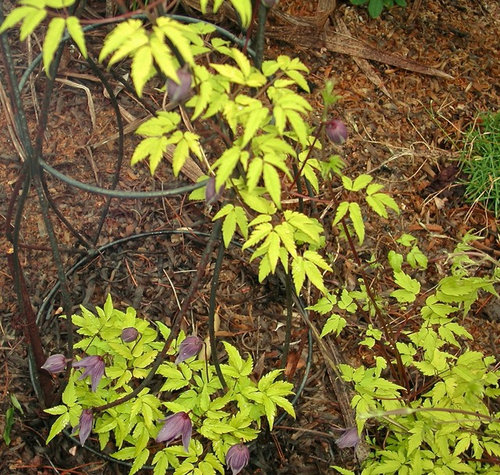
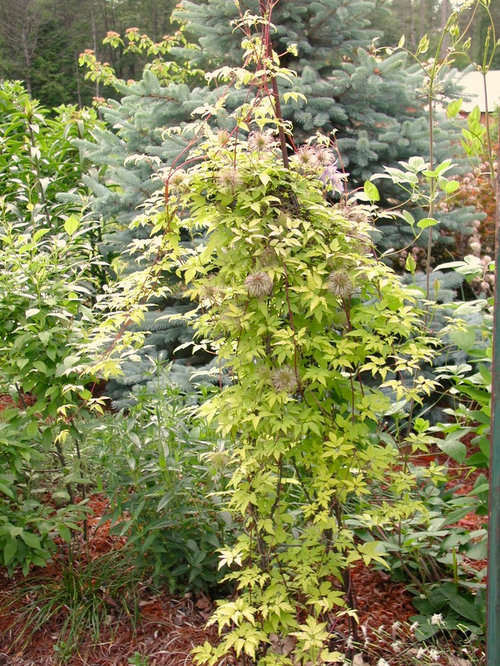
Stolwijk Gold (prune 1) I am unable to get a photo of this plant with both the leaves and the flowers correctly colored. This is good for the leaves which stay a bright gold to chartreuse all season, but the flowers are a cool blue, not this reddish purple. Blooms in May.


Ornamental seed heads


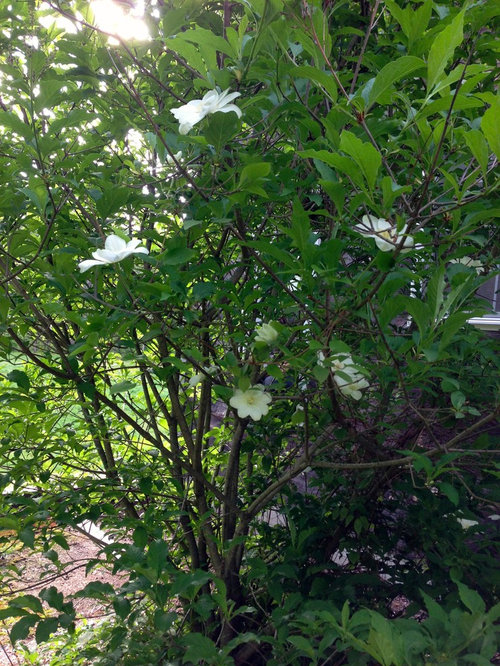
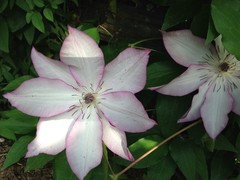
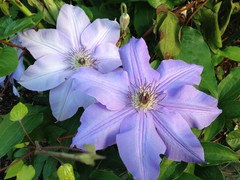
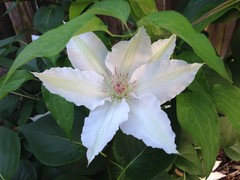
Guernsey Cream (prune 2) blooms for me in almost total shade with large lilacs to the east and west, a large building to the north and a bunch of full sized trees 20 feet to the south. I can only imagine what it might look like under better circumstances.


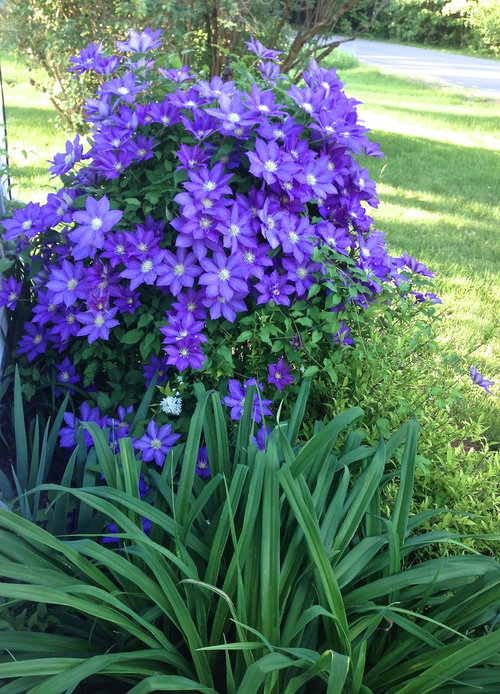
HF Young (prune 2)is a bit bluer than this in some light conditions and a bit lighter and more lavender in full sun. So depending on when I look at this plant the flowers look slightly different in color, but every year this plant spends 3 weeks with this explosion of color.


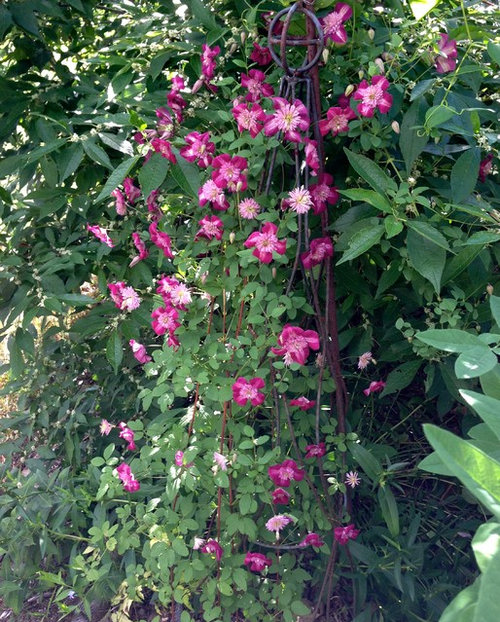
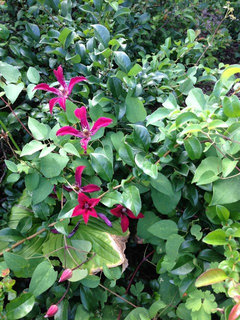
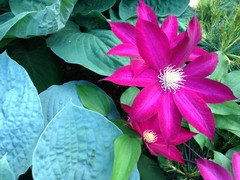
Ville de Lyon (prune 3) is usually described as cerise. The outer edge of the petals are deep pink and they lighten toward the petal center. I love the flower shape on this one and it blooms for a long time in a spot with less than half day sun.


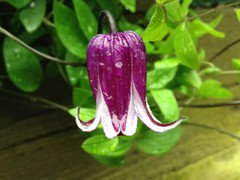
Fascination (prune 3) has these cute little bells and is one I am replacing as soon as I find one since the voles did it in last winter.


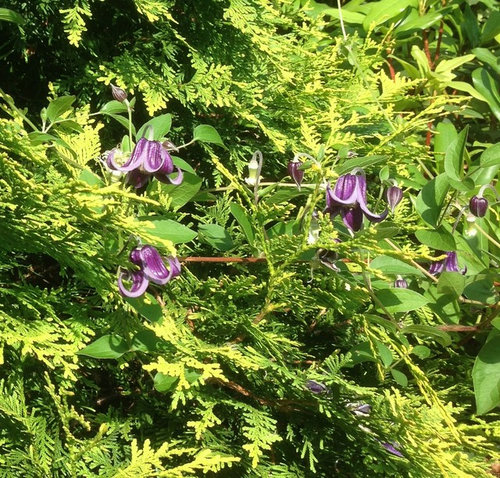
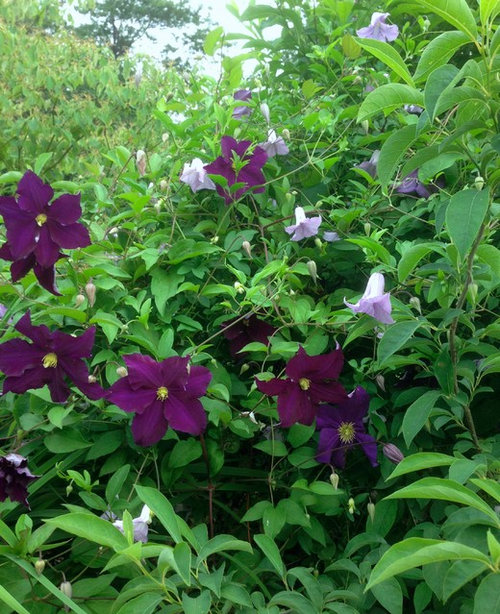
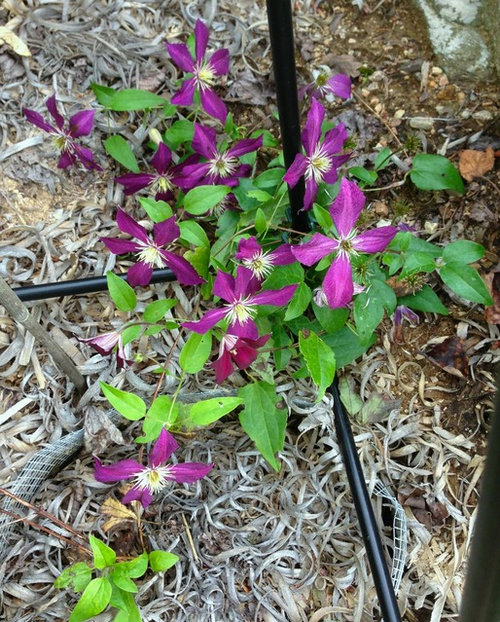
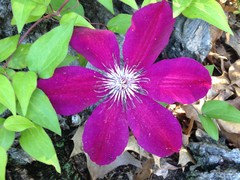
The lavender bells are Betty Corning (prune 3) which is a huge plant, but has these delicate looking bells that dance in the wind. The darker more open flower is Viola (prune 3), which is a true dark purple, not this red-purple.


Little Bas (prune 3) has flowers that make me think of butterflies. This is another vigorous plant that unfortunately the voles did in and is being replaced.


Avant Garde (prune 3) is almost the exact color of Ville de Lyon, but has masses of tiny flowers centered with pink pompoms that stay around for a while after the outer petals have dropped.


I love the color of Mikelite and it is a long bloomer for me.


They will only let me post 10 photos in one post.

Comments (7)

  • 10 years ago

    What a wonderful and kind gift this thread is! Made my Monday! Thank you so very much, NHBabs. It was from the Clematis Forum (nhbabs) that I learned about the pruning types of clematis, Brushwood and Hummingbird nurseries, and also from you and Molie, about the great site http://www.clematis.hull.ac.uk/new-clemalphasearch.cfm. Armed with the most info I had ever had about clematis, I ordered four of pruning group 3 to plant in my rhododendron border. They are: clematis Durandii, Sugar-Sweet Lilac, Princess Diana and The Countess of Wessex.

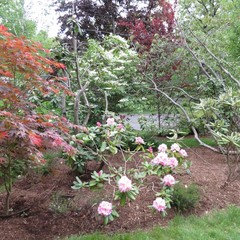
    Some folks here may recall my 90' long border of lost pines that was transitioned to a border of rhodendrons in 2008. This picture was in Spring 2013, and as you can see, there are areas that need to be filled. Those two back-to-back storms we had in 2011 raised havoc in this border. I had to use ropes tied to the riding lawn mower to pull the tall rhodys back into place after they were completely unearthed by Hurricane Sandy. So the border has had a few experiences. It is to fill the voids that I bought shorter-growing clematises, 1-2 meters.


    I bought clematises for sun, their feet should be cool under the mulch, and it is my hope that eventually, with enough plants in this long border, I won't find any more 11' tall wild blue lettuce plants and mystery vines that only UCONN could recognize.

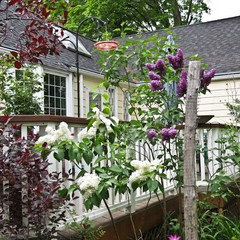
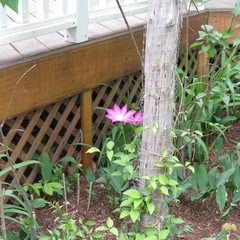
    I do not have a picture of my one clematis cedar pole when the plants were fully out, but here it is next to the deck:

    That one little bright pink head is at the bottom of the pole and is planted next to Jackmanii, which was not out yet. My next effort is to try having clematis as a ground cover in the rhododendron border, so I will continue searching for those varieties that are suited for sun and ground crawling. The varieties I ordered recently are purportedly prime for containers and are the shorter growing type.


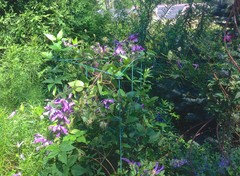
    At the moment I can't remember this little plant's name, but in his first year, he was most happy, so I have hope the new clematises will also be content to grow in the rhody border.

    NHBabs, not only am I grateful for the time you spent posting, but by now you must realize that you are quite a plant enabler. I will now order even more clematises thanks to your pictures! Your love of plants and specific knowledge of botany has helped many on GW. Many thanks.

    Kindly, Jane

  • 10 years ago
    last modified: 10 years ago

    I like being thought of as a plant enabler, particularly a clematis enabler! Might your photo be of Asao? That was one of the ones that the voles munched to death here I think.

    I have Princess Di and she is lovely, even blooming in a far less than optimal amount of light, and Durandii stuggles to grow faster than the voles eat. Both bloom for a relatively long time, despite the abuse, just not too densely. In better conditions, I can imagine they'd both be wonderful.

    Durandii needs a nicer support, but it needs something to help it rise above the Amsonia hubrichtii which is larger than I expected when I planted it.

    Durandii is another one with nice seed heads.

    One that is similar in genetics and form to Princess Di is Gravetye Beauty, but is a darker red. Mine is near the front of the house where I see it daily. It rambles through a shrub and some perennials after it spills off its 5' obelisk, and bloomed well in 1/2 day shade before we lost a tree to snow damage. It's now in full sun and blooms from about the second week of July into late August or early September.

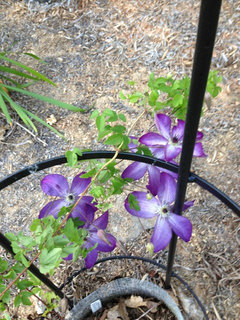
    This is only a first year plant, but is another favorite, Venosa Violacea. The voles totally ate one, and are doing serious damage to another, so this one was planted in a cage. The purple is just a bit less red than this photo.

    Another ground rambler to check out is Mrs. Robert Brydon, which is the size of a medium to large shrub even without support, and though it doesn't bloom for long, is covered with flowers when it does.

    Another rambler that blooms really well is Arabella, though I have no good photos.

  • 10 years ago
    last modified: 10 years ago

    I have a feeling you may be turning many heads on this forum with these pictures and ideas. Thus far, I have not had vole tracks or damage, but chipmunks galore and they tunnel enough to disrupt the health of some shrubs. In your bottom picture of Venosa Violacea, is that the top of the bottomless wire basket in which you place the plant? Am now searching Google for wire mesh plant baskets, but have yet to find 'bottomless' - or are you trimming the bottom off - or using maybe 6" wide wire and rolling your own? Again, many thanks.
    Jane

  • 10 years ago

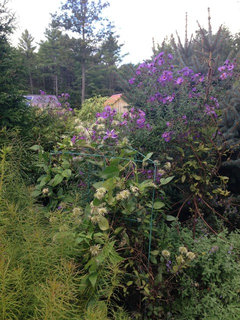
    DtD, Such pretty combinations! The first one is probably one of the dark-leafed forms of C. recta, such as 'Serious Black' AKA 'Lime Close' or purpurea. I planted 'Serious Black' last summer and have high hopes for it.

    I really like the combination of the deep pink clematis with the dark-leafed smokebush. I will have to tuck that in the back of my mind for when I have a spot for a smokebush. The purple ones sometimes have severe die-back here, so it needs to be in a spot that it can be late emerging and planted with one of the smaller clematis, perhaps Piilu to match the 5 or 6 foot height they usually reach as a maximum after die-back.

    Jane, yes that is the top of one of my baskets. It's a bit homely, but since the voles tend to winter tunnel at the ground-snow interface and summer tunnel just below ground level, I wanted them to be both above and below ground. Usually my gardens are dense enough so they don't show much, but this is in a new bed that I started in 2013. I have seen evidence of vole tunnels turning aside summer and winter, so I know the baskets work. I only started using them extensively fall of '13, so I don't have long term experience. I figure that the roots will grow through the basket and so there may be some root pruning by the voles outside the baskets, but there will always be some roots and the central growing part of the plant remaining rather than total loss. I do go around in the spring to pack down soil around the baskets so they aren't surrounded by air-filled tunnels which the plants don't like. I use them also for some other plants that the voles particularly like such as Dianthus, though usually smaller baskets (from 24" wide rolls, so a bit over 7 1/2" diameter) sunk closer to the soil rather than 2" proud of ground level as for the Clematis.

    I also looked for something commercial I could use, but didn't find anything, so I make my own. I get 3' wide rolls of 1/4" hardware cloth at the big box store. I use tin snips (not wire cutters - too slow) to cut across the roll to make a strip that is 6"-8" wide x 36" and roll it to overlap about 1". The roll comes wrapped with wire, and I use a piece of that with a pair of small pliers to "sew" the ends together with 3/4" stiches to make a tube that is 6"-8" high and about 11" diameter. Wearing leather gloves helps prevent the sharp wires from chewing up my hands as I make them. If you have a storage spot, making them is a good garden chore for winter evenings.

  • 10 years ago

    Omoshiro


    Westerplatte


    Ramona


    Hyde Hall (Pruning Group 2)


    Bourbon


    Rooguchi (non climbing type)


    Steve

  • 10 years ago

    Thanks for the added photos, Steve. You have some nice selections!

    I was looking for something else in my photo library and ran across a photo of my wire baskets before planting. The seams are tucked over to the sides, but in the larger one the seam is on the left edge with the stitches slightly visible. Gallon jug for scale.


Sponsored
Grow Landscapes
Average rating: 4.5 out of 5 stars8 Reviews
Planning Your Outdoor Space in Loundon County?