Software
Houzz Logo Print
sivalleysteph

Installing Micro Drawer flush to inset cabinets?

11 years ago

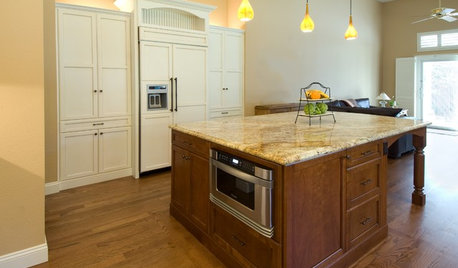
We are looking at getting the Sharp SMD2470AS. Adding up the dimensions of the box plus the door it is just a shy bit more than 23" (23" + 1/64"). With the standard 24" cabinet box, 3/4" for the back wall, we *should*, in theory, be able to install flush to the cabinet box front. Will need to build a false front back into the cabinet by the distance of the door to nail into.

Has any else done this?

Sharp has a picture on their website where it looks like this exactly was done, but their installation instructions don't really address this situation.

Comments (16)

  • 11 years ago

    You need an extra deep cabinet run to do that in inset.


  • 11 years ago

    GreenDesigns, Have you seen it done? I could absorb an extra inch in this run, I believe. Need to figure it out since the cabinet maker is starting! 25" is good enough or even 24-1/2"?

  • 11 years ago
    last modified: 11 years ago

    25" is good. It gives a bit of wiggle room. But, I'm a big proponent of extra deep lowers for the whole run if you can manage it because it gives you extra counter space overall. 27" is a good comfortable number that 13" uppers can work well with.

  • PRO
    11 years ago

    Ditto GreenDesigns. The 24" "standard" cabinet depth is actually too shallow for many of the uses to which cabinets are put in modern kitchens, 27" or even 30" is better if you have the space. A 30" deep cabinet allows 25% more storage in the same footprint, and 15" deep wall cabs, which is also 25% more storage.


  • 11 years ago

    @StarCraft 25% more storage? I thought the depth of the drawers did not change except, perhaps, in truly custom. I also do not understand "same foot print". Does the toe kick space just get 6" deeper? What are the new uses for cabinets in modern kitchen (how is a 30" depth cabinet used differently than a 24")? Extra counter top is always nice, but I did not realize that having a deeper cabinet (as opposed to pulling the 24" cabinet out and adding support rails on the wall) made the cabinet more useful.


  • 11 years ago

    I have 27 inch deep base cabinets with 24 inch deep base drawers on one wall (standard 24 inch deep base cabinets have 21 inch deep drawers). Every inch counts in my small (by GW standards) kitchen. The 15 inch deep uppers are wonderful also for my inset style. My toekick drawers on that side are deeper also. Having the deeper base cabinets helped with the Gaggenau induction cooktop venting in the back since I have a wall oven under it .

  • 11 years ago

    Problem solved. We purchased a Bosch microwave drawer instead, which allows for a flush install.


    Phew, I was not sure about that Sharp drawer with the flip down panel anyways, so glad to go with something else.

  • 11 years ago
    last modified: 11 years ago

    Just so you know, Sharp makes all the MW drawers, including Bosch (with the possible exception of Viking - I couldn't verify one one or the other). The outside is changed a bit and then it's re-badged as Dacor, Bosch, etc. (and the price is increased!)

    Sharp-badged MW drawers are 1,000 watts, all others are 950 watts. The Sharp-badged are also the only ones with the angled controls.

    The Sharp-badged drawers get the new innovations first. In this case, the hidden control panel that actually makes it even easier to read & use the controls than on the older models.

  • 11 years ago

    Thanks buehl, I have heard that.

    The flip down panel seemed very uncomfortable to flip down and up when using it at the store. Also, It's not designed for flush install. And it seemed you'd need the front panel of the micro to protrude in order to use the small tab to flip the panel down.

    I see how the angled controls would be easier to read, but the open/close on the panel was a turn off. Could not find any reviews of the micro to see how people liked it irl.

  • 11 years ago

    Buy the older model Sharp off of Ebay and save enough money to increase the cabinet depth. It's worth doing.

  • 11 years ago

    @StarCraft OK, as far as increasing the cabinet depth on truly custom cabinetry. However, even semi-custom, such as Dynesty by Omega, charge for oversizing (not undersizing). Upcharge for oversizing the cabinet, and oversizing the drawers. To avoid that expense, which could be considerable, or not available in other cabinetry brands, is there any reason why pulling the cabinets out from the wall a few inches would not work? And how much does the increased countertop material increase? (I love the idea of more and more countertop space.)


  • 11 years ago

    Side extend back isn't a big $$ increase. What's expensive is if you do the whole box ID and use the ID glides. That can run into some money. But, it also increases the actual storage space inside the cabinets as well as the counter space. That's a cost/benefit analysis that only you can determine is worth it for the extra room. In a small kitchen, extra "found" storage can be what makes it work.

  • PRO
    11 years ago

    Thinking solely in terms of standard factory sizes for kitchens is one of the most common mistakes homeowners (and kitchen designers) make when remodeling kitchens. this sort of "in the box" thinking stems from the assumption that custom cabinets must cost more than factory cabinets because, after all, they are custom cabinets. Not always so.

    Our fully custom cabinets, with installation, cost about 20% less than mid-range Home Depot cabinets with installation. How can that be?

    Easy, we don't have the giant HD markup and we don't ship cabinets halfway across the country. Most of our customers are local. Our shop is just as efficient as the big factories -- after all, there is only so much automation that can be applied to cabinetmaking. No matter how big the factory, it is still a hand-on business not amenable to an automobile-type assembly line fabrication.

    We all have the same machinery, ours is just smaller in scale. But, our CNC machines work just the same way as Omega Cabinetry's CNC machines and are just as efficient. Large factories have an advantage of scale, which lowers some costs, but we have the advantage of not having massive shipping charges for transporting large quantities of air.

    Shipping a typical assembled sink cabinet means shipping a shell wrapped around six cubic fee of air. This air takes of volume, and shipping charges are based on volume and weight. We don't pay those, and so wipe out any advantage of scale the large factories enjoy, and then some.

    So we are very price competitive. But, what we provide that the large factories cannot, or do not, except at what we believe are rather excessive extra charges, is precision fitting. If your space requires a 22-11/16" cabinet, that's what we build. Not a standard 21" cabinet with a 1-11/16" filler strip.

    So, back to the actual topic, deeper cabinets:

    To make a 30" deep cabinet requires sides that at 6" wider than a standard 24" cabinet. The front and back are the same. A 24" wide 34.5" tall 30" deep cabinet is still 24" wide across the front and still 34.5 inches tall. If we cut a 24" side, we have 24" left in a standard 48" plywood panel, so we can cut the other side out of the same panel. If we cut a 30" side, we only have 18" left. What can we do with that? Well, we can cut out the 15" side for the upper cabinet, and still have minimal waste. So the material cost of making a 30" cabinet rather than a 24" cabinet is about the same.

    How about hardware? Everyone knows that the hardware to extend a drawer in a 30" cabinets costs more than the harware required for a 24" cabinet. And, they're right. Drawer glides for a 30" cabinet are heavy duty glides that will support up to 150 lbs., compared to 75 lbs for a standard glide, and they cost twice as much. We pay about $58.00 for a pair of glides and accessories vs $27 for a 24" cabinet a $31.00 difference per drawer.

    The cabinet cost for a typical small kitchen is about $12,000, installed. If you use 30" cabinets throughout with 15 drawers, you will pay about $465.00 extra for glides. This is whopping a 4% price increase. Who can afford that? Deal breaker for sure!

    For the additional storage and added convenience of deeper cabinets, this should be a no brainer.

    If our cabinet cost is about the same, and it is, and glides a very modest additional amount, the only concern left is countertops, and the cost of these is much more likely to depend on the material selected than size.

    So, cost should not be a factor, and if it is a factor, you have selected the wrong cabinetmaker.
    If you are like most homeowners, you are only going to remodel your kitchen once. So, you should do everything possible to make sure that this once-in-a-lifetime project is exactly right, which means the cabinets are exactly the right height -- not always 36", in fact rather seldom 36" high -- and exactly fit your space and your needs. Giving up utility and function because your cabinetmaker cannot or will not make what you need except for an excessive extra charge is just plain nuts.


  • 10 years ago

    Hi...I am also looking at the SHARP to flush set. My question is on the backside...I cannot put the outlet specifically where the spec sheet asks. Heating pipes are in the way. Can I move the outlet 5 inches to the right? Is the cord long enough? I also want it flush set. What is the minimum depth for doing so? I might be able to recess the outlet a little to gain more. But right now my max depth is 25". Can anyone who's installed one of these respond? Thank you!

  • 10 years ago
    last modified: 10 years ago

    We just installed the Sharp in our 24" deep island. We put the outlet in the cabinet to the left (trash pullout) so you should have plenty of cord to place your outlet 5" to the right. For a flush mount you need to purchase a deflector from Sharp. Good luck! I love ours. We did not flush mount ours since we only had 24" depth to work with.