Software
Houzz Logo Print
tarheel_lawn

Help with Logan Lab soil test results

11 years ago
last modified: 11 years ago
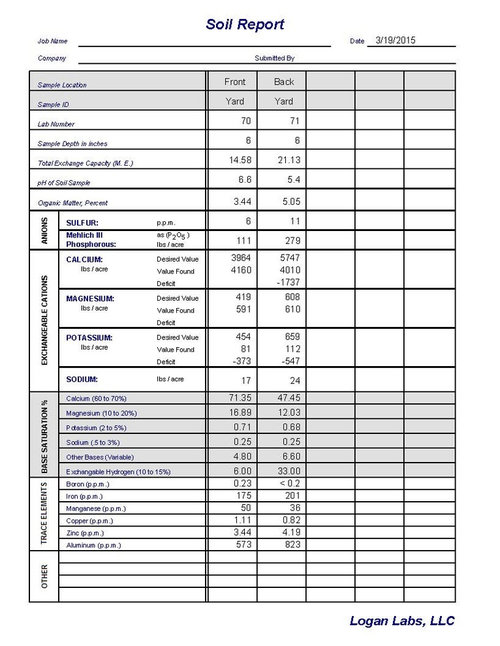
Hello everyone! I've been lurking for awhile and finally
decided to join in. I got a soil test done through Logan Labs and I'm looking
for some input on what I can do to help things.

I'm located in Chapel Hill, NC (zip code 27517), I've Fescue grass in my front yard (800 sq-ft) and Bermuda grass in my back yard (800 sq-ft). Both my front and back yard lawns are on a slope. I've a sprinkler system.

I'm a first time home buyer. I've very little experience in lawn care, I have been following this forum to educate myself.

There are many bare spots in my front yard that need seeding. I need to control crabgrass in my backyard.

I'd appreciate your suggestions. Thanks!!!

Comments (2)

  • 11 years ago

    This is interesting! Your soil has a bit of a split personality, so we have to treat the front and back differently. It happens sometimes, particularly on slopes, or where a lot of soil was brought in originally to create the grade. As to where the division lines are between the soils, that may or may not be clear. Just do the best you can.

    Where recommendations go on both the front and back, I've taken care to keep them together. Where they don't, the chips fall where they may.

    EC 14.5/21.1: Both are moderately heavy soils, and I'd expect a lot of silt in both. The back may include some clay, although I wouldn't expect a vast amount. Both soils hold a lot of resources (back more than front) and are more resistant to change than the average.

    pH: Always a symptom, never a cause. We'll deal with both individually under Ca, Mg, and K. Ultimately, your natural pH balance looks like it'll be a bit lower than what I tell most people--6.3 or so--but with an EC like that, I'm not terribly worked up about hitting it quickly because that won't happen.

    OM 3.4/5.0: Fair in the front, good in the back. Certainly mulch mow and consider organic feedings; although good is good, it isn't excellent. Higher levels of OM mean more water retention and less watering.

    Sulfur 6/11: Both are pretty normal, although the front is kind of trim. It doesn't matter as I've made recommendations below for a sulfate based potassium, which will boost sulfur levels a little bit. Neither is deficient.

    Phosphorus 111/279: The target for you is 200. The front is low, the back is great (the extra P simply gives you margin against usage and leaching). The recommendations are below.

    Calcium 71%/45%: A little high in the front (but nothing to worry about), but extremely low in the back. Recommendations below under the Back section.

    Magnesium 17%/12%: Both are fine and in the optimal range. No magnesium required or desired as it tightens soils (hence the calcitic lime recommendation below; cheap lime contains a lot of magnesium in addition to being slow, far less effective, and overall more expensive when you have to correct the problems).

    Potassium 0.7%/0.7%: Borderline deficient. Most garden stores or landscape shops will be glad to order potassium sulfate for you if you ask (or you can get it over the Internet but shipping is a killer). Recommendations below.

    Sodium 0.25%/0.25%: Perfect, Low sodium levels are desirable, even though this looks like it's off the normal scale.

    Most Minor Elements: Fine, except for boron and copper. I'm not inclined to adjust copper this year with everything else going down. Normally, I'd ignore boron this year as well, but in this case we can't. I've included a few words about iron below as well.

    Boron 0.23/<0.2: Deficient. We use Milorganite to apply this as the amounts are very small (0.2 PPM is 200 parts per billion). Target is 0.7 PPM. In a wheelbarrow or something like, and adjusting for your 1600 square feet, dump a full bag of Milorganite. Add 4.5 tablespoons of 20 Mule Team Borax (laundry section of your grocery store) to the Milo. Spray very lightly with water as from a hand-held spray bottle (the hose even on light spray will wet it too much). Mix. Spray occasionally to damp the Milorganite and make the 20 Mules stick. Keep mixing. Apply the entire bag to your 1,600 square feet by setting your spreader low and criss-crossing several times.

    The Milorganite will also give you a nice boost of iron--making the lawn greener--and a nice gentle feeding with organic nitrogen.

    Iron: 175/201: Both are fine, definitely not deficient, but may not produce the best color in the lawn--particularly in the back as the calcium and potassium hit. At any time you like, you can apply Milorganite at bag rate (your full lawn will use about 2/3 of a bag) to gently feed your lawn and apply iron for deeper color.


    Front Recommendations (fescue):

    May 1: Apply 3 pounds potassium sulfate per thousand square feet.

    May 15th: Apply any starter fertilizer (high second number like 18-24-6) at the bag rate.

    June 1: Follow the above prescription for boron.

    September 1: Apply any starter fertilizer at the bag rate.

    September 15: Apply 3 pounds potassium sulfate per thousand square feet.

    October 1: Apply any starter fertilizer at the bag rate. Follow the above prescription a second time for boron.

    Growth Stoppage: Apply any high nitrogen fertilizer at the bag rate (don't use starter at this time). The date on this varies, but is usually November 15 give or take a lot.


    Back Recommendations (Bermuda):

    General: Bermuda should be fed monthly throughout the growing season with a high-nitrogen fertilizer. That won't interact with anything except the calcium (plus potassium to a lesser extent, but I'm not worried about that). Try to leave at least 1 good rainfall (or irrigation) and 2 weeks between feeding and calcium.

    April 15: Apply Mag-I-Cal or Encap calcitic lime at 5 pounds per thousand square feet; don't buy cheap lime as it's ineffective and will mis-balance magnesium levels.

    May 1: Apply 3 pounds potassium sulfate per thousand square feet.

    June 1: Follow the above prescription for boron.

    September 15: Apply 3 pounds potassium sulfate per thousand square feet.

    October 1: Follow the above prescription a second time for boron.

    October 15: Apply Mag-I-Cal or Encap calcitic lime at 4 pounds per thousand.

    tarheel_lawn thanked User
  • 11 years ago

    If all else fails, you can always throw your hands up in the air (for now, at least), stay inside, and enjoy the best holiday season in the entire year.... MARCH MADNESS. Hopefully you're a Tarheel fan (I see that you live in Chapel Hill) and enjoying their spot in the Sweet 16!