Software
Houzz Logo Print
bertspro

Japanese Holly Compacta

11 years ago
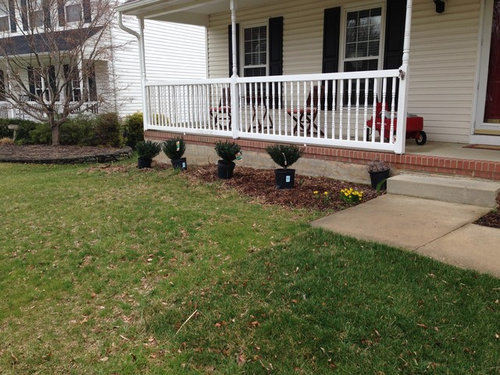
Hello all,

I recently ripped out my front garden and cut down and ground away an overgrown holly tree and would like to replace everything with Japanese hollies. There seems to be a lot of conflicting information out there as to how big the different cultivars get. I bought some "compactas" at a big box store (they are cheap there and if I end up having to rip them out, not as big a deal, plus i think they come from the same farms as the nurseries/landscape suppliers around here) and can't figure out how far apart to space them. i'd like them to be rounded but basically touching, and I'd like them to be far enough off the house that I could get behind them if I had to. Anyone have any thoughts?

Did I buy the right ones? I would hate to put these things in the ground and have them grow a few years only to discover they are going to max out at 3' in height and width.


thanks


Comments (10)

  • 11 years ago

    no plant.. specifically shrubs.. ever stops growing at some magical height ...


    and the proof of that.. is most likely.. what you tore out ..

    i took your common name to google.. converted to the latin.. and flipped to images ... at the link below ... this ought to give you a flavor so how big they can become.. .subject to how much shearing you want to do ... to my eye.. they have rather vast potential ....

    link

    if you want to walk behind them.. i would probably put them at least a foot into the grass ... more even with the edge of the sidewalk ...


    4 looks fine ..


    i highly doubt any BBStore locally sourced plants .. i might bet a nickle on a TN source ... no clue why .. lol ..


    ken


  • 11 years ago

    I wanted to buy some of those aswell but is seems as it they can get 6Hx6W which is too big for what i wanted.

    Japanese Holly Compacta

  • 11 years ago

    Another one to consider is the dwarf burford holly. It is vvery pretty with glossy leaves and red berries. The tag on the ones at lowes say they get 6Hx4W but i think they can get a little bigger that that with age.

    Good luck!

    Something else that you might consider is the crimson pygmy barberry. It has beautiful color and only gets to 3Hx3W.

    I just brought some this weekend, but they do have little spines.

  • 11 years ago

    bertspro:

    'Compacta' can be easily sheared once to maybe twice a year and stay inbounds.

    Not sure where you live and what zone you are in, but you might consider I. crenata 'Hoogendorn' (holly) for a lower alternative for that spot.

    I would think you'd def. want something evergreen there, but not knowing your zone makes it hard to suggest alternatives.

  • 11 years ago

    Thanks everyone for the tips. I think I'll stick with these compactas and move them a little away from the house and space them 4' apart.

    Btw I'm in Maryland (it used to say that next to my username, not sure what happened to that), the area gets full sun after about 10 am, and the soil is pretty terrible - mostly clay, so I will be adding about a foot of compost/topsoil to raise them up and give them better soil. I was told by the guys at a local landscape supply place that Hoogendorn stays pretty small and I'm looking for something that I can keep around 4-5'

  • 11 years ago
    last modified: 11 years ago

    'Hoogendorn' is wider than tall, more spreading and grows somewhat slowly. In my mind it would be ideal for your usage. Eventually it can get 2 feet high x 4 feet wide -- a lot like a greener version of 'Helleri'. It rarely needs pruning. It's really a hardy and handsome shrub and I highly recommend it! I'm seeing them planted more and more around foundations here in North. VA.

    That said, I think you'll be just fine with 'Compacta'. I can see why you'd not want to repurchase something when you have these already. They take shearing really well and are tough. As long as they have fair drainage, they can take clay soil just fine. BTW, Ilex crenata is naturalizing (invading?) all over our woods, so they must be adaptable to our climate!

  • 11 years ago
    last modified: 11 years ago

    And while trees and shrubs do not stop growing until they die, once they
    have attained their genetically programmed size, they do slow in growth
    significantly.

    The only thing that "tops out" is bamboo. Flowering trees and conifers with clearly defined growth patterns like pines can often be seen to convert to a more branching, slower growing stage when they start diverting energy from upward oriented vegetative growth into flowers or cones. But the vigorous hedges so often wanted to function as living architecture with fixed sizes and ~dwarf shrubs like the holly being asked about here do not grow for a comparatively short time and then slip into a conveniently small maturity when there is very slow growth that continues indefinitely. That an evergreen hedge or shrub might theoretically some day slow down multiple decades down the road almost never pertains to the usual issues encountered. It is much more realistic to assume that something that is supposed to typically be 4' tall in 10 years could be getting somewhere into the neighborhood of 8' tall in 20. There ARE tall camellias, hollies, rhododendrons and other examples of long-lived shrubs around to show that if a planting is old enough and site conditions remain suitable such plants do keep at it - awhile back a friend measured a Camellia japonica down the street from his place that was 33' tall.

  • 11 years ago

    I just drove by some 10 foot Ilex crenatas on my way home last night. Hard to tell the actual cultivar -- it may have been 'Convexa', but yes, they can grow large!

    The original poster will certainly be committed to several-times-a-year pruning with that selection.

  • 11 years ago
    last modified: 11 years ago

    And if a formal sheared hedge is not was was envisioned originally then the planting will not have worked out at that point.

    A single story house near me has a Japanese holly above roof level, looks like it has been pruned to be walked beneath. This is not one in an historic neighborhood either. Another Japanese holly, at Lakewold Gardens near Tacoma was something like 22' high some years ago (1990s). Jacobson, Trees of Seattle - Second Edition (2006) mentions a 'Mariesii' 21 1/2' high (planted 1950), a 'Snowflake' 21' high (planted 1960), and a planting of 4 I. crenata with the tallest having reached 19'.