Software
Houzz Logo Print
akgildea

Wildflower meadow OR buffet for deer?

11 years ago

I have about an acre of clear clay soil on a mountain ridge in West Virginia, originally bare and compacted from construction of my home. Over the last year I've amended and tilled it with mushroom compost, eliminated the weeds, and will soon be planting the wildflower seed. However, I can't seem to find any solid information about what I need to do (anything?) to prevent the new seedlings from being completely decimated by deer browsing.

Certainly many many folks who have tried to establish a wildflower garden have dealt with fauna wandering their gardens. I've found lots of info about how elimination if emerging weeds is the paramount concern, especially in year one of garden establishment -- but almost no mention of deer as an issue. Do deer generally have little interest in native wildflowers? Or can I assume that my planting will be so plentiful, thus odds are good that many/enough plants will survive even considering deer browsing?

Fencing the area is out of the question -- same for light/sound deterrents. Rigorous use of Liquid Fence is an option, but I don't yet live there full time, so I can only be so vigilant/regular about that. Am I setting myself up for a huge disappointment, because I am really not planting a wildflower garden, but instead just a food plot for the deer?

Comments (14)

  • 11 years ago

    If it's truly a native wildflower planting (which is probably unlikely), then the deer and the wildflowers have evolved side by side and some the deer may like and some they may not.
    If it's some canned seed mix of mostly exotics, there is no telling, though longterm success is unlikely. Sustainable "meadows" are not native most of the climate and soil conditions of the eastern US, you will be fighting to even attempt to maintain it long run against the climax vegetation: trees.


    akgildea thanked dbarron
  • 11 years ago
    last modified: 11 years ago

    Agree with dbarron's basic comments. That said, I am required by my job to oversee large areas of "prairie" plantings around my city's stormwater ponds, etc. and I can tell you, we don't have any issue with deer. We've got the deer in large numbers, and they are a huge problem with some of the woody plants we also use around these practices, but the grasses/sedges/forbs of the meadows....no, not once have we ever thought deer were seriously impacting that stuff. I'm in Wisconsin and you're in W.Virginia, so there's that. But I doubt it will be a major issue for you.

    What d was saying will hold true though-both here and where you are- meadow was never anything except a temporary stage between stands of forest trees. Say a small area burned in a forest fire. It would then indeed come up in plants that had seed lying there, but which could not grow in the shade of the former stand of trees. So the fire "released" them, causing the formation of a meadow. But this would immediately begin to fill in with woody plants. It's only where Indians kept burning the land that more or less permanent prairies were able to develop, in places like Illinois and south and westward. So if you are to really maintain this thing-and there are some compelling reasons to do so-you will have to continually rogue out tree saplings via handwork, herbicides, or fire. We burn big areas every spring-going to be doing it here soon if the rain ever quits-and that does much to keep these sites open. Nothing especially "natural" about it though, even if it does help some bird, insect, and animal species that need such habitat.

    +oM

    akgildea thanked wisconsitom
  • 11 years ago

    I tried my hand at prairie in the savannah area of NE Oklahoma, and found Tom is right on. Once I stopped burning (after having to call the fire department)...the trees got away with me.

    akgildea thanked dbarron
  • 11 years ago

    Here (NC) deer eat anything if hungry enough...have lost evergreen ferns in the last two very cold winters. My friends who plant meadows just have enough for the deer as well as for their garden area. I use a product called I Must Garden, which has saved most of my Trillium blooms and other "special" plants I don't want eaten. My meadow type plants get eaten early on. This means they will not be so tall and flop over. I start spraying them mid June or so to stop deer browsing, and plants still bloom in the fall.

  • 11 years ago
    last modified: 11 years ago

    Can you list some of the plants in your mix. Echenacea is candy to a deer. Liatris they will snap an inflorescent off and the plant will branch, not die. aThey leave ratabidas be. Coreopsis they leave be. I am in Central Texas and that is ravenous deer country also. Ours are smaller, hungrier and (I hear but can't swear to it) more numerous. They go more for woody things but they are not picky. My suggestion is move in quick and get a dog.

  • 11 years ago
    last modified: 11 years ago

    Bottom line here is, deer vary in their preferences. Here, I would never worry about Echinaceas or Liatris being affected by deer herbivory. Heck, I've got northern white cedar-Thuja occidentalis-I'm talking the actual straight species tree, not landscape cultivars-growing all over my land a little to the north of where I live. This tree is considered the ice cream cone of deer, and it is common to see "browse lines" on groves of this tree at exactly the height deer can reach, yet mine are completely untouched. Blanket statements about what deer eat can be summarily dismissed, each location having its own deer population. Trial and error is going to be your only friend in a lot of this.

    +oM

  • 11 years ago
    last modified: 11 years ago

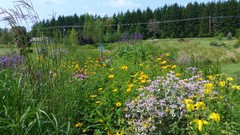
    I am 3 yrs in to a similar project to what you plan to do. Establishing a tallgrass prairie (1/2 -2/3 of a acre) on our property in the country. We have a heavy deer population in our area as we live next to a large block of land that does not allow hunting. I maintain firebreaks through, and around, the entire area. This way I can kill off and plant one small area at a time. Also, when burning, I can burn one or two areas without burning the entire prairie.

    One thing I am doing differently is actually planting young plants. I winter sow them in containers over the winter to stratify the seed and then plant them out when they are big enough over the course of the summer and fall. Big job, over 1000 plants so far, but that's another story.

    Back to the deer. From my experience, with over 100 species of forbs and grasses native to the midwest, the deer are a BIG problem. They will not touch any of the sedges or grasses, but, they will eat just about any new growth on forbs...especially this time of year (in the spring). Here, there are certain plants they will devour at any stage of growth - asters, oenothera, and all of the native legumes. I have several dozen small cages I've made from 2' and 3' fencing and I put these over small seedlings as I plant them out - I keep them in place with long landscape staples. After they become established I remove the cages and use them on new plantings.

    The one thing I've not heard anyone talk about is where they walk. I have lost more plants to them crushing small plants than I have to plants they have browsed too heavily. This could be a problem in your case, not planting seedlings and sowing seed?

    Make sure to plant at least 50% grasses, not only will deer leave these alone, but they will be the backbone of your project. Not gonna lie, it's going to be tougher than you think it will - woody vegetation, weeds, deer, weather, etc. - but, it is very rewarding. Amazing, the variety of wildlife we see enjoying our tallgrass prairie area.

  • 11 years ago

    Where you at, Plant4? Nice going project there. I would like to just add one little editorial comment: I see in the background of your photo, a thick stand of forest. Now, correct me if I'm wrong, but this suggests that prairie is not the dominant plant community where you're operating. This is my case as well. So....woody vegetation "invading" the prairie planting is as natural a thing as can be. Here in NE Wisconsin, any "prairies" were simply areas that had burned or had windthrow, and which had not yet returned to being forest. Not sure where I'm going with this except to say, let's call things what they are. A "prairie planting" can be a wonderful thing-it looks like yours is-but it is not "restoration", it is not somehow more righteous than a woody plant community. In fact, I've had to watch woodlots being torn down for housing developments, all the while having to attend to an adjacent "prairie", making sure no non-native species, etc. were taking hold. Kind of ironic, on a number of different levels.

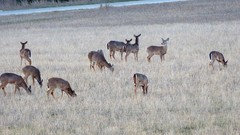
    At any rate, I'd be interested in hearing where your project is. The tails on those deer suggest west somewhere. Thanks.

    +oM

  • 11 years ago

    SE WI - Waukesha County. We are located between 2 large blocks of timber, in a 1/2 mile area with some ag fields. Large alfalfa field borders one side of our property.

    Not trying to make the point that a prairie is more 'natural' than than a stand of forest, or more important. Just trying to describe what it will take to maintain a native grassland/prairie and the importance it has in offering food/shelter for certain wildlife. Having a passion for wildlife and the connection it has with native plants I have planted over 1000 native trees in the last 8 years - I realize the importance, and beauty, the forest offers. In the two years we've lived up here I have planted over 150 native trees and shrubs throughout this property.

    Coming from Iowa, I have seen the decimation of native grasslands/prairies, as well as, the clear cutting of forested areas. So, I certainly understand what it's like to watch something beautiful be destroyed to build more houses, buildings or farms...it seems it will never end

    Our property here, was nothing but weeds, grass and this incredibly annoying plant, buckthorn when we moved up here a couple of years ago (you can add Canada Thistle to that list now thanks to our neighbors). I felt a grassland/prairie area would help diversify the property and with the addition of the right native tree/shrub plantings, be the chance to create a special place for wildlife - best of both worlds, so to speak.

    Though this area of WI is not as heavily forested as your home area, it is far different than where I have spent the past 50 years. Guess I'm just trying to create a small space like 'home' and have it fit in up here.

  • 11 years ago

    Hey, thanks bud. Sounds beautiful! And yes, welcome to buckthorn central-eastern Wisconsin! We are blessed with much of that. Sorry for the unsolicited lecture on plant communities, lol! I do that every now and then. What you've got going sounds great. Doing any burning this spring?

    +oM

  • 11 years ago

    Burned a couple of small sections in late March, but because of the slow process of growing and then planting, it will probably be a couple years before I have a large burn-off. I had forgotten how switchgrass can really take off and fuel the fire...


  • 11 years ago

    I got my book on doing fires "Conducting Prescribed Fires" by John weir. I have done 30' wide circular fires, but nothing big. I am scared and also the regulation hoops make me scared too.

  • 11 years ago

    Yes indeed-switchgrass burns readily! Surprising too how well a stand of year-old Monarda bursts into a ball of fire! I'd only add-prescribed burning is a science and an art. We use the services of a company headquartered in Wisconsin with the initials AES. I swear those guys could do this in their sleep. More generally, it may be worth the $$ to hire this part of your maintenance out to the pros.

    +oM

Sponsored
Daniel Home
Average rating: 4.8 out of 5 stars20 Reviews
Premier Interior Design Team Transforming Spaces in Franklin Co, Ohio