

Confirmed RRD
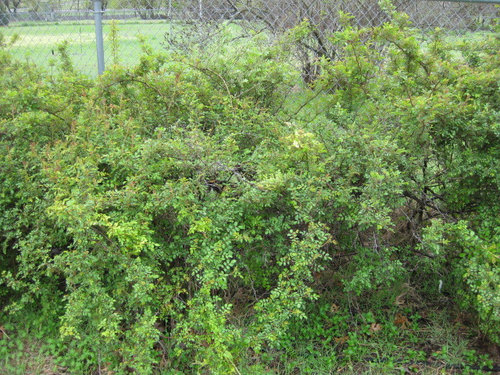
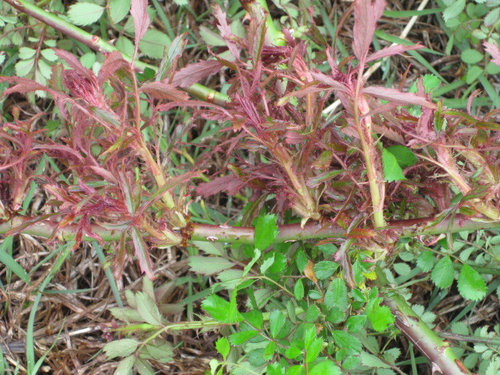
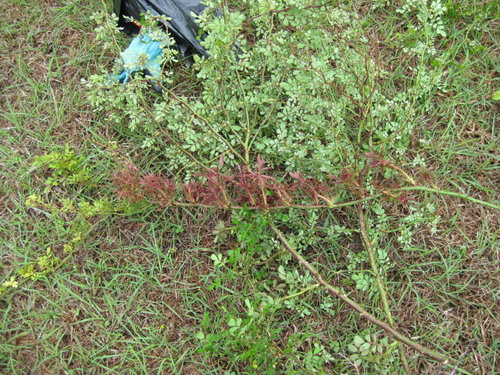
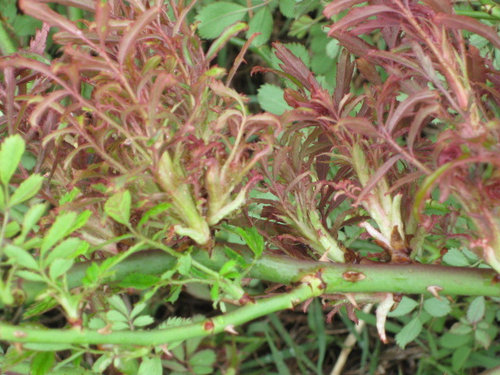
I started a thread asking about this the other day but the site was misbehaving and pics would not upload and the thread got kind of discombobulated so I decided to create a new thread. Attached are pictures of an affected cane from a Alba Meidiland I have growing as part of a hedge. I decided just for my own piece of mind to go ahead and test it for the virus and it was confirmed. Tragically I saw some suspicious growth on a Mrs. BR Cant on the complete other side of my 2 acre yard and it was confirmed as well. Didn't get photos of that.
FYI I sent the samples to Oklahoma State University Plant Disease Lab and they both checked for the presence of the mites (positive on the Alba, didn't see any on Mrs. Cant) and ran the RNA test for the virus. It was $35/sample plus I spent $10 to overnight them, so worth it to me just to know for sure. I sent them Monday and got the results today so for a complex test like that I was very pleased with the turn around time. Jen Olsen at the lab is interested in good photos of affected roses of different cultivars, so if you have any more you might want to contact her and send some if you have them.
Once I found the suspicious cane, I sprayed all the roses I own with horticultural oil to hopefully knock back mites on the bad ones and maybe protect the good ones. Getting the Albas out is going to be a big project so I could not undertake it until I had a weekend it's going to require a long stretch of daylight.
The photos depict the hedge and then the affected cane but it's on the ground lying on some other pruned canes, there was no way to photograph it in place.
I hope someone else finds this helpful and educational.
Comments (20)
 11 years ago
Can I ask how will you dispose of the infected canes? Will you burn them or throw them in the trash? Your bush looks enormous. How will you put them all in trash bags?
 11 years ago
I'm so sorry to hear this, Lucas. I wish you well with the task of getting them out and disposed of.
Related Professionals
Selma Landscape Architects & Landscape Designers · Covington Landscape Architects & Landscape Designers · Aberdeen Landscape Architects & Landscape Designers · Raleigh Landscape Architects & Landscape Designers · Hempstead Landscape Architects & Landscape Designers · Sarnia Landscape Architects & Landscape Designers · Oxford Landscape Contractors · New Haven Landscape Contractors · Albuquerque Landscape Contractors · Tampa Home Builders · McAlester Home Builders · Myrtle Beach Home Builders · Niles Home Builders · Youngstown Home Builders · Rapid City Home Builders 11 years ago
Do you have wild multiflora in Texas? I always thought the mites were able to travel like they do because of the abundance of the wild multiflora. We have no wild roses in central Florida, so I was hoping RRD would never get this far south. However, if you don't have wild multiflora and your roses still got it, I guess that's a pipe dream.
lucas_tx_gw
Original Author11 years agoKaren, getting rid of those monsters is going to be a challenge. I think my best bet is probably going to be to douse the bushes with horticultural oil so the mite are either dead or at least hopefully stuck to the canes then cut most of the canes off before we try to get the stumps out. I don't think they will go in plastic bags well at all. I'm considering just getting something like some painters plastic, laying out a big sheet and stacking the canes on that then rolling it up.
The local cities have started a task force to combat this and have declared it's OK to send the infected plants to the local compost places. Apparently the mites die pretty quickly without a host as does the virus. So not sure if I'll cart them to the recycle place or just put them in the trash. We can't burn where I live so that's not an option.
Buford, yes of course MBRC is my second favorite rose next to my 15 year old 30 foot wide Mutabilis and she of course sits next to the mutabilis and a nice Georgetown tea on the other side. Just praying I got this soon enough that they are not yet infected but it's very discouraging that she and Alba are so far apart.
I appreciate all the kind words!
I need to investigate whether there is multiflora around here. The actual native rose, R. setigra is one that apparently seems to be quite resistant. I have a lot of other native plants, maybe I'll have to go native on the roses. but up till now the antiques and shrub roses have been just as healthy and useful to wildlife as my native plants and of course the repeat bloom is a big draw.
I'm afraid to count how many roses i have, not hundreds like some people but in addition to the alba I also have hedges of The Fairy and Red Fairy which are probably 5-6 plants each and then all my old garden roses as well and a new bed of Verandas (that's 9 more right there ;-) from in an area where we removed a tree that was too close to the foundation and didn't want to put a tree back. I'm guessing 50 or so. Cross your fingers for me! 11 years ago
Lucas, where in Texas are you? I'm asking because recent reports are that RRD is moving south. For others, it is rampant in the Fort Worth - Dallas area and has started showing up 100 miles south in Central Texas but hasn't been seen another 100 miles south in Austin.
- 11 years ago
Oh, how awful for those of you in Texas. And this is without a lot of wild multiflora to help the mites spread? Ugh. I guess we'll be next. I know it's been found in north Florida. There are not a lot of roses in Florida, so I was hoping they wouldn't spread here.
- 11 years ago
Spraying with oil first is a good plan, but you should get rid of the leafy parts of infected roses right away. When I had to take out a huge alba, I just bagged the tops and painted the stubs with full-strength Roundup.
Also remove any canes of adjacent roses where leaves were touching the infected plant.
- 11 years ago
Very sorry to hear about your roses- hope that it doesn't spread any further in your garden.
- 11 years ago
The comment was made: " painted the stubs with full-strength Roundup."
H.Kuska comment. I do not recommend using a herbicide anywhere near a rose garden. There is scientific documentation that Roundup can leave the roots of a treated plant and be picked up by the roots of neighboring plants.
- 11 years ago
Do they have wild multiflora in Texas? Not a whole lot, but once RRD gets established in a city, it spreads from the infected domestic roses, often mass plantings of Knock Out.
- 11 years ago
Thank you, Michaelg. Now I dislike those mass plantings of Knockouts even less.
lucas_tx_gw
Original Author11 years agoThanks, Henry. It appears from your page that 2-4D on the stumps would also be risk to roses nearby? That is the Claude Graves who is doing a lot of education in N Texas says he does with resprouts from left over roots.
FYI for everyone, due to obligations with work and other orgs, I was not able to do anything but spray until yesterday afternoon. I've got the foliage of one of them and will finish today. We recently lost our ability to burn out here (city was informed by env. quality org in TX that you can't allow burning in our county if trash pick up is available which it is) so right now I have that giant pile covered with a tarp in an areas of my yard that is not downwind of any roses. Going to be a challege just to figure out how to get rid all that. We might have to get a trailer and take it to the recycle place. The local cities have decided it's OK to take it to commercial composting site.
Thanks for everyone's help and support. I spend more time on the Antique roses forum so it's nice to be welcomed here!lucas_tx_gw
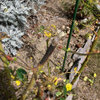
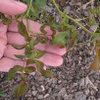
Original Author11 years agoI just got all the canes off and came in to take a rest. I thought it might be helpful to other people researching this disease to see a couple of pics I got today. I said in the original thread, the affected cane that I found was affected down the near the crown not at the tip. The tip had normal growth on it. As a result I just reached in as far as I could with my loppers and chopped at the bottom and pulled it, so I wasn't really positive where it was located. But I think I now know. Luckily this is kind of in the middle, not next to any of the neighboring roses that I want to leave Alba Meidiland doesn't normally produce a lot of really red new, growth, though the young leaves might be pinkish tinged. So as I was pruning I got down to where I could see this growing. I believe than that this growth occurred since last Sunday.
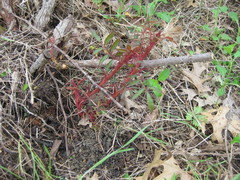
Another view
Here for contract is an apparently healthy sucker growing close by.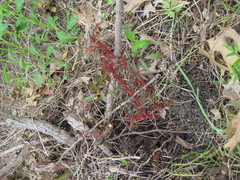
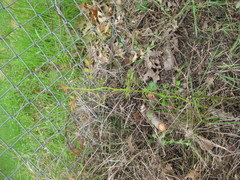
Sorry there are sideways but you can see the tiny hint of pink in the new leaves.
I'm hopeful that the infections was not too widespread but it's kind of weird it started at ground level, that's not too typical I don't think is it?
Now what to plant here? Many salvias don't overwinter here well because of wet clay but I might put some in at least for the summer till I see just how bad this RRD outbreak is going to get. I know it doesn't look like a very pretty bed or typical rose garden but keep in mind it was just growing as a big wild hedge previously.
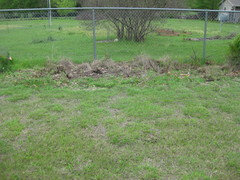
The body bags. Next step, dig out out stumps and figure out how to get rid of all this stuff! The prevailing wind is from the south which is where the fence is and there are no roses in this side of the yard, so hopefully I can get yesterday's bunch on the right there covered a little better and it can sit here for a while till I figure out a plan.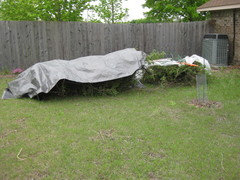
- 11 years ago
Yes, I've seen nasty red growth just like that on infected Alba Meidilland. I don't think it can start at ground level. To get into the roots or crown and affect basal growth, the virus has to be translocated from the original infection above ground.
- 11 years ago
Sorry it happened to you Lukas. Since there is nothing to be done about it, take the opportunity to grow roses that you had always wanted to. Good luck.
lucas_tx_gw
Original Author11 years agoThe more people we can get looking for it and removing affected planted especially the neglected ones in commercial plantings, then perhaps the disease level will die down enough we might be able to grow some roses, the way it's going now, it's just going to keep getting worse and worse around here.




prsb