Software
Houzz Logo Print
mjl5007

Lawn needs some help, thinking about going organic

11 years ago

I've got about 7,000 sq. ft. of lawn in central PA (Zone 6) that needs some help, and I'm thinking about going organic as well. Looking for some advice on a plan of attack for my various issues.

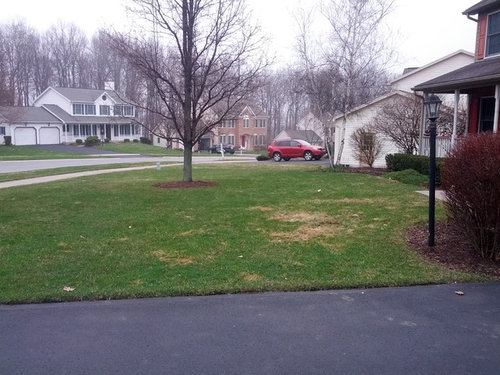
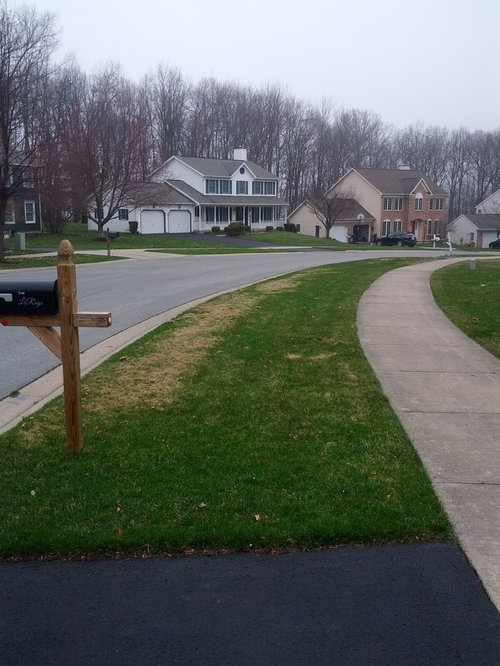
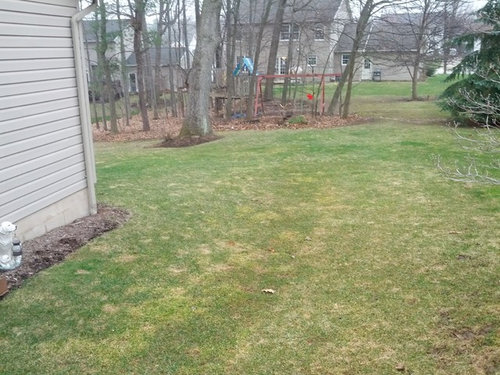
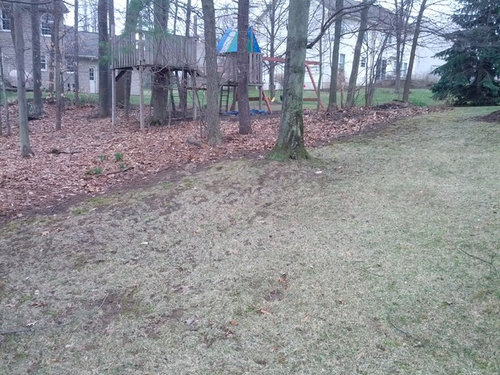
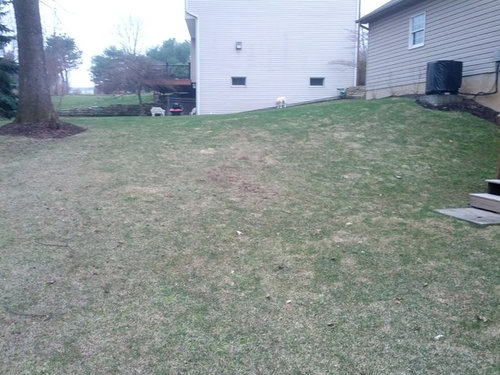
First, description of the lawn. Standard subdivision lot, 1/4 acre with 2-story house and driveway. The house faces NNW, but there is a small section of very tall mature trees between my back yard and my backyard neighbors, so the back yard doesn't get full sun like you'd expect with southern exposure. The N (front) and W side get more sun than shade, and the E side is probably 30-40% sun, all morning. The entire lawn seems to be a standard northern KBG/rye/fescue blend. The front yard is in the best shape: some thin areas, some dead/bare spots (a dozen or so, mainly along the sidewalk, I suspect from the neighborhood dogs... although our dog pees all over the yard and doesn't kill anything), but mostly average thickness green grass that grows pretty well. The W side is pretty thin, and looks like it has been patched several times in different areas with different varieties of grass. The E side is also thinner and on a fairly steep slope (a full story since we have a walk-out basement which walks out the back of the house at the E corner). The back yard is in the worst shape: very thin, uneven/bumpy, quite a bit of moss. Along the back edge of the back yard where it meets the trees is basically just bare dirt -- once the trees have leaves it's full shade along this back edge, although the closer to the house you get the more sun there is.

Now, what I've done so far. We moved into the house in late November 2013 (after Thanksgiving), so I didn't have a chance to do any fall work on the lawn. Once things finally started to warm up in early April I had a soil test done (Penn State AASL), which came back with pH 6.5, Phosphorus 18ppm, Potassium 48ppm. Recommended no lime and 3-4 applications/year of an 18-6-6 fertilizer at 5.5 lbs/1000 sq. ft. Closest I could find was a 19-5-5 at the local John Deere Landscapes, so I applied that 3 times in 2014 (mid-May, early Sept, late October). I also applied some Dimension pre-em in late April 2014, although I don't think I needed it -- the only weeds I had to deal with were dandelions, probably because the neighbors yard was covered with them. I mulch-mow fairly high and leave the clippings. I rented a core aerator and did the entire lawn in Sept 14 (what a pain in the butt) because I hoped it would help with drainage -- the lawn seems to hold water like crazy, stays sopping/squishy wet for at least a day after any significant rain. It didn't really help with drainage, and unfortunately the lawn was too wet when I aerated especially in the backyard because there were a half dozen or so places where the aerator just tore huge gouges rather than pulling plugs. After aerating I overseeded with probably 5lbs of a sun/shade mix in the front/sides, and 5 lbs of Shade Select in the back (both from John Deere Landscapes). It doesn't seem to have helped or hurt the front or sides, but the back is probably in worse shape (certainly not better) this spring than it was last year.

So, what to do? I would really like to do something this spring about the moss and the very thin back and sides, as well as take care of at least the bare/dead spots in the front. I had been planning to topdress the entire lawn this spring along with overseeding, although I'm not sure what to topdress with -- screened topsoil, mushroom compost, regular compost? I can get mushroom compost for $28/yd just down the road (comes from the mushroom farms in SE PA), or just "regular" compost from a few places, varying from $20-$30/yd. If I overseed, I think I would seed first, then topdress making sure it was only 1/4-1/2" deep at most, mainly as a mulch to help retain moisture while the seed germinates, but also as an amendment for what I believe to be pretty crappy soil. Presumably I would want to rake/remove as much of the moss as possible prior to seeding/topdressing.

As I mentioned I'm also considering going organic, or at least semi-organic (until I use up the leftover chemical fertizer I have), and I wonder if using compost for the topdressing might be beneficial in getting some more microbes into the soil. I've seen the recommendation of 1 yd of compost/1000 sq ft of lawn, which puts me at 7 yd of compost. I would probably do only 5 yd for 7,000 sq ft, mainly because that's how much I can fit in the T-Tag dump truck I can borrow from a contractor friend to pick the stuff up and I'd rather not make two trips. Besides, spreading 5 yds of compost sounds like enough work, and I'd rather not do all 7 if I don't *need* to. By my math 1 yd/1000 sq ft comes out to just shy of 1/3 inch thick, so 5 yd would be about 1/4 inch, which should still be fine, yes? We have a TSC on the other side of town where I can get alfalfa pellets, and I'm sure I can find a feed store (we're in the middle of farm country) to get other organic fertilizer material as well. I also get plenty of leaves in the fall, especially in the backyard, and boy do I hate raking and hauling them to the curb for the township to collect -- I'd be happy to just mulch them up with the mower and leave them instead.

Finally, some photos (forgive the slight blurriness, my phone camera isn't great...):

Front yard:


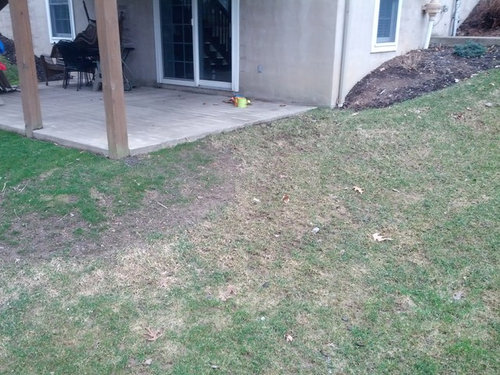
Where my leaves sat for several weeks before the township finally came around last year:


W side yard:


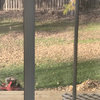
Back yard:


Comments (13)

  • 11 years ago

    One, consider getting a Logan Labs test. I've never been impressed with PSU's, which contains too little information for me to make any recommendations. The look of your lawn indicates some resource issues.

    I see some snow mold on the lawn--no big surprise after this last winter we had here in PA--and that will fade out by itself. Probably starting this week as temperatures rise and there's more sun.

    Don't seed in spring. When July hits, the roots are too thin and weak, and the grass is massively stressed. As a general rule, losses are really heavy. Spend this summer working on the soil and the chemistry, and seed around August fifteenth, just as night-time temperatures start to fall at the end of summer. That gives your grass all of fall to grow roots (and it's extremely cold-tolerant so winter won't be an issue). Then it has spring before it has to deal with summer.

    Compost is completely optional and I've actually never used it, but if you want to, go right ahead. Any amount up to 1/4" deep is just fine and won't harm your grass.

    For feeding, I use soybean meal (cheaper than most store-bought organics) at fifteen pounds per thousand square feet. That's applied in early May, August 1, September 1, and October 1. Then I winterize with a high nitrogen synthetic around Thanksgiving when growth has stopped, last mow is done, and the lawn is still green.

    For soil changes, I tended to use cracked corn at the time as it was cheap. Nowadays, not so much. However, if you can get spent brewer's grains (usually free) or used coffee grounds from Starbuck's (usually free), those are great alternatives. Oat hulls and rice hulls aren't free, but they're usually cheap...although tracking those down is a bit difficult. I don't recommend overuse of alfalfa on northern lawns as the growth hormones can damage the grass.

  • 11 years ago

    I don't think it is unusual for soil to be squishy soft for a day after a deep rain. That sounds perfect and is what I strive for. But following the rain you should allow the surface of the soil to dry completely for a week or more (many more) before watering. This time of year for you it should be more like monthly deep watering if you don't get monthly deep rainfall. I have three yards in Texas, about 100 miles from each other, and have not watered any of them since last August. We've been very lucky to get some nicely spaced out rain storms. With yesterday's showers and current temps in the low 70s, I don't see watering again for another 3 weeks at least. We are on watering restrictions limiting our watering to once every 2 weeks. Those of use who are deep watering when we can are doing fine. If you are watering more than once a week in the hottest heat of summer, then that might be causing your moss problem as well as any other weed issues.

    I think compost is over rated for lawns. Assuming you have the best compost available, you can get a better bang for your buck (and back) by using organic fertilizer instead. I don't have trucks available to haul it so for me, compost costs about $75 per 1,000 square feet. Whereas organic fertilizer costs about $5 per 1,000. I can apply organics 15 times before I approach the cost of one dose of compost. Your mileage will vary but not by a factor of 15. It's still going to be way cheaper to apply organic fertilizer than compost.

  • 11 years ago

    morpheus-

    Yes, I noticed the snow mold as well a few weeks ago once the snow finally started to melt. It's already pretty much cleared up, thanks to the sun and 60-degree weather the past two days (finally!)

    I'm going to have to do at least some seeding now, because I need to re-grade/smooth out the area around the concrete patio below the deck that I started working on last season (last photo in my post above -- notice the section of much greener grass). The previous owners had a planting bed along the edge of the slab (in front of the deck posts) that was in really poor shape and we didn't want it, so I filled it in. As you can see the lawn is 3+" lower than the patio, to the point that you can start to see the underside of the slab, so it needs to be raised. You can't really tell from the photo but I also did a pretty poor job blending the part that I filled in with the rest of the lawn, in terms of grading, so I want to smooth that out a bit as well. Anyway, my wife isn't wild about the idea of a big section of bare dirt (which will inevitably be full of weeds) all summer long, so I need to do something about it now. I understand I will likely have to seed again in the fall to thicken it up, and I'm fine with that. I've got some seed leftover from last year I can use now.

    That being said, my plan is to pick up about a yard of topsoil to re-grade (raising grade by about 1.5-2" at the thickest point), mix in some compost (1:3 compost:topsoil?), seed, lightly rake the seed in, and then possibly cover with a mulch of some sort -- more compost? Straw? Those pellets of recycled paper with fertilizer in them that expand when you water them? Should I bother with a starter fertilizer?

    Soybean meal -- where do I find that? Feed/farm store? Order online?

    We've got several local breweries around here, so I'll look into whether I can get my hands on their spent grains for fertilizer. What's the application rate?


    dchall-

    I've not been watering pretty much at all (save for some watering after I overseeded last fall), and certainly not any yet this season. We've been getting plenty of rain the past few weeks. Re: the soggy lawn, it seems to stay soggy much longer than my neighbors, in-laws, etc., and develops several areas of standing water if we have a whole-day deep rain -- hence my concern about drainage.

    When you say compost is over-rated, do you mean that in the sense that it doesn't work as well as "advertised", or simply that you can get the same benefits from cheaper/alternate sources (e.g. organic fertilizer?)

    By organic fertilizer, are you talking about stuff like alfalfa, soybean/corn meal, etc., stuff that isn't necessarily labeled/marketed as fertilizer? Or the retail packaged stuff that I can get at HD/Lowe's -- Milorganite, others?

    I went and checked out the mushroom compost at the place a few miles down the road over the weekend, and it seems like good stuff -- no foul smell, fairly fine texture for the most part. I'm going to check out the stuff at the township compost facility this morning and see how it compares (it's only $20/yd vs $28 for the mushroom compost), and probably get 4-5 yards to topdress with. I figure it's likely that I'll never want to do it again after I break my back doing it once, but I've got the energy/motivation to do it right now so I might as well.

    Thanks to both of you!

  • 11 years ago

    >>seed, lightly rake the seed in, and then possibly cover with a mulch of some sort -- more compost? Straw? Those pellets of recycled paper with fertilizer in them that expand when you water them?

    Peat moss is great. It's light, easy to apply, and a good mulch. A quarter inch is sufficient to protect the seeds, and it decays slowly enough that it'll still be mulching the lawn this summer.

    >>Should I bother with a starter fertilizer?

    Normally I say "not without a soil test," but frankly? I'm familiar with that belt of PA. Apply starter fertilizer at bag rate when seeding (or before) if it's convenient for you to do so. If not, it's no big deal to skip it.

    >>Soybean meal -- where do I find that? Feed/farm store? Order online?

    Feed/farm store, farmer's co-op or grain mill.

    >>We've got several local breweries around here, so I'll look into whether I can get my hands on their spent grains for fertilizer. What's the application rate?

    Anything up to 25 pounds per thousand square feet is great. Even if you can only get a few pounds per thousand, use it--the advantages are far greater than the amounts applied would make it seem like it'd be.

  • 11 years ago

    Drainage is a valid concern. In your last picture it looks like you have dirt mounded up almost to the window. What's up with that? Hopefully it's an optical illusion. Because if it really is piled up that high, you can have a rot problem going on inside your wall. It sort of looks like that was piled up there to keep water from flowing down the hill and collecting at the base of the house. If that is the case, you need a professional grader to come evaluate your situation. That dirt HAS to come off the house. The normal way to do that is to grade the soil so that it slopes down from the house at 6 inches down per 10 feet out. If you don't have 10 feet out to go, then you need a retaining wall so you can dig out 10 feet and down 6 inches. When he's out there he can evaluate the rest of your drainage issues.


    Compost is overpriced and is far more work than its worth. You have to apply 700 pounds per 1,000 square feet to get the same effect as 20 pounds of organic fertilizer. The cost of 700 pounds for you is $25 plus your time and delivery. Cost for the organic fertilizer (soybean meal or alfalfa pellets) is about $4. Applying compost is a daunting task involving wheel barrows, shovels, and hours of time. Applying the fertilizer takes a few minutes with a scoop. I use a kids wagon to move it around with me.

  • 11 years ago

    OK. Last Wednesday I added topsoil with a bit of compost mixed in to the area around the concrete slab in the last photo, graded, lightly tamped/walked on it, seeded with 50/50 Blue/Rye mix from Lesco, lightly raked it in, sprinkled a thin layer of compost on top (1/4" or so), and have been keeping it watered (morning and evening with the hose the first few days, and then mother nature has been watering for me since then). I also applied 18-24-6 starter fertilizer yesterday. No sign of germination yet, hopefully something soon. The seed was leftover from a 10lb bag I bought last fall, hopefully it's still good? It was kept dry in the garage over the winter.


    I also discovered that the township recycling center sells compost for $20/yard, so I got 5 yards to topdress with. I've got about 1,500 sq ft done so far. I've just been filling a wheelbarrow, dumping it in a few piles spaced apart (the easy part), then spreading them around with the back side of a bow rake. Once it's spread into a nice thin layer that is mostly on top of the grass I just run the backside of the rake back and forth at a very shallow angle to work it down between the blades, until you can barely tell it's there. Seems to work OK, although the compost does have some small bits of sticks/mulch in it that tend to not want to fall down between the blades very easily, and it can be somewhat clumpy so I spend a good bit of time breaking up clumps larger than 3/4" or so. Although, I suppose that if core aeration plugs disintegrate on their own after a few weeks, no reason clumps of compost shouldn't do the same, yes? Anyway, I'll be keeping at it as time/weather permits -- wife says the pile in the driveway has to be gone before Memorial Day :-)


    As I mentioned before, the back yard has quite a bit of moss in it, which I presume I should remove before topdressing back there. What's the best solution for that; just remove it manually with a rake (plastic shrub rake, metal tine leaf rake?) or by hand? Better to do it when the lawn is wet or dry?


    Oh, dchall -- your question re: the dirt below the window in the last photo. There's a fairly steep hill along that side of the house (right side of the photo) from front to back since the yard is level with the first floor in front and with the basement in back because of the walk-out, and there's a planting bed along the entire side of the house down that hill, which is what you're seeing below the window. Halfway down the hill in the bed there's a concrete slab where the AC compressor used to be (before the PO moved the furnace to the other side of the basement and moved the AC outdoor unit with it); you can see that empty slab in the photo as well. Anyway, I don't think there's any drainage issue here; it would be impossible to not have dirt up against the wall, and it is all sloped gently away from the house perpendicular to the wall, as well as very steeply down the hill towards the back yard. Unless I'm completely missing something...

  • 11 years ago

    There's a very specific sealing process that should have happened along the wall where the soil touches it. I don't know what that is buy when I lived in Dayton, my builder was extremely proud of his methods. In fact he flat guaranteed no leaks in his basements and backed that guarantee up with his actions. My neighbor called about a leak and before lunch time the yard was dug up all the way down to the foundation. By the end of the day they had resealed the walls, backfilled the yard, and replanted his garden. It was just amazing. So I hope you have whatever sealing you need as a barrier to keep water out of the walls.


    I wish I had reread your first post before I punched the Submit button on my first reply. You likely didn't need any top dressing on your lawn before or after you seeded. Additional soil is only needed when you have to change the drainage. You seem to need to change your drainage but that's not the reason you used it. It could be that over time, too much top dressing caused your drainage issues. And top dressing with compost over the seed is counter productive. In nature grass seed sprouts on top of the soil, not buried 1/4 inch under the leaves. Now you're going to have grass sprouting and trying to lift the top dressing. Much of the grass will be able to do that, but some of it will just run out of energy and not make it. Where you are just top dressing with compost, it sounds like you're doing it right. Rub it in until you can't see it, because the grass that gets buried under it will likely die. I've seen entire lawns smothered by compost. One bermuda lawn never did recover back to original.

    Rye grass should sprout in 1 week. Bluegrass seed will not sprout for a full 3 weeks. So don't get excited when you see the rye grass sprouting and forget to keep watering 3x per day for at least 2-3 more weeks. You will also see crabgrass seed sprouting. Ignore that - you just have to - and continue watering to get the bluegrass to sprout.

  • 11 years ago

    This sort of grading is very typical in this area on homes with walkout basements. Near the top of the hill (which you can't see in the photo), the grade against the house is low enough that you can just barely see the black sealant that was applied to the outside of the basement wall to seal out moisture. Given that the house is 20+ years old and has never had any issues with moisture in the basement, I'm not concerned about it.

    My understanding was that topdressing with compost will not change the drainage much if any, because the compost will break down/disappear -- as opposed to topdressing with topsoil, which will stick around. Is that incorrect? My main reasoning for applying the compost was to introduce beneficial microorganisms and to improve the condition of the soil. By doing this now and then proceeding with organic fertilization (alfalfa, soybean meal, others?) throughout the season, I'm hoping to a) maintain/improve the existing grass and b) improve the soil enough so that overseeding in the fall (late Aug/early Sep) will be effective. Am I on the wrong track here? Assuming not, when should I apply the first round of fertilizer? The grass has already greened up quite nicely, and all the neighbors (including myself) were out giving lawns their first mowing this past weekend (it was over 70º on Saturday, woohoo!).

    Good to know that I should expect the rye to begin sprouting in the next few days, but to keep watering until the Bluegrass comes in another two weeks or so -- hopefully.

  • 11 years ago

    One more thing I forgot to mention:

    I checked with a local craft brewery about their spent grains, and they said I was welcome to them, just bring in some 5 gallon buckets to fill up. Morpheus, any estimate on how many lbs of grain I should expect to get in a single bucket? How many buckets am I looking at needing for the yard? When/how often should I apply it?

  • 11 years ago

    One thing I just noticed that nobody has mentioned in this thread is the leaves. Leaves are an excellent, free source of organic material. Instead of raking/blowing/bagging and leaving them at the curb for pick up just mulch them in this fall. It may take two to three passes to get them chopped up but it's normally faster and less work than moving them to the curb for pick up. With the compost you're adding now and a few organic feedings through the year you'll be amazed at how many leaves the microbes can eat plus you won't have that patch of dead grass at the curb if they don't get picked up quick enough.

  • 11 years ago

    Yes -- definitely planning to do that. In fact I just outfitted my mower (Honda HR215 I inherited from my late father, still runs great) with a twin-blade mulching setup, so hopefully that will make mulching the leaves that much easier.

  • 11 years ago

    5 gallon bucket? No real idea, but I'd expect 5 to 8 pounds if very dry. Far more than that if wet, but we use dry weight for application amounts.

    How much you apply depends on your target. Ten pounds per thousand with 7K square feet? You'll need 70 pounds, or 9 to 14 buckets.

    Nobody's saying you have to do the whole lawn at once, all that often, or at ten pounds per thousand. Do what's convenient.

    Exact amounts added really aren't that important, here. They're low on the feeding range, something like corn, as they're waste stream material and the grains don't have much kick to begin with. This is more to encourage diversity in your soil microbes and add an extra kick of organics.

    As Forsheems noted, leaves are also an excellent organic addition. They count as 0-0-0 in the feeding department (they actually do have some N, P, and K, but not really enough to bother counting them). I haven't raked a leaf in nine years, although I do blow them out of the dead air spaces and shrubs into the lawn for chopping up.

    For a few years, I imported from my mother's lawn and her neighbors' lawns (all known good lawns with few issues). My top flight year? Over 200 pounds per thousand of leaf mass. Which was back-breaking.

  • 11 years ago

    Alright, I've topdressed the entire front lawn and one side with the compost -- a bit more than 50% of total lawn area, I think. It's not the most back-breaking work I've ever done, although it is a good workout -- just time-consuming. I also seeded the dozen or so bare/dead spots in the front lawn and mulched with peat moss. Sometime in the next week I'll apply fertilizer to the entire front and one side, the last of the 19-5-5 I got from Lesco that I need to use up. Should I do another late-spring feeding (late May?) or am I waiting until August to feed again? Otherwise, I'll just be spot treating weeds and crabgrass and mowing as usual. In August I'll definitely plan to overseed.


    Now for the back yard. It really is in rough shape. Moss everywhere, very thin grass, many bare spots. I spent 30 minutes clearing moss from a 6'x6' square area with a shrub rake (almost 100% moss coverage, very little grass) and realized it's going to take me forever to clear it all by hand, and especially difficult where there is more grass. Where do I go from here? Presumably I need to get the moss out before I topdress with the compost? I'm considering renting a dethatcher/power rake to make quick work of the moss so I can get the compost down (and out of my driveway). After that, what should I be doing in the back to make sure that overseeding in August is as successful as possible? Fertilize? Other amendments?