Software
Houzz Logo Print
saltygoat

Conifer Identification

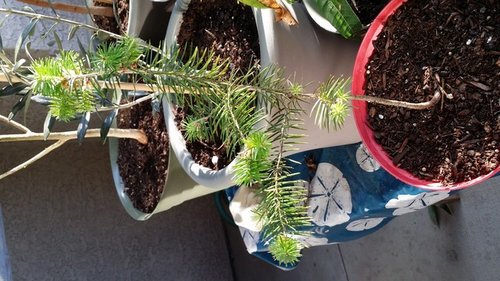
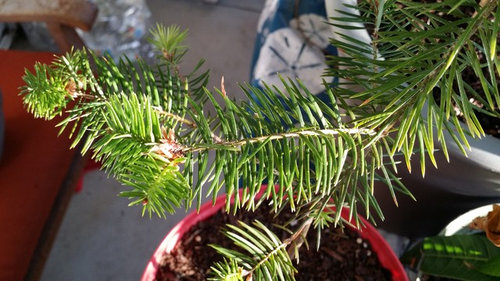
I need help with the ID for this conifer seedling. I think it might be a Douglas Fir. It come from stock gathered in Marin County, California.

Comments (13)

  • 11 years ago
    last modified: 11 years ago

    This is a true fir, one that almost looks like Abies bracteata - which would be kind of special if you happened to end up with that one. Did you dig up a seedling or gather a cone, plant the seeds?

  • 11 years ago
    last modified: 11 years ago

    Thanks...I see your point. But if it is a true fir, I find it hard to imagine that it is Abies bracteata (Bristlecone Fir/Santa Lucia Fir). From what I have researched of this fir, its native range is very limited and much farther south of Monterey. Stock trees were growing wild and they were plentiful in the area. I am going to keep researching it.

  • 11 years ago

    It is definitely a true fir, what remains to be seen is which one.


  • 11 years ago

    I'm not very familiar with them, but Big Cone Douglas Fir is found south of there. I have seen them in the Los Padres National Forest at around 3,000 ft.

  • 11 years ago

    Perhaps Abies pindrow or Abies chensiensis, but very tricky with stunted juvenile foliage. It'll be easier to identify in a few years when it has mature foliage, and easier still when it has cones.


    Resin


  • 11 years ago

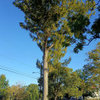
    Here are some pictures from the area where the seed stock originated; looks like more than one type of conifer growing there.


  • 11 years ago
    last modified: 11 years ago

    Outside of China California is the Home of Conifers, sites with multiple species present are not unusual. And not all kinds in every wild appearing location got there by natural means.

  • 11 years ago

    Embothrium,

    Thanks for your insights. One question: you say it is definitely a "true fir" (i.e. Abies genus); what makes you so sure of this? I guess what I am asking is, what are you looking at in the picture that makes you so sure?

  • 11 years ago

    Sword-like needles etc.


  • 11 years ago

    Embothrium,


    Thanks. After further research, I am beginning to think you were on to something with your Abies bracteata theory. I found a close-up picture online showing Abies bracteata with new and old growth; it looks strikingly similar to my seedling's new and old growth. Given that Marin County is not too far north of its native range, and the climatic similarities between the two areas, it is not such a stretch to imagine that Abies bracteata could be present near Mount Tamalpais in Marin County as well. My only real hold up on the subject is that I cannot find any other mention of Abies bracteata in Marin County, growing wild or otherwise. I need to go hiking there again and see if I can identify a mature specimen in the same area where the seed was harvested.

  • 11 years ago
    last modified: 11 years ago

    Resin...your suggestions are (unusually) quite baffling. The thought of Abies pindrow or Abies chensiensis reaching sexual maturity, unirrigated, anywhere in California, would be quite surprising as far as I'm concerned. Even in the moister parts. Do you have any knowledge of those spreading naturally in California, or anywhere in the US for that matter? Anyhow both are still very rare in the US, even in collections. In Marin county they perhaps could have made a long, bird assisted journey from the Quarryhill Botanic. (where, obviously, all of the Asian goodies get summer watering)

    The only time I've read of an Asian fir naturally spreading in the US is a report of Abies firma naturalizing at over 2500' somewhere in North Carolina near the high precipitation epicenter of the eastern US, where no doubt the very high and consistent summer rainfall made it feel right at home. Those areas that get the first orographic lift of Gulf and South Atlantic moisture-laden winds, (importantly) even during "Bermuda High" pressure systems, when the rest of the SE only sees sporadic "pop up" convection. This freedom from drought is probably why an Asian monsoon adopted species could spread.

  • 11 years ago
    last modified: 11 years ago

    Lots of regeneration from Abies nordmanniana grove(100 years +) in Highlands, NC at 3850' elev. Very limited examples of reproduction at "The Biltmore Estate" in Asheville NC.

    I've read that there are several A. bracteata specimens in San Francisco area which produce viable seed!

    Johnny

  • 11 years ago

    Thanks Johnny. That is interesting.
    Though Asheville is actually in a rain shadow compared to Highlands, I would suspect its standard deviation of rainfall is lower than most of the SE. The gardens of Biltmore certainly seemed very lush in my admittedly vague early 1990s, teenaged memories of the place.


Sponsored
Snider & Metcalf Interior Design, LTD
Average rating: 5 out of 5 stars25 Reviews
Leading Interior Designers in Columbus, Ohio & Ponte Vedra, Florida