

rain fed stream under basement
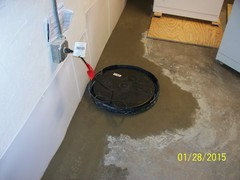
Sometime after this house was built in the 70s, an underground stream moved/formed under the walk-out basement slab. It is at an uphill corner. The previous owner had the slab jackhammered and installed a sump pump.
We've been in the house 18mths and this winter the stream seems to have changed course. The sump pump still works steadily when it rains, but we developed new signs of moisture in the drywall of the bedroom closest to the sump pump.
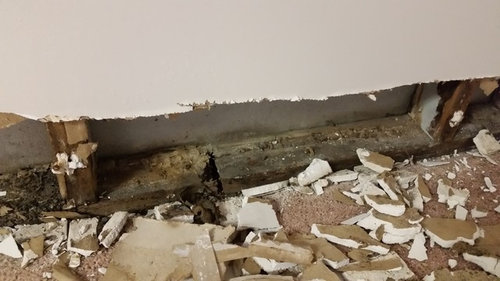
We've removed the drywall and discovered the base wood and some of the studs have rotted. A week ago the wood was dry, but today, after a steady overnight rain, some spots are as wet and mushy as a kitchen sponge.
We know we need to remove the rotted wood and drywall, then deal with moisture seeping through concrete wall blocks.
My questions are:
1. what else do we need to watch for?
2. Will the underground stream compromise the 6" thick slab?
3. Do we need to save up to install a second sump pump in the basement?
Photos:
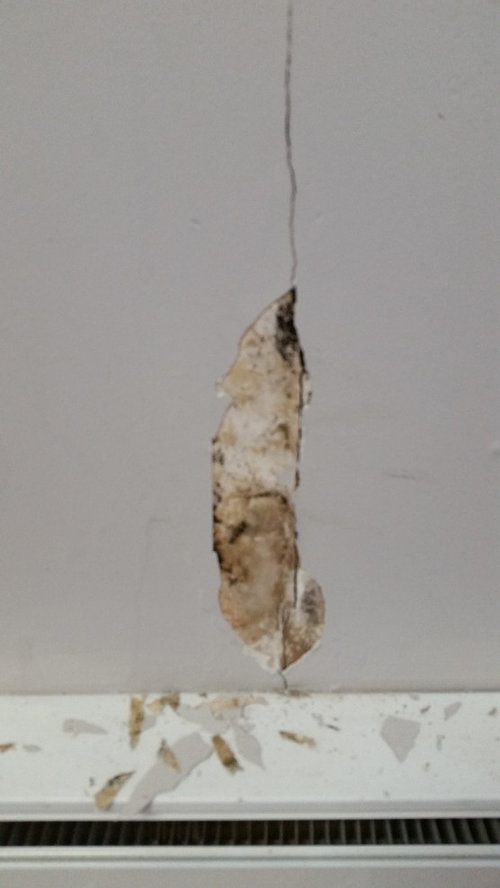
First sign we had a problem. The mold wasn't visible until I pulled the crack open so I could patch and paint. The damaged wallboard was clean in January with no cracks, before snow melt.
Next after removing wallboard.
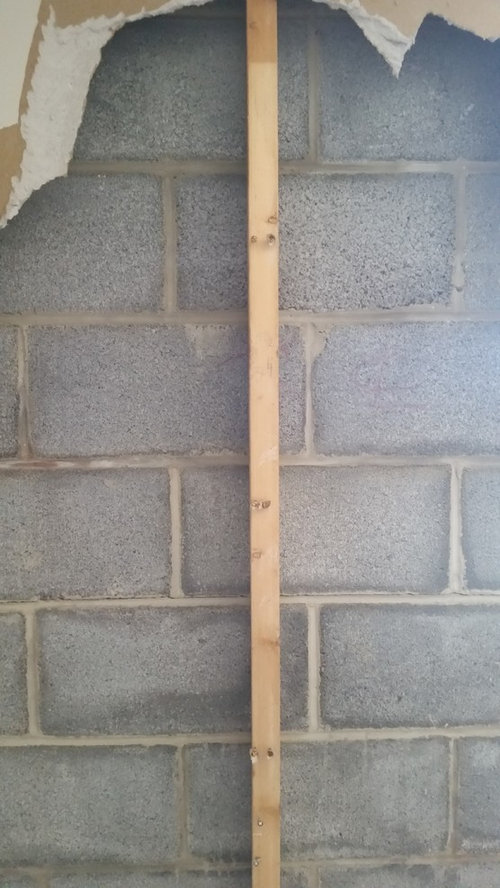
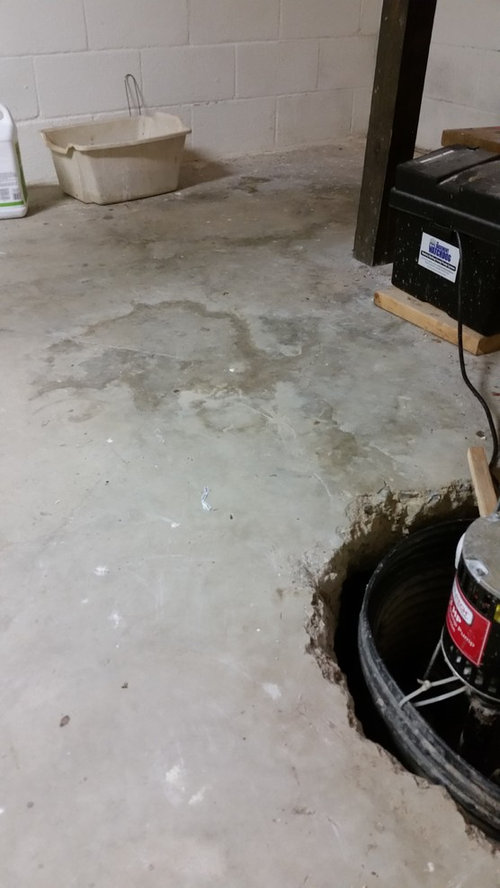
and last, the slab around the sump pump
Comments (41)
Kathleen Marineau
Original Author11 years agoHaven't found any pooling or water saturated soil next to house, but have started on some regrading in a couple of potential problem areas. Gutters drain away from the house into front lawn and side yard, both downhill of the problem areas. Sump pump drains into raised vege bed 30' from house.
I'm just trying to get some education so I can recognize when a "pro" is making unreasonable or excessive recommendations.
Trying to divert the underground stream would mean removing the sun porch or tearing down the garage then trenching more than 10' through shale, clay and solid rock. At our age, not going to bother. We'd have to live to be 100 to pay for that much work.Related Professionals
Mobile Interior Designers & Decorators · Topeka Interior Designers & Decorators · Raleigh Interior Designers & Decorators · Portsmouth Interior Designers & Decorators · Leominster Interior Designers & Decorators · Bangor Interior Designers & Decorators · Tulsa Architects & Building Designers · Myrtle Beach Architects & Building Designers · Poughkeepsie Architects & Building Designers · Ottawa Architects & Building Designers · Minneapolis Kitchen & Bathroom Designers · Worthington Kitchen & Bathroom Designers · Lebanon Kitchen & Bathroom Designers · Brooklyn Kitchen & Bathroom Designers · Carlsbad Kitchen & Bathroom DesignersKathleen Marineau
Original Author11 years agolast modified: 11 years agoDuring yesterday's storm we had new areas of 100% moisture reading on meter, all on concrete slap at foot of basement stairs, seen at top of the last photo. The area has efflorescense, but not visible water, just dark staining.
 11 years agoThis problem will only start to be solved by a professional that can explain to you exactly what is going on here. It may take you several weeks of appointments with different contractors and several quotes to understand the entire scope of work for your situation.
By getting several eyes on the problem, you may be surprised that there is a creative solution that won't be as expensive as other options.
Surely there's going to be some expense involved, but you need to know the entire picture before wasting money putting band aids on this.
Best wishes in getting this solved!Kathleen Marineau thanked tlcnc5005Kathleen Marineau
Original Author11 years agoUpdate: We diverted a gutter drain from the most uphill corner of the garage by laying 50' of non-porous drain pipe just below the soil line. It extends about 30' downslope, maybe a 5" drop total, exiting to the surface next to one of the raised vegetable beds.
Since then, the sump pump is running less often and water seepage through the walls is less, except in the area around the water heaters where pipes that touch the exterior wall are wet as is the floor. 11 years agolast modified: 11 years ago
 Waterproofing Basement · More Info
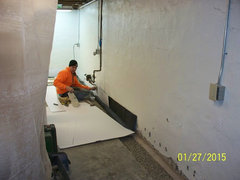
I uploaded some of my basement waterproofing, this one shows the concrete blocks that have had weep holes drilled and it's being covered with felt (leads down to the drain pipe) and plastic, to be followed with a layer concrete.(Note: the previous owner had tried to seal the concrete blocks with a layer of grout/concrete and then waterproof paint...didn't work, the blocks filled with water and it seeped through...given time).
Have you had any basement waterproofing companies look at it? It looks like your concrete blocks are not drilled and have a path to drain to the french drain along the inside footing. Was the complete inside perimeter trenched to the sump pump pit? If you have a walk out basement they may have only done the uphill wall, not even the side walls.When my basement was waterproofed they drilled 1/2" holes in each concrete block (if it was dirt, they drilled higher up until air was found). Then a felt mat and thin flexible plastic covered these holes and allowed water to drain to the french drain/sump pump pit.
Winter time basement humidity dropped to below 35% (my dehumidifier hasn't extracted water since, even with 11" of rain in June2015).
Kathleen Marineau thanked rhdricoKathleen Marineau
Original Author11 years agolast modified: 11 years agorhdrico: I haven't found a basement waterproofing company in my area. I think there is one in the Martinsburg, WV area, about 45min away, a couple in Hagerstown, MD, an hour drive, and in Winchester, VA, also an hour away. We called one that said it serviced all of the eastern panhandle of WV, but never got a call back. A contractor friend drove up from Warrenton, VA (1.5hr one way) and suggested a second sump pump and install french drains on the outside. A man who does remodeling on the side and works for the local Ace said to replace our old sump pump with a newer model with higher capacity. He gave a quote that left hubby in a bad mood for a month.
I read about the interior wall drains, but couldn't figure out how to do them without gutting the entire downstairs apartment, including the kitchen. In the bedrooms the egress windows open to 3' deep window wells. One of the kitchen windows sits about a foot above grade.
I'll take some exterior photos to show the level of ground to basement wall.
Kathleen Marineau
Original Author11 years agoThis is the outside of the basement room where I first found mold in the drywall seam. To the right is the unfinished portion of the basement, the PVC is the sump drain which ends downhill of the propane tanks.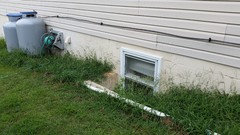
We have water oozing through the masonry wall where the propane tanks are located which is where the water heaters and water well pressure pump are located in the basement.
The previous owners rented the main level and basement separately, thus 2 tanks and 2 water heaters. It was listed as a single family home when we bought it, partly because the septic percs for only 3 bedrooms, 1 kitchen, 1 laundry. We are using 1 upstairs bedroom for an office and 1 bedroom in the basement. We'd like to use the room this window is in for a craft/sewing room, if we ever get it back together.
Yes, I need to get all the grass out, did once, but need to again.
- 11 years agolast modified: 11 years ago
A co-worker had a house with a walkout basement (wish I had one!!!!) and he did exterior french drains on the front and sides, draining to the ravine in back...but still had water problems. Really needed the interior french drain and walls draining.
I will be covering my walls, but may put up some plastic waffle mat which is for basement walls and floor...allows some air flow and water drainage. I'll get a picture and post it.
P.S. Would it be possible to move wall sections 3-4 feet from the wall? If the walls are wet in some spots you should check everything.Did you check for weep holes at the base of the block walls?
Kathleen Marineau thanked rhdrico Kathleen Marineau
Original Author11 years ago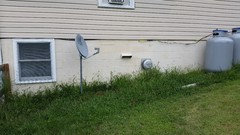
Here is the basementy kitchen window, heater vent and propane furnace exhaust. The end of the sump drain is near the dish antenna. The ground continues that slope for about 2 feet beyond the fence which is at the corner.
Again, it all needs a thorough weeding.
Kathleen Marineau
Original Author11 years agoThere are no visible weep holes. Here is a photo after we removed the interior wall and baseplate, which was so rotten I put it on the compost pile.
More photos coming.
Kathleen Marineau
Original Author11 years ago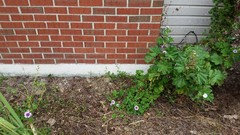
Outside fireplace wall which is the east end of the unfinished portion of the basement. The ground next to the wall is about 3-4" lower than at the walkway I'm standing on to take the photo. I'm not sure if I should apply more parging before adding fill dirt to correct the slope.
Kathleen Marineau
Original Author11 years agolast modified: 11 years ago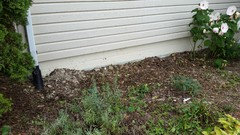
The front of the house is cleaned up. This is the front rain gutter drain which goes under the walkway, coming back to ground level about 12' away in the front lawn. I planted rhubarb around it. About where the flowers are located is where the third underground stream comes into the basement. As you can see, this shrubbery bed slopes away from the house. I do plan to add more soil, but am considering renewing the parging coat first.
Kathleen Marineau
Original Author11 years agolast modified: 11 years ago
The front window well has the misfortune of being under the main level living room window A/C unit. There have been no problems with water intrusion in this part of the basement.
Kathleen Marineau
Original Author11 years ago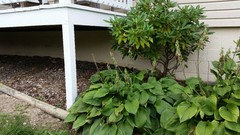
Last front basement wall photo showing that the area under the porch is dry. This is the family room area in the basement.
Kathleen Marineau
Original Author11 years agoHad to re-log on to get my email to update. Here is today's photo of the persistent moisture seepage in the basement. The vertical black lines are where the studs used to be. The "fix" after Hurricane Sandy included drylock a few rows up the masonry block wall, but did not include removing the wet studs and base plate.
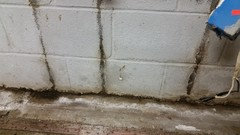
This is directly under the window on the south side of the basement, the one in the photo showing the PVC for the sump pump outflow. This is the dry season and the sump pump hasn't run in a week or more.
- 11 years ago
What kind of soil do you have? Is there an agriculture extension in your area of the state? Home Depot and Low's have approved contractors for home repairs (and they're focused on satisfied customers!). My co-worker has used them for kitchen floor tiles, exterior carpeting, and several other projects...quite happy with the work.
My favorite house description is that "it's in a clay bowl"; since my ground is 100% clay it's true for me. That means that any water that peculates down (through the topsoil) within several feet of the foundation will be funneled to the foundation.
You're lucky that the sloping ground means half of your basement wall doesn't have water held against it (and it's easy to use waterproof paint on). The windows wells are bad news (yeah the daylight is great, but) all I can think is "they funnel water to the basement wall". Possibly outside french drains to quickly drain along the side walls (with the sloping ground)?
I priced an egress window for my place...$5000, with easy access for heavy equipment etc. They have to dig way below the basement floor to provide a dry well to hold any rainwater or put in a sump pump or tie the the interior french drain along the footing. Note: the bottom of my basement windows are at least 4" above the ground.
I used something like this (below) without insulation on part of my basement floor. It allows drainage and keeps the wood dry and even without insulation is much warmer that concrete. This is Amdry Insulated Subfloor panel, I used 2' x 2' tiles ($5.50, Menards) covering 1/4 th my basement floor. 2' x 2' tiles are also available at Home Depot. I'm interested in the Amdry but wonder what the cost is.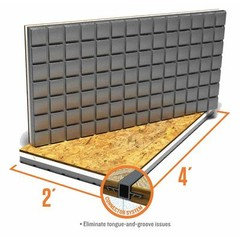 Kathleen Marineau thanked rhdrico
 Kathleen Marineau
Original Author11 years agoSoil: 50/50 broken shale and clay, visible in the front yard photos. Water runs through rapidly. The sump pump starts running within 3 hours of the beginning of a rain storm. If is doesn't rain for 2 days the ground is as hard and dry as a month old bagel. The contractor we hired to install a fence for our dog and chickens broke a jack hammer and a powered post hole digger without ever hitting bedrock. He managed to get the posts a foot into the ground.
The subflooring looks interesting. How much does it take off the floor to ceiling height? We have 7'6" to the hung ceiling tiles which clear the upper floor joists by 6". In that 6" is all the electrical, gas and plumbing, including the drain traps for the main kitchen and 2 bathrooms. BTW: the main floor ceiling height is also 7'6".
Kathleen Marineau
Original Author11 years agoFound Dricore on Lowe's website, went to Dricore.com. Now to convince hubby. I'd like to do the walls in that one wet room also. Thank you very much for the suggestion, it may solve our problem at a price we can afford.
We used Lowe's for our kitchen reno and bathroom updates. We were happy with the work and satisfied with the payment terms. It'll take us a few years to pay it off on our retirement income but we're very happy with the improvements.
- 11 years agoI have tried to follow this play by play. All I can add is I have seen on This Old House and various HGTV, etc shows where they have excavated along block or poured concrete basement walls to below the base and installed drain tiles....I'm sure you have done that or ruled it out. Wish you good luck in your new home.Kathleen Marineau thanked patrinkac
 PRO11 years agoLook up Building Science Corporation. Joseph Lstiburek
He wrote the book on fixing problems.Kathleen Marineau thanked dk architects, inc.- 11 years ago
Well, there's ''problems'' and PROBLEMS. This is the latter and will take a heck of a lot of money thrown at it to even get close to a fix. It might be smart to think about an exit strategy here.
Kathleen Marineau thanked User Kathleen Marineau
Original Author11 years agoIf I could get Holmes to come this far south, I'm sure he would send us to a motel, disconnect the propane tanks and trench down to the basement cement slab. He would also remove the sun porch which is outside the original footprint of the house and is uphill of the only side of the basement that is fully underground.
We bought this house in 2013 because it was within our budget, less than 2 hrs from our son and grandkids, and had extra space in case our daughter and teen granddaughter needed to move in with us, again. Which happened 5 mths later.
We are stuck with it for at least 3 more years, so we need to minimize mold risk without taking out a 2nd mortgage in our old age. I'm all for permanently removing the carpet and leaving the concrete floor and masonry wall open to the air. But, hubby wants to return the room to how it looked when we bought the house.
- 11 years ago
Your house looks pretty new (ok, mine's 1924), can you find any information on how it was built (possibly with exterior or interior foundation footing drains). Clogged with dirt? Possibly the concrete blocks extend below the concrete floor, with weep holes that drain to the sump pump pit (do you see pipe entering the pit from both walls? If not, jack hammer the concrete above the footings, maybe just drilling weep holes and pathing to the french drains, along the uphill wall and partway along the side walls.
I know on my exterior backfill the water will travel along the footing (I have a open, but covered, concrete porch and water used to seep along the clay surface (under the concrete) to the backfill and then along footing to a protected area...with major leakage.
Oh yeah, how 'bout plastic covers for those window wells?
P.S. My basement ceiling is 6'10", with a cross beam and main duct dropping down to 6' 4", across the middle of the basement. Very tight.
Kathleen Marineau thanked rhdrico Kathleen Marineau
Original Author11 years agoThis is a 1976 modular home. Basement built on site to spec, then 5 stick-constructed modules trucked to the site for assembly. The center line weight bearing wall is 8" thick - basically 2 walls of 2x4 studs sandwiched in place. 11' from center to outer wall on both sides. A separate 2 car garage with a full loft and 10x20 shop may have been added at the same time or later. The space between the house and garage became an enclosed sunporch with a pine floor, when I don't know. I might be able to learn when if the local property tax office has the records.
There is a 3' high retaining wall 3' from the side of the garage, opposite the house and about another 5' rise from there. We've diverted some of the water that comes from that hill, but haven't figured out how to keep the rest from seeping under the garage and the sun porch to the basement wall. If you look at my original photos you can see stains on the concrete where a rain-fed stream runs to the sump hole. When it rains we have 3 distinct streams. We can see the water exit the rocks in the 2-3" space between the walls of the hole and the shell of the sump drain enclosure. It is obvious that the hole in the concrete floor was hacked out some time after the house was built, but before Hurrican Sandy.
There is no documentation of any exterior drainage. We can see that something black was applied the the exterior of the basement block wall and cream colored parging applied above dirt level and on some of the interior blocks, but not all.
Kathleen Marineau
Original Author11 years agoInteresting information on the Building Science Corporation website, such as do not put a vapor barrier on the inside if you have one on the outside. The drawings they showed listed semipermeable insulation, air space, then drywall with latex paint for the interior so a dehumidifier could remove excess moisture.
Which again has me questioning the use of drylock on the interior of the block wall. Everywhere else and everyone we've talked to in person said to apply drylock before redoing the baseplate, studs and drywall.
- 11 years ago
 Does your sump pump pit look like this inside it? This is how my french drain lines drain.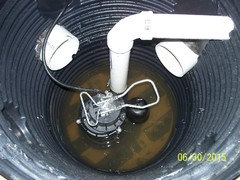
I'm wondering if there was even an interior french drain installed at all. (do you have the "basement built to spec." info) In my exterior pump pit picture, you can clearly see the fresh concrete around the sump pit and along the wall/floor (above the french drain lines).
If water is really gushing in between the basement wall/floor joint, it needs to be addressed on the outside of the wall. The concern is water flow washing the backfill out on the exterior side. Mine was seeping clear water, but the dirt may have been trapped inside the concrete blocks (some had to be drilled higher up for an open area), but dirt was being washed from my backfill (which is covered by a concrete porch...no sink-age visible yet), which you don't want.
I have seen articles where a french drain uphill of the house diverts the water (below ground) so the house stays dry. Possible 4'-6' deep, depending how the water is flowing through the soil. It could be done well away from the house. Local experts in West Virginia should know.
Note: with my walls draining, I will use/refresh the drylock paint on mine because the wall is drained (it's only on one side anyway). Basically, the concrete must breathe to allow moisture to evaporate. They specifically say not to seal both sides of the concrete, that would trap any water (from leaks above, or where ever) in the concrete!
Also, some Waterproofing Companies may estimate for the "gold" level water proofing. I had one estimate for $10k with 2 pumps and a battery backup pump in the sump pump pit. The other estimates were $4-5k (for 130' perimeter) with a single sump pump.
Kathleen Marineau thanked rhdrico - 11 years ago
Water issues can be very destructive, both to your house and to your health (and the resale value). You bought this house just two years ago, but it appears this may be a long-standing issue which predated the sale. Depending on your state's disclosure laws, if any, and any representations made by the seller, agent or broker, they may have liability to you for undisclosed major issues. I would recommend paying for a legal consultation.
Kathleen Marineau thanked qam999 Kathleen Marineau
Original Author11 years ago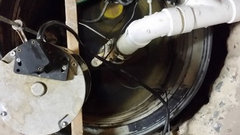
The complex of pumps we inherited with the house. Main pump at the bottom left, battery powered backup pump in upper left with the yellow alarm box was added after Hurricane Sandy turned off the power for 3 days. The basement had 6" water according to the disclosure form. According to the report they also had to replace the main pump.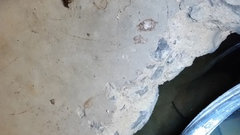
This shows the gap between sump container and the wall of the hole. There was no water problem and no sump pump when the house was built in 1976. Don't know the year the hole was jackhammered through the concrete then several feet into the bedrock.
No french drains under the house because there wasn't any evidence of water when the hole was carved for the basement. Underground streams around here tend to meander as they work their way through the shale hills (they call them mountains in West Va, but they're hills to us California natives). At Skyline caverns, about 45min from us, they have an underground stream big enough to support blind fish. They don't know it's source and haven't found it's outlet even with dye tracing.
- 11 years ago
Have you seen Basement Systems of WV web page (http://www.basementsystemswv.com/basement-waterproofing/french-drain.html)? Do you know what kind of basement floor you have (wall-floor-footing, monolithic, or something else)?
The sump pump pit should be sealed around the floor and have a cover...reduces the basement humidity significantly and radon (hopefully).
My (worst case) seepage will easily drain to the existing floor drain. If you have battery backup (because the basement floods), then a generator is really needed. We had an 11 hour power outage in June 2015 (which is rare here) and it rained the whole time...lots of houses had a pile of wet carpet in front of their houses, despite their sump pump.
Kathleen Marineau thanked rhdrico Kathleen Marineau
Original Author11 years agoYeah, to the wet carpet. Battery backups only last a few hours. We had a 3hr outage last April and the battery failed. Sunday afternoon the right auto parts store was open and had deep marine batteries. 3 of us bailed until he got it installed, then we balled some more because the smaller pump couldn't keep up. The water stayed in the unfinished portion of the basement, but barely.
I looked at the basement systems several months ago. In order to take care of our second wet area in the laundry room we'd have to remove 2 water heaters and the well pump. We used towels and blankets to sop up the standing water in April, May and June. Since then it's only been damp.
Hubby says no to any extensive, or expensive solution, or anything that would cause us to move to a motel for the duration of retrofitting. Which includes installing wall drains on the inside or resealing the wall on the outside or installing exterior french drains (have to disconnect the propane tanks).
Kathleen Marineau
Original Author11 years agoTo all who have commented on this thread:
Thank you for your shared experiences, advice and links to possible solutions.
Hubby has decided that what I've done on the outside is sufficient.
He"s going to drylock part of the basement concrete slab and up the
masonry blocks then put the wall back together. Not sure if he'll pay
someone to replace the studs and put up the drywall, or DIY.I
expect the problem to return the next time we have a couple feet of snow
and heavy spring rains. In the meantime, I'm not putting anything
irreplaceble in the basement.- 6 years ago
If at all possible, get a pro solve the problem -- not patch it. Sump pumps are not the long term answer.
What is in your basement -- is there necessary living space there?
Hope you've already ripped out all sheet rock or other drywall anywhere near this problem. Hidden mold will spread faster than mold exposed to light and heat and air -- spread faster than mold that is on a surface that can be cleaned.
If, for cost reasons, this becomes a DIY project and you know you're staying put, seriously consider beginning the project by using treated boards to add supports to the floor -- the basement ceiling --a lot of support in case the exterior wall fails. Create the weight bearing wall(s) to l be useful even after you've solved the water problems.
The water entering the basement needs to be turned away from the exterior wall of the home and waterproofing needs to be added to the exterior of the basement wall, preferably all around the house even if it can be done only one section at a time.
What is the slope of your yard beyond that basement wall and how large is the tract of land on which your home sits -- Is digging a ditch above the house to turn the water into a drainage ditch and away from the house an option?
Sympathy extended. Hope you get this resolved soon.Kathleen Marineau thanked suezbell Kathleen Marineau
Original Author6 years agosuezbell, Your suggestion to dig a ditch uphill of the house is also our son's idea. We have about 50' to the uphill property line, which is the side of the garage. There is an existing row of shrubs, I think it's chinese boxwood, which we decided this month will need to come out anyway. Haven't figured out why they were put in such an out-of-way place. We have nearly 3 acres, so there's lots of room to work on all sides of the house.
We painted drylock on the exposed basement walls and hired someone to rebuild the interior wall. Each fall after cleaning out flower beds, and after snowmelt, I refresh the regrading to encourage surface water to drain away from the house. The sump pump PVC drain is now underground and exits downhill of the house. So far we've not seen a return of excess moisture in the unfinished basement space around the sump pump, although I'm sure it will come back if we get a couple of wet summers in a row.
Soon as we get a few debts paid off, we plan to check into hiring a pro to get the uphill side of the house dug out and drained properly, along with some landscaping to redirect water. It'll mean hiring a back-hoe to get through our broken shale & clay ground.
In the meantime our daughter, a horticulture specialist, and I do more re-landscaping each year as budget allows. We've removed large shrubs and trees that were close to the house, created small channels of perennials and flowers to redirect surface water, added a mounded shrub bed 20' from the house to intercept uphill runoff and other small projects. The cumulative effect plus a dry summer has helped a lot.- 6 years ago
Before the expensive repairs are made, you and your contractor must find the source of this underground stream and 1)erect a wall to redirect it, 2) build a channel to redirect it, or 3)if it is coming from someone else’s property, you and that homeowner will have to come to an agreement on how to deal with this water. You may need to get the city building department involved if a neighbor’s attempt to solve a water issue on their property has caused the water to invade your property. If there is natural drainage from a higher area onto a lower area, the city may have acceptable suggestions to correct the drainage. Try not to involve a lawyer unless it is absolutely necessary. Fixing the damage before fixing the cause is a bad idea.
Kathleen Marineau
Original Author6 years agofelizlady, don't know where you live, but around here the underground is laced with small streams. Even Skyline Caverns, a family friendly cave system with an underground stream only an hour away has been unable to find out where their water comes from and where it goes. They have enough water in their cave stream for blind fish.
It is not possible to block the underground natural streams, nor their tendency to change course. They were not here when the house was built in 1976 according to the original owner, whom we bought from. They showed up in the 90s.
Our goals are to manage the water from the underground streams, divert as much of the rain and snowmelt as we can, and keep the basement apartment livable.
- 6 years ago
Just curious, there's no floor drain in your basement? Are you connected to city sewer? I never mentioned that I do have a floor drain in my basement, so even before "water proofing" the water wasn't more than 1/8 of an inch deep. In fact I just added a basement bathroom with another floor drain. That is the basement low area.
P.S. I've started on adding a wall along the toilet, it won't always be so "exposed".
P.P.S. The bottom of the walls rest on hockey pucks (w/bolts in the concrete floor) to allow any water leaks a flow path the the floor drain.
- PRO6 years ago
I hate to say this but no matter how many pics you post and how many answers you get from people guessing you still need a pro to deal with your issues and IMO hubby needs to slow down and get some real help before he does anything.. Dri core is okay for a tiny bit of water that might get into the spce under the flooring I have it in my basesmtn but it is not made to handle anything more thn that.
Kathleen Marineau thanked Patricia Colwell Consulting Kathleen Marineau
Original Author6 years agoNope, no floor drains. Never saw a single floor drain when we were house hunting, not even in the house we rejected because of black mold covering the wall and floor behind the oil tank for the oil burning heater. No one we've talked to at church has a floor drain in their basement. Maybe it's just our area, eastern WV, northern VA and western MD. We've toured brand new homes which have sump pumps standard in their basements, but no drains.
Maybe it's because we're not in a city and not connected to a public sewer system.
 6 years ago
You have a serious drainage problem that clearly is getting worse. And the longer you wait, the more expensive it will be to correct. And if you don’t fix it properly, it will significantly reduce the value of your property when you sell. This is not the time to monkey around with handymen contractors. It’s way beyond Home Depot and Lowe fixes. You need a drainage expert. This kind of work is often done by landscape architects but you’ll have to make sure the one you hire is not a just a plant designer but has a speciality in drainage issues. If there is a University in your state/area that trains Landscape Architects, start there. Or chat with the best plumber in your area for some suggestions on experts. Good luck!
Kathleen Marineau thanked Sonja SuitorKathleen Marineau
Original Author6 years agoMy challenge is to convince my husband to put money into the drainage issue. He thinks everything is fine and has a "so, what's new" response when I show him the 98% reading on the moisture meter when it is setting on the basement floor.
Sometimes I think he figures he'll be dead (we're in our 70s) before it's so bad he must do something about it. It has no visible effect on him, so he doesn't think it's important.













miacometlady