Software
Houzz Logo Print
traveler000mkl

Improving soil drainage

11 years ago
(Zone 7a VA)

Help!

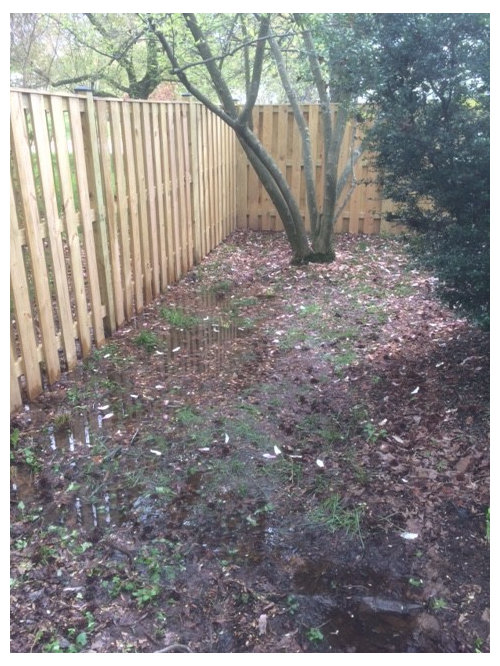
This is the East side of my house, and an area that we never really use because there is not much there. It is pretty heavily shaded once all the trees sprout their leaves. Tree in the picture is a large southern magnolia (which is healthy), and also our neighbor has a sweetgum that is not too far. I want to plant a shade garden here this spring, but today after a night of rain, I noticed this big rain puddle that is up to a few inches deep.

I never noticed this much before, but probably because we just don't go there often especially right after the rain....

Is there something we can do to improve the drainage in this area, such as amending the soil? Or would it need bigger project such as french drain, etc?

There is a drain further down (i.e., behind my back when I was taking this picture) alongside the fence that previous owners put in but not sure how effective that is. Part of that is broken as well..... I assume nothing really will grow well here (currently it is grass/weed patch), and we want to do something.

I would appreciate any opinions!


Comments (7)

  • 11 years ago

    Soil is few inches of decent soil and weed barrier of some sort and below that is clay. I have no idea when the barrier was put down, we have been here past 3 years, and previous owners lived here since 1969.

  • 11 years ago

    Get rid of any weed barrier fabric - pull it out. You can't do anything to improve the soil deeper so long as that is there. Any soil amendments will just sit on top. If it were me, I would then pile on ground up leaves (mulch of whatever type), over the whole area where you want to put in the shade garden. Things like azaleas don't like wet feet, but they love a deep mat of leaves. Some of the leaves I would mix right in with the soil - that moisture will help anything incorporated rot down quickly. It will bring the soil surface level up a bit as well as helping the soil be more absorbent so the moisture soaks in. The worms will go to work for you, and it really won't be long before you could plant all sorts of shade-loving plants.


  • 11 years ago

    Thanks drmbear, this area already gets a lot of fall leaves so that should not be hard. I think that is the only reason why there is that few inches of good soil on top of weed fabric.

    You don't think raised soil level will bother my magnolia right?

    And when you say long before, how long do you mean :)? Few years? Next year?

    I unfortunately planted a few things here last weekend, I will need to relocate those poor plants to somewhere else until I fix the issue here.

  • 11 years ago
    last modified: 11 years ago

    If you decide to modify the clay with sand, remember you'll be working it roughly 50-50 and it adds up. A thousand square feet of clay to remove and replace, four inches deep, is twelve heavy cubic yards, so it's good to avoid carting stuff away. As a rule of thumb, think of sand for drainage and organics (tons of it!) for growth. Two separate goals.

    If you do go the French rubble drain route and use an imbedded tube, look into local conditions concerning using weed barrier/landscape fabric to guard against finer materials seeping around the gravel/rubble. It can get in the way of drainage, even at what might seem to be a super slow rate. Here, in our very arid ground, I wrap a perforated three or four inch plastic pile with sunscreen when I bury it in the fill, so if the fabric/pipe clogs the fill might still drain and vice-versa.

  • 11 years ago

    The neighbour's Sweetgum (Liquidambar) will be loving that water. They get their roots into drains and all sorts of things. It might be slurping up quite a bit of it.

    I would get rid of the weed barrier. And then I would start building up the soil by adding fallen leaves, straw, horse(or cow or sheep) manure - whatever I could get my hands on; but never sand, which would make almost no difference to drainage in a clay soil.

    I think shade loving plants would love such a site. Grass doesn't like those sort of conditions. Helleborus comes to mind as something that would rejoice there, and cyclamen. And if in some places you manage to build a spot up a bit higher, then something that needs better drainage could grow quite successfully.


  • 11 years ago

    Why does the water accumulate there? Is it because of compacted soil or a high water table?

    If it is because of compacted soil adding sand will not do much and a lot would be necessary to do even that little bit. The best material to lessen soil compaction is organic material.

    If that water is there because of a high water table, ground water too close to, or above, the surface, If that is what is causing the water accumulation drainage, a well designed and constructed system will be needed, and where that excess water goes needs to be properly planned since you cannot dump your excess water on your neighbors.

    The Natural Resources Conservation Service (used to be the Soil Conservation Service) people in your area may be of some help since they have surveys that show the high water tables.

    kimmq is kimmsr

  • 11 years ago

    Get rid of the weed barrier, then figure out where the water is supposed to go. I assume it is supposed to eventually end up in the Chesapeake somewhere, so your job is to help it get there. It should be *above* ground. You do not want to be messing around with drains for this. Once that is taken care of, then you can start figuring out what will grow there.

    If it is currently a weed patch, then things do grow there. If there is grass, then it isn't even problematically shady.







