Software
Houzz Logo Print
upperbaygardener

uncommon shrub suggestions sought...

11 years ago
last modified: 11 years ago

Ok, obviously, shrubs and forbs generally have larger foliage for shade or wet climates. Think aucuba (shade), colocasias and cannas (wet climates)...etc.
Can anyone think of an unusual zn 7 shrub - or even a subshrub, grass, or forb - with bold, large foliage that wouldn't mind full sun? I'm realizing a certain part of my garden will have a lot of small or even fine needle-like foliage: Genista, Erica, Rosemary, Helianthemum, and I want something that's a visual contrast in that area. I've given up on Trachycarpus this far north ;-( Drought is a possibility, but it's unlikely to ever be really dry there for various reasons. Obviously, I don't want to put a patch of cannas there, or I wouldn't be asking. Perferably something that somehow looks like it belongs in a drier ecoregion...I just don't know what that is. Is there a dwarf Arundo donax? In New Zealand or California I'd just put a dwarf Plumeria in there: alas I'm not in NZ or CA!
But actually hadn't ruled out a Sabal 'Birmingham', minor, et al., which will take forever to size up. But when it does it will really be too big for the area. Ideally, something that's about 3X3 or at most 4X4. Will X Fatshedera lizei tolerate full sun? It looks like it could be formed into a blob and its size controlled.

Comments (42)

  • 11 years ago

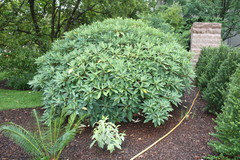
    Boy.....that's a toughy! Most of the big foliaged plants for sun are more tropical in origin and won't be hardy for you. About all I can come up with shrub-wise is Drimys winteri 'Pewter Pillar' - big, bold foliage and hardy to z7. And looks like it might fit a xeric type setting with that silvery gray foliage. Doesn't require a great deal of water, either.

    Otherwise, Inula magnifica makes a bold statement. Also Musa basjoo, but if you don't want to use cannas, maybe the banana is too close in appearance. Melianthus major is a great choice but not winter hardy for you. Can be grown in a container and schlepped indoors for winter. Same with brugmansia.

    Also Ricinus communis or Geranium maderense for annuals. Big foliage and fast growth.

    The Fatshedera is not fully hardy for you and not a great choice for full sun.


  • 11 years ago
    last modified: 11 years ago

    Can't think of any large-leafed plant that is 1) hardy to zone 7a, 2) takes full sun and 3) is borderline xeric. Is this a sheltered spot? or does it get winds in winter? Fatsia won't work and Fatshedera is zone 7b/8a at best. Are deer or rabbits an issue?

    You might consider one of the smaller Southwestern evergreen scrub oaks such as Q. turnbinella, Q. mohrianna, or Q. emoryi ? Not sure they'll be totally evergreen though and you'll have to check hardiness. They have a blue-green look.

    Of course there are the yuccas -- rostrata, recurvifolium, filamentosa, and gloriosa that love good drainage. And of course opuntia but probably not to 3 or 4 feet unless cholla.

    Euonymus can take heat, sun and drought (like E. japonicus), but if you have deer fah-get-a-bout-it.

    Osmanthus x fortunei might work but it gets big.

    Viburnum 'Conoy' maybe. Not sure about the drought factor, but it's hardy. Deer are not particularly fond of it.

    Photinia serrulata, but that gets big too. Too course to keep small.

    There might be some smaller hollies like I. cornuta 'Carrissa', 'Needlepoint', 'Dwarf Burford', or 'Rotundifolia'.

  • 11 years ago

    Since I usually think of shrubs as fairly large plants, my brain defaults to perennials for questions like this. Opuntia? There are spineless varieties, and they may get to some size there.


  • 11 years ago
    last modified: 11 years ago

    thanks for the ideas
    Gardengal - if only I could assume a Drimys would do well here...zn 7 rated or not. ANY Chilean shrub is highly suspect in this climate. And the wet summers are more the problem than the winters in many cases...at least in the pre-2013 mild winters. The exceptions have only been an Escallonia of some type that I've had since 2007, and Azara microphylla which survived and even thrived in the very wet but not very hot summer of 2013. (and, amazingly, I found a reference claiming it grows in New Orleans! Could be wrong but it certainly seemed anomalously tolerant of summer humidity and moisture: it is a member of the willow family.) For example Berberis X lologensis from the late lamented Colvos Creek would survive a couple summers and winters, start to size up and bloom and then...KABOOM...root rot would take it out over the course of a summer week. Yet another plant to consider grafting onto something more eastern-tolerant, but I'll have my hands full the rest of my life doing that with other genera, probably. Likewise, I've tried one of the Macaronesian Geraniums here and, though they look cool as heck, they are quite fussy in a non-maritime climate. Canary Echiums will heart breakingly collapse as soon as we have a dewpoint above 68F. (obvously not trying these outside in the winter, I'm just talking pot specimens)

    Dave:
    "Southwestern evergreen scrub oaks...Not sure they'll be totally evergreen though and you'll have to check hardiness. "
    Thanks, yeah, as I've noted before you have to be careful of semi-evergreens. When they fail to remain mostly evergreen, I at least find myself wishing I'd just planted something deciduous! Besides all those oaks want to get big and the ratio of leaf size to plant size isn't really favorable for what I wanted.

    Mad_gallica and dave...I've tended to avoid cacti as they aren't my favorite things (you have to be really special to justify having spines or thorns IMHO...I only have 3 roses and am about to delete one of them from the garden rolls...years ago I got a Poncirus thorn stuck in my finger and it became hugely swollen.) But I hadn't thought of that, and it's a really good recommendation. They are certainly "bold" and "xeric"! It's the best thing for fitting the "why didn't I think of that" part of this question. It's a shame the thornless Opuntia isn't very hardy!

    Problem with both a cacti and a wide-leaved yucca is, even on a raised berm here, winters here are just so wet it seems. Take every synoptic-scale rainstorm you have in Vienna or DC from Nov. to March and add .5 to 2 inch to the totals. Cycas panzhihuaensis sailed through 3F in my former Manassas garden...in a spot with very little winter sun and soil frozen bone solid too...and has repeatedly died here, no matter how well drained a spot I try to find for it. (this probably helps various BLEs avoid dessication though, since I would certainly never bother to water anything in winter) Unfortunately, my planting berms were mostly filled with clayey loam, not sand. The area that was best draining and did seem to be sand currently has a Yucca already. My other yuccas died in 2013-2014 because the wet snow covering them for weeks rotted them. I suppose the very hardiest Opuntia might survive there. I will put that on my list of things to consider...however, at the moment I have another thought. I ordered a Salvia nutans from Flowers by the Sea, not knowing where I would put it. It just arrived today...and I actually got a look at the plant. Anyhow, it kind of fits the bill - though the foliage isn't huge, it is at least much broader and bolder than the other things I listed that will be in the same area. Furthermore, it looks vaguely Mediterranean. Even if it actually isn't.
    But...still open to other ideas. That picture of a dwarf plumeria is so cool, it's tempting just to bury one in a pot and lift it for winter. But I said I never wanted to get into that kind of gardening, some plants like my Correa are just too awesome not to cater to in that way.

  • 11 years ago

    Umm. I have a thornless Opuntia. It collapses every winter, and takes a while to recover. It also never blooms, but it's out there, and has been for several years now. I honestly thought I lost it this year because it was smothered with mountain mint, but it seems to have survived. The straight species Opuntia humifusa grows wild about 50 miles south of here. So long as it has sun it doesn't seem to be at all a tricky plant.

  • 11 years ago

    Wow! For some reason I'd only seen the thornless ones listed as zn 9! I'll have to research this more thoroughly, thanks for the tip.


  • 11 years ago
    last modified: 11 years ago

    Opuntia cacanapa 'Ellisiana' is usually hardy here. But they still have glochids. Needs really good drainage. Not anything I would plant anymore because of maintenance issues. If I had more time maybe.

    Quercus mohrianna is more of a shrub.

    You didn't say whether this was an exposed site. I still think you should check into Viburnum 'Conoy'.

    I saw Drymis at a local nursery but didn't think it was worth the risk at all.

    Anyway, it sounds like you'll have to move to zone 8 to get what you really want.

    Now, I need ideas for a small broad-leafed evergreen shrub or perennial in a mostly sunny spot that is rather wet that gets no taller than 2 feet or so. Preferably more spreading. So work on that one for me.


  • 11 years ago
    last modified: 11 years ago

    "Anyway, it sounds like you'll have to move to zone 8"
    Make that zone 10! Or at least 9b LOL.

    As for your question, I see things like Bergenias and Ligularias in mostly sunny spots - but, again - in maritime climates w/cool summers. I have a Rodgersia in a spot like you describe that only gets about 2 hours of shade, and it barely makes it through summer. It would prefer more. Likewise, the Gunneras in the UK seem fine with full sun as long as they are by a pond. At 80/62f summers Lake Maggiore - sunnier but wetter than the UK, they are in deep shade but clearly thriving; here they are pretty close to ungrowable. I've heard of them being grown north of NYC, with heavy winter protection of course.

    "I saw Drymis at a local nursery" I love how they just blindly trust their wholesaler to offer it, when I know that plant is not proven in the DC area. But to my surprise, the RBGE multisite search shows that there are a couple at an arboretum in the Piedmont of NC. Of course, that doesn't mean they are growing well. Or maybe they protect them from root rots with antifungals. That's what I'm doing with a handful of very select rhododendrons until I can graft them, a project that is finally advancing. At any rate, after winters like the last 2 I can guarantee you ANY Chilean BLE would have shown some damage in the DC area.

    (It's the Bartlett Tree company arboretum...I'm tempted to find out if you can visit it because they list many interesting things, even compared to a place like the NCSU. It's over in Charlotte though, so much more of a drive from the I95 corridor)

  • 11 years ago
    last modified: 11 years ago

    Another to consider might be Daphniphyllum humile, but not sure it would be all that happy in full sun.

    As for my situation, this small raised bed sits with eave runoff on both sides, so even though the top 4 inches or so is good, below that it stays pretty wet. I currently have a Hoskins Shadow yaupon there, but it died back badly after last winter. It will likely come back OK, but not sure.

    But I wanted something lower around it. I had put Soft Touch hollies there, but it was too wet for them. They died slow deaths.

    I'd be OK with bergenia though. or any evergreen perennial (except lirope). I have a nice variegated pachysandra that might work too. Was also considering inkberry. This spot gets winter shade until about 2:00 pm.

  • 11 years ago

    The other posters above are far more knowledgeable than I, but I love tropical looking broad-leaved evergreens and have been tempted by some of the large-leaved hollies for that reason. For example, long-stalk holly (ilex pendunculosa) and lusterleaf holly (ilex latifolia). I know it's not exotic or rare, but I planted Winter Sun mahonias to break up the monotony.


  • 11 years ago
    last modified: 11 years ago

    The problem is both of those are really trees and not shrubs, and I was looking for a small shrub or even subshrub.
    That being said a dwarf form fo Ilex latifolia (or I. perado var. platyphylla), which had the large leaves but stayed a smallish bun or ball, would be an interesting plant.

  • 11 years ago
    last modified: 11 years ago

    Would you prepared to coppice regularly? Maples or Pawlonia can grow very large leaves if they are regularly cut to the ground.

  • 11 years ago
    last modified: 11 years ago

    Nandina? For a larger choice, what about Cotinus?

  • 11 years ago
    last modified: 11 years ago

    Sorry I missed them, thanks for these suggestions. I suppose I wouldn't mind pruning, but Paulownia looks a bit like a white trash tree to me because it's a weed along the east coast. If I see one in a yard the next thing I look for is the car or truck on blocks. So, no to that. As for Cotinus, actually, again a dwarf cotinus that still made huge billows would be cool, but there isn't such a thing and you'd have to prune a normal one like crazy to keep it 4X4'.
    I think the lesson of this thread is as GG said, there aren't many things like this, with a compact shape, large leaves, and sun tolerance. Spineless cactus certainly is one of them so I will probably try that. I am also trying the Salvia nutans so we'll see how that goes.
    Fatsia and canna have bold foliage but are tropical, not Mediterranean/steppe looking...and besides in the case of Fatsia would be impossible in full sun.

  • 11 years ago

    What about Osmanthus heterophyllus 'Goshiki'?


  • 11 years ago

    For Dave in NoVA who wants something wet tolerant, short and evergreen, look at Chamaedaphne calyculata.

  • 11 years ago

    Here's a deciduous suggestion, do you have the space?

  • 11 years ago
    last modified: 11 years ago

    Is that Edgeworthia? Actually for this spot, I had debated about another Edgeworthia. (I already have one in another part of the garden, right next to...drum roll please...Osmanthus 'Goshiki'. The great minds of this thread clearly think alike ;-) )
    As it is, guess what I've done? I've gone and ordered myself a couple (cheaper) plumerias from Florida Colors. I'll find out if they really are easy to lift & store for winter.
    I think with the Plumeria, the opuntia, and some fat leaved herbaceous perennials like the Salvia nutans, I'll have enough textural contrast with all of the various needly-leaved plants.

    (One of the plumerias was one recommended by dave, IIRC, in an old thread as staying short-branched. 'Kimo'. And yes, having to be removed for winter is the ultimate deciduous LOL. But I think I wanted evergreen in the first place more for the bolder effect that evergreen foliage usually has. Just look at the picture of a plumeria I linked to...wow.)

  • 11 years ago
    last modified: 11 years ago

    NHBabs(4b-5aNH): thanks so much! I'll certainly look into the Chamaedaphne.

    Sam, that Edgeworthia is gorgeous. Keep those photos coming.

    davidrt: As for Plumeria, I'd suggest 'Penang Peach' and 'Divine' for their compact shape. I usually grow them in pots which are easier to move come the Fall, because inevitably, when the weather turns cold I don't always have the time to dig and move. usually it's at the last minute and usually it has rained and everything is wet. So if you have no 'family committments - like kids!', go for planting them directly in the ground.

    I would also suggest you consider Nandina 'FirePower'. Leaves are larger than typical nandinas. They stay pretty compact. And turn a cool red in the Fall. Easy to find in the nurseries. They love sun and once established don't need a whole lot of water. Rodents can be a problem - rabbits/voles. If you mulch them, the voles will come. You could use pea gravel all around the base of the plants.

    Also, don't discount some of the Osmanthuses - such as x Fortunei, americanus, armatus, etc. They might yellow a bit in full sun, and they may need some pruning to keep them smaller.

  • 11 years ago

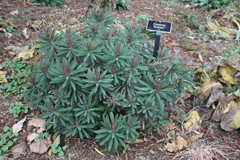
    Paperbush won't suit? Why not "spurge" ahead with one of these?

  • 11 years ago
    last modified: 11 years ago

    Dave guess what, the other one I'm ordering is Penang Peach LOL.
    I already have a veritable herd of spurges, they love the microclimate in this area so well they spread like crazy. (though are manageable)

    I have various Osmanthus but to me they look better (both in a health and aesthetic sense) in a woodland glad/forest edge setting.

  • 11 years ago

    OK, good on Penang Peach! Just a hint, put them in a nice big pot and drill 1 inch holes near the bottom of the pot. Then, sink the entire pot in the garden spot. You can also use a short rebar to drive down thru the pot and into the soil to keep it anchored. This way roots can grow thru into surrounding soil and if you forget to water once in a while, no big deal. They are easier to dig this way in the Fall too. Just push a spade around the pot and cut off the roots growing out the drainage holes.

  • 11 years ago
    last modified: 11 years ago

    Drimys being cold hardy in USDA 7 doubtful, apart from summer conditions.

  • 11 years ago
    last modified: 11 years ago

    Firetree I agree, simply because there are hardly any Chilean BLEs are are truly, fully zone 7 (as in, a & b) hardy. I've certainly tried enough to know. (And, yes, summer conditions are as much if not more of a deal breaker in most cases...that's why I'm particularly surprised to know of a local DC nursery offering a Drimys.)
    OTOH I will keep my poor little Escallonia whatever-it-is soldiering along so I can at least have one shrub from Chile in the garden. It did survive this winter too, but is now really, really set back after 2 bad winters in a row. Just one tiny branch regrowing. In mild years it was a big sprawling 4'X4' shrub that was reasonably showy in flower.
    Another one that is humidity resistant (not too surprising considering the family) is Fabiana imbricata. It's not fully zn 7 hardy though in my Virginia garden it lasted for years with south wall protection and got quite large.

  • 11 years ago

    I have never experienced a midAtlantic summer so cannot speak at all to those conditions but I believe Drimys are quite a bit more cold hardy than many suspect. There are a number of well established ones around that have been in place for at least 10 years (that I am aware of - maybe even longer) without any sign of winter damage. Hard to say the same about other southern hemisphere 'borderline shrubs' - escallonias, pittosporums, eucryphia. In the southern end of their range, they can experience winter lows of -20C, reportedly without issue. That's pretty darn cold.

  • 11 years ago

    How about a Bigleaf Magnolia. They would not handle wind well, but certainly would look tropical, while being deciduous, and I don't grow Paw Paw but they might suit, also.


  • 11 years ago

    Glad you're working it out, David!


  • 9 years ago


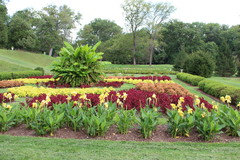
    davidrt28, what did you settle on? How could you live w/o Musa basjoo seen here in the gardens near Hampton House, Towson MD. ( you know you want one :)


  • 9 years ago
    last modified: 9 years ago

    Sam, you thread bumper you!

    Can't really say how I addressed this 'need' for my garden, other than moving on to developing other needs LOL. Sadly the Plumerias I bought did not survive their winter layover. I think they were too wet and cold in my garage garden.

    I have a Musa basjoo but I prefer the look of them in more of a woodland setting.

    The closest thing I've come to for meeting this requirement, actually was a black-leaved Colocasia from Brent and Beckys, except I placed it in a different spot than the one I was thinking of back in 2015. It is advertised as zone 7 - we'll see. I think the issue with those sometimes is even if they do survive, they take too long to come back in the spring. That was happening with Brugsmansia 'Charles Grimaldi', whose roots will survive milder winter around here, but doesn't start growing back until mid-July, and then only gets about 3' by late fall. And thus may not have the carb. reserves to survive another winter. You really just have to bring those inside. (It was 'Illustris', rated zn 7, another one they actually rate as zone 6! but that one was really expensive)

    BTW I have to admit I planted that Colocasia specifically because I saw them used as permanent bedding plants in SE Australia. I can't grow tree ferns outside but it was a minor way to mitigate my jealousy LOL. It's so mild there that Hedychiums were already blooming in their equivalent of early May, even down in the Dandenongs. Leaves had just a touch of frost damage from "winter" LOL. I am also trying a few more Zantedeschias because they are an impressive feature of those gardens.

    I am also trying to raise some cardoons, which are a pretty bold-foliaged.

    Funny to read these old threads. On a positive note, a Canary Echium from Annie's Annuals somehow managed to survive this summer of deluges. Hasn't grown much though, I guess if it does anything it won't be until spring 2019.

  • 9 years ago
    last modified: 9 years ago

    Thanks, I was looking for something more shrub sized. Nice plant though! Is that yours?

    I have a Mag. ashei X macrophylla from Woodlanders in my woodland garden.

    Spineless Opuntia was closest, probably, to the effect I was trying to get. But the one I tried outside melted and clearly winters will just be too cold and wet here. I have a backup plant in a pot. I think they are not nearly as hardy as the spiny ones.

  • 9 years ago
    last modified: 9 years ago

    I really do not know what species of Opuntia is being referred to as "spineless Opuntia". I do grow lots of Opuntia humifusa which definitely IS cold hardy to zone 6b and 7 and does not mind WET and COLD in the least. It does however have those tiny prickles (whose botanical name I always forget), in addition, there is the occasional long thorn here and there on random plants. It will spread though and I as I don't EAT them (nor do the DEER), they basically take over the hottest, driest "he// strips" where every thing else dies.

    Considering your requirements for bold foliage and xerophytic (and SMALLISH), I thought of a few not mentioned above. What about Hellebores?

    I have both Lenten Rose and Christmas Rose and they are sort of xerophytic-looking and I know they do well in dry soils (I have mine in dry shade, under a Magnolia grandiflora but I read they can grow in full sun too). Another plant that comes to mind is Distylium "Blue Cascade". I find the foliage looks like like Olive leaves (a very Mediterranean plant), but don't know if the leaves are as sizable as you were looking for.

    Most of my planting and collection focuses on the tropical to temperate wet plants, but I do have a zone 7 cold hardy, xerophytic collection of..., Opuntia, Yuccas, dwarf pomegranate, bayberry, lavender, rosemary, and other Med. herbs, dusty miller, coneflowers, coreopsis, among others.

    Others: Yucca, a Dwarf Laurel, False Indigo (Baptista), a dwarf holly?

    UpperBayGardener (zone 7) thanked User
  • 9 years ago

    David, thanks for your reference to this species, O. cacanapa-ellisiana! I did not know about this Opuntia at all until you mentioned it. I just purchased and received cuttings from an on line source. Absolutely gorgeous! Received several LARGE pads for $12.00! I have LOTS of O. humifusa which I also love..., despite the thorns and the prickles. The spineless one is hardy also to Zone 7a..., I hope it too is deer resistant! LOL. BTW, do you happen to know if either of these species is eaten, by humans (I know that there is at least one tropical species is eaten), O. indica (which I do grow but not to eat!) Oh, I am not even that much of a cacti nut..., except for epiphytic cacti, Opuntia and Cereus (so, I guess the more tropical/subtropical species, not so much the xerophytic ones).

  • 9 years ago

    Glad to be of assistance LOL.

    I actually don't know much about cacti. Suggest you ask either in the cacti forum here, or somewhere else on the web. If you search gardenweb/houzz, several threads come up from the past.


  • 8 years ago

    Can anyone confirm Drimys winteri 'Pewter Pillar' zone 7 hardiness, flowers scent filling the air and suggest where to get it from?

  • 8 years ago
    last modified: 8 years ago

    Will experience some foliar damage in cold temps - teens to single digits, possibly even higher. I don't find the flowers overly fragrant and they certainly don't have the carrying power of something like sarcococca or daphne.

    Pewter Pillar is a Monrovia exclusive. But a great many retail nurseries order from Monrovia and Monrovia now has a mail order feature where you can order and purchase from them directly but the plant will be delivered to your local nursery with their next order for you to pick up. Not always available with all their plants however :-))

  • 8 years ago

    I would beware of that hardiness rating!


  • 8 years ago
    last modified: 8 years ago

    I would beware of a Drimys being able to grow on the east coast at all.

    Oh, just remembered /nothing fail/ is in SE Europe. Still, seems doubtful that Drimys would do well there, even though nights are probably a little cooler than ours.


    Anyhow, wow, this is a thread that refuses to die. FWIW the cardoons had a nice bold effect like what I apparently sought 3 years ago. But I bet they all died! Will be interesting to see if the Colocasia from Brent & Beckys comes back in a timely manner. (or at all!)

  • 8 years ago

    Would a tiger eyes sumac work for the dry spot? Interesting leaves. Or a large perennial like a compass plant, maybe leaves like that?

  • 8 years ago

    I am in zone 7 in Northern VA. Could you use a camellia? Mine are flowering now and are evergreen.

  • 8 years ago

    Monrovia replied Drimys winteri 'Pewter Pillar' was hardier than the straight form but its flowers were not fragrant.