Software
Houzz Logo Print
websrchr1

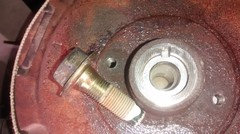
Removing the flywheel holding bolt

11 years ago

My problem is with a Craftsman LT
1000, B&S 316707-0230.E1-040614zD 17.5 HP engine.

In trying to solve my problem I have
learned quite a lot. Took advantage and cleaned everything. Blew all clippings
and then power washed everything, especially the front end, which had a lot of
gunk. Clean gas tank, battery at 13.2, new oil, strong spark from the .30 spark
plug, Set the valves ¼ past TDC at .004 and .006 gaps, cleaned carburetor and
it has a working solenoid, readjusted the magnet to business card thickness and
tried it. Flywheel turned vigorously, but it didn’t start, instead it backfired
on the carburetor and when throttle fully closed, it backfired from the
muffler.

Then I read about the possibility of
a sheared key and I realized that in fact, last time I used it, I had hit a
surface root and although the blades probably stopped, the engine didn’t; I
backed up and continued, but the following week, when I tried to start it, it
didn’t.

So, I removed the shroud and tried
to remove the bolt holding the flywheel steady and using a ratchet on a counter
clock wise motion, but no success; or is it clock wise?. I have used 40-D. have
tapped it gently several times on all six sides, have applied heat with a
torch, but it doesn’t budge. I don’t think the torch produces enough heat to
get the bolt red.

Are there any other ideas I should
try? How long should I apply the heat? Can I engage the blades and block them
to get more steadiness in the removal?

Thanks for your suggestions

Comments (21)

  • 11 years ago

    Thanks Justalurker for your reply.

    Followed your suggestion and got a ½" DeWalt DW290 corded impact wrench and tried it in reverse. The bolt didn't react; tried it again and again with same results. Is it possible that the bolt is threaded clockwise? If not, do you have any other suggestion?. Should I try clocwise and counterclockwise several times?

    Thanks again.


  • 11 years ago

    remove spark plug. Take a 4 foot length of CLEAN 3/16 dia nylon rope. Knot one end. Stuff other end into plug hole cavity (with cyl piston fully retracted). Feed rope in until cyl is full. Using wrench or breaker bar, turn flywheel retaining bolt clockwise until piston fully compresses rope in cylinder chamber. Then apply necessary force to break bolt loose (lefty loose,righty tight).
    Caution: can use same technique to reasm, but 1) mating parts must be absolutely clean and 2) flywheel bolt must be torqued to Briggs spec.
    good luck.


  • 11 years ago

    Thank you very much for your suggestion Rexlex.

    I didn't have to go that way because I tried the clock, counter, clock, counter clock wise motion and was able to get the bolt out. The body of it was not rusted and my hope that the key was sheared didn't materialize; it is intact. So, now is back to check everything. I'll make sure that the torque is to Briggs specs.

    Thanks for your effort to assist.


  • 11 years ago

    and don't forget that CLEAN thing.....good luck.


  • 11 years ago
    last modified: 11 years ago

    ... and a dab of anti-seize on those threads

    CORRECTION: along with a dab of anti-seize make the appropriate correction to the DRY torque spec to arrive at a WET (or lubricated) torque spec which will be lower.

  • 11 years ago
    last modified: 11 years ago

    "Using wrench or breaker bar, turn flywheel retaining bolt clockwise until piston fully compresses rope in cylinder chamber. Then apply necessary force to break bolt loose (lefty loose,righty tight)"

    What kind of clock do you have? Maybe Australian. Well lefty loosey righty tighty is correct.

    When doing the "rope trick" with an OHV engine such as your 31 series engine, be darned sure you have the piston coming up on the compression stroke where both valves will be closed other wise you risk damaging the exhaust valve.

    Note that B&S has increased the flywheel retainer torque from 100 ft. lbs. to (I think) 125 ft. lbs

    Walt Conner

    .

  • 11 years ago

    To Rexlex: Didn't need to follow your lead, but thanks.
    To Justalurker: I did
    To Tinkerer 2000: Didn't use the trick.

    Thanks to all of you for reading and commenting.

  • 11 years ago
    last modified: 11 years ago

    conner/JAL - if you apply antiseize to flywheel capscrew threads, do you use dry torque or wet torque values ? Usually makes around a 20% difference in clamp load ?...

  • 11 years ago

    I never use antisieze. Torque specs. call for dry torque.

    Walt Conner

  • 11 years ago
    last modified: 11 years ago

    @ tinkerer200... I was told on numerous occasions by technical writers and engineers that dry torque specs can be modified to wet torque specs but that's rarely stated because technical writers expect that professionals know that. Another service manual trap for DIYers.

    Unless specifically stated in documentation NOT to use anti-seize I use it with the lubricated or wet torque setting. Been using anti-seize for many decades professionally and personally. Never had a fastener I used it on come loose and never had a fastener I used it on refuse to release. Made good money removing fasteners that anti-seize wasn't used on though.

  • 11 years ago

    all true, JAL...but what about that necked capsrew that ultimately fails due to using dry torque specs in a wet torque scenario..? results can be a tad ruffling..


  • 11 years ago

    Well since we are talking experience, I have been working on small engines for about 70 years, never used anti-size on any engine part never intend to and never had any problem as a result of not using.

    Walt conner

  • 11 years ago

    @rexlex,

    There's do-it-yourself and there's screw-it-yourself.

    @Walt,

    You have me by a few years but I've been working on small, medium, and large engines independently and in a manufacturing environment with the advantage(?) of engineers at my fingertips... and over my shoulders. I know what I know and I use that knowledge on customer and personal equipment with never an anti-seize related failure so I'll continue to do so and advocate using anti-seize correctly.

    You know what you know and I support your right to do what you want.


  • 11 years ago

    well, JAL.. I guess them engineers really got yer back. Obvious you ain't never been out on a field campaign trying to replace failing fasteners on a mass produced product because some fool in assy decided that a bit of oil made it go together sooo much easier before he hit it with the torque gun...


  • 11 years ago

    rexlex,

    Yup, them damn engineers who set the specifications and expect assembly personnel to read the specs and correctly apply them.

    I've done more warranty repairs on the bench and in the field than I care to remember. I've also trained assembly line personnel in the correct torquing of fasteners. Now, everyone I've trained could both read and speak English... and since this thread is going no where I'll leave it to you.


  • 11 years ago

    we agree to disagree on this one...


  • 11 years ago
    last modified: 11 years ago

    No we won't agree because you are blaming the failure of a fastener on the specification and/or the engineer who set it when it is the stupidity or ignorance or incompetence of the person torquing the fastener that is causing the failure.

    Don't confuse field experience with production line experience. Production line sequences are detailed down to the last movement. If the torque spec calls for anti seize then it is applied and torqued to the correct spec for that circumstance. If the sequence doesn't call for anti seize then there is none at the assembly point and the torque spec is correct for that circumstance. If the loose nut on the end of the torque wrench does not understand the specification then they should put down the wrench and back away. If they are being paid to tighten the fastener then they should be fired when the fasteners fail in the field if it is not correctly torqued.

    Service manuals are not a how to, step by step, instruction guide for
    DIYers. Tech writers write service manuals expecting the reader
    to already be a competent mechanic and often leave simple universally
    understood (by professionals) steps out of a procedure. If there's no
    instruction to use a thread lubricant and one chooses to use a thread
    lubricant like anti seize that choice should be accompanied by the
    knowledge of how to use it.

    When we're talking about what one does to their stuff in their own garage that's a different story. If the dry torque spec on a flywheel bolt is 100 ft lbs dry and one wants to use anti seize one has to modify that torque spec for the use of anti seize. If one doesn't understand that then a resulting failure is their fault whether one was lazy, stupid, ignorant , or incompetent and not the fault of anti seize or the engineers who set the dry torque spec.

  • 11 years ago

    well, JAL... make sure thet soap box is in good shape. I spent over 60 years in light and heavy mfg dealing with such problems.. and they do happen. As to giving advice here, best to keep it KISS.


  • 11 years ago

    The length of time someone does something is not indicative of the quality of their work.

    I kept is as simple for you as I could...

  • 11 years ago

    son you ain't doing much but blowing smoke. now we agree to disagree on this issue. leave it be.


Sponsored