Software
Houzz Logo Print
spectrograph_nc_7b

Help with soil report

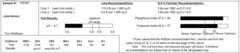
I have received this year's soil report. It's not as complete as a Logan Labs report, but our local ag extension office offers free testing, and you can't beat free. Maybe next year if problems remain I'll get the more detailed report. In the mean time, would you folks be willing to help me with the report?

I live in the piedmont in North Carolina. We've had the house for about three years. For a long time it belonged to a greenskeeper, but for maybe 5-10 years after that it had other owners who where neglectful. Our soil is clay + the usual 2 inches of random topdressing from the builder. Back yard is shaded probably about half the day. Additionally, I think it's a kind of zoysia. It's definitely warm season, spreading, it almost never grows higher than 3-4 inches and never puts up seed heads. The yard has gotten shadier over the years as neighbor's trees have gotten taller. I assume at some point I'll have to give up on zoysia there, but for now it's holding on and it's a pretty damn ideal turfgrass. The front yard is 75-100% sunny and a very invasive bermudagrass. I'll be attempting to make the bermuda as happy as possible, because I like its low maintenance character.

Last year after the report I limed front and back with dolomitic lime. Before that, I core aerated (though since then I've seen this forums views with regard to aeration). I also fertilized once last summer after the report with a pure nitrogen source in the front. I did not fertilize the back yard because it's currently affected by three large patch / brown patch infections. These have been there since we got the house, spreading 1-3 feet each year.

This spring I fertilized both yards (plus the strip by the street) with slow release nitrogen in May, but have yet to make any further amendments. I under-limed the front yard last year out of caution, and because I underestimated its square footage.

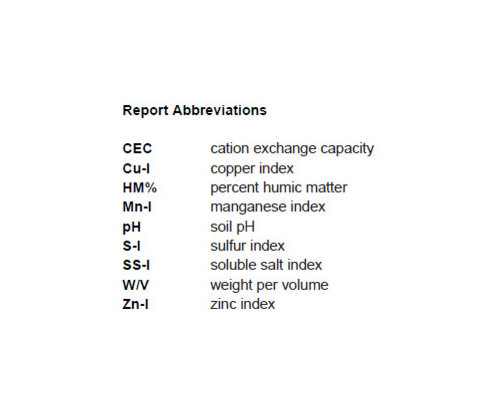
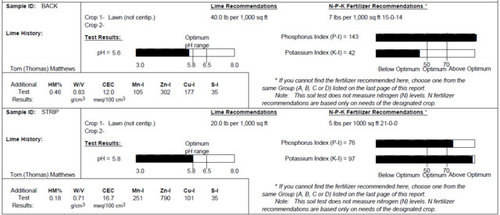
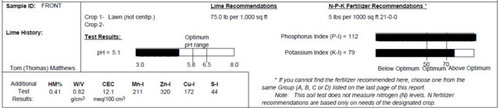
Here are this year's reports:


Comments (8)

  • 11 years ago

    And here are my reports from last year (2014):

    Thanks for your help!

  • 11 years ago

    Morpheuspa, thank you so much for taking the time to give me solid recommendations. I will be following your plan this year, and we'll see how it looks again in the spring!


  • 11 years ago

    Question: is a phosphorus above 70 actually a problem? The way the report is presented, it seems like I would want to avoid any phosphorus containing fertilizer. However, it is also my understanding that a lot of the phosphorus in soil may be either immobile or unavailable for biological use. This is also a free state test, so might also have a larger margin of error?


  • 11 years ago
    last modified: 11 years ago

    Well from Morph's plan it looks like he is infact avoiding it. It is a very soil stable nutrient - it doesn't leak through soil profile. Like nitrogen is prone to (and potassium barely). Once it is to good levels adding more is not needed typically. It is one of the reasons phosphorus-free fertilizer rules are in place in many states.

    Excess phosphorus doesn't cause to many problems with Turf (iirc) - excess potassium can from what i recall... i suppose it will get recycled if clipings are mulched?

    Phosphorus amounts in Milorganite or Grains is fairly minimal (unless adding exceptional amounts).

  • 11 years ago

    Yep! Phosphorus has a very wide window of acceptable values. On the Logan test, numbers around 200 are optimal for soils with a good pH, but that optimal number can rise as high as 300 or so on high pH soils.

    It looks like a 60 on this test is equivalent to a 200 on Logan's, but we'd need a Logan test to be sure of that.

    However, even 1,000 isn't anywhere near toxic to grasses, although I would never recommend addition of P to soils that are at or over optimal levels as erosion of P-laden soils into waterways is a serious pollutant.

    If the scale is linear (I don't know) and if the numbers are proportionate to the Logan test (again, I dunno), then your highest level of P is around 400. While high, and none is required, that's certainly not a problem.

    P's very stable in soils, leaching only very slowly, because most of the time it's in a water-insoluble form that's not only non-leaching but not available to the plant. Fortunately, plants recycle the stuff very well (as do you), and don't require a great deal at any one time.

    Only a few parts per billion are available in soil solution at any particular moment, and only that tiny amount is susceptible to leaching out. Free state tests are pretty useless as it depends heavily on soil temperature, soil moisture, and biological activity at that one particular instant.

    As Boat noted, mulching your clippings will also recycle most of the P (and N and K for that matter), reducing any additions required. I haven't added P to my lawn in five years or more as it's staying pretty stable.


  • 11 years ago

    Thanks, that's very helpful. My local garden shop sold me some slow release 30-4-10 fertilizer this spring based on last year's test. I used it for the spring feeding of the Bermuda before the 2015 test, as you can see from the year over year P increase in the front lawn. Should I just give the rest of it to a neighbor? Or if it wants more potassium in the spring would that small amount of P not be a bother?

  • 11 years ago

    P is phosphorus, so the 4% in your fertilizer is not a problem.

    K is potassium. A 3:1 ratio of nitrogen to potassium is just fine, actually, so the 10% in this particular feed is not a problem.

    Like phosphorus, potassium soil binds tightly, just not as tightly as phosphorus. It leaches more easily as well.

    The windows for potassium levels in the soil are proportionately about as wide as for phosphorus, and potassium levels aren't extreme at any point on your lawn.

    I'm a fan of some excess potassium for cold and heat resistance, plus disease and insect resistance. Potassium also isn't a water pollutant as there's a vast amount kicking around naturally and it doesn't set off bacterial, fungal, or algal growth in waterways.

Sponsored
Peabody Landscape Group
Average rating: 3.5 out of 5 stars8 Reviews
Columbus' Reliable Landscape Design & Contracting