Software
Houzz Logo Print
hzdeleted_63513

I have this theory

11 years ago

About Hosta, air circulation, the southern humidity, and southern blight--or whatever you wish to call the problem in your part of the world.

Two Hostas with the blight here in years past were The Razors Edge and Totally Twisted. I lost my beautiful TRE in one day, deader than a door nail. TT did not die the three times it got blighted. I knew what I was looking at, and that made a difference. My DH (his degree in chemistry came in handy) said the expensive product to fight blight was nothing but hydrogen peroxide diluted 10:1 with water, so each time TT came down with it, I cleaned it up and it lived. DH also uses it preventively on his veggie garden, and we have lots of empty brown bottles going in the trash.

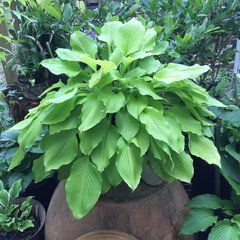
My theory involves the types of Hosta which get blighted, and those that seem not to have the problem. Densely packed crows with little room for air circulation may lead to blight sensitivity. Open crowns with erect petioles, perhaps a vase shape, a growth pattern that allows air to flow through the Hosta, may be one reason some Hostas perform well in the more humid climates. Not speaking of those Hostas bred for lower dormancy, but the most successful of those also have some attributes to permit good air flow too.

I formed my theory of open shape by looking at the Squash Casserole family....of which I now proudly possess ALL the available sports and hybrids! These in particular perform well in Mobile. They all take sun including afternoon sun all season long...which goes from March to November, sometimes longer, poor things. I begin daily watering with tall sprinklers unless it rains, cooling the air around them in early afternoon so they get a break from the heat . The SC family does not noticeably sunburn as some golds, greens, or blues do. Just because a Hosta is gold does not protect it from leaf burn. But that is another issue not intended to intrude on this discussion.

What I want to hear about is your observations of Hostas in your garden which might have previously succumbed to southern blight, what happened, which ones were they, and did you continue to grow them and where, replacements, or treatment effective?

I point out that SC family does not possess high substance like some, so the ability to thrive in hot humid areas without sunburn lies in other characteristics.


Comments (13)

  • 11 years ago

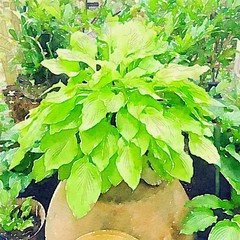
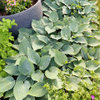
    i give. whats the painting ... you have other talents???

    ken


    User thanked ken_adrian Adrian MI cold Z5
  • 11 years ago

    I agree with what you say. I have similar observations. Too busy today to write.

    Ken, she has a program that does that with a photograph. I used to have one that did it. It didn't work on anything after Windows ME, though. I loved that program.

    bk


    User thanked bkay2000
  • 11 years ago

    Yeah, Ken, what BK said.

    But I am on my new iPad, about which I know nada, and that is the pic it chose for me and I could not make it delete. That is my studio known as the Teahouse, which is emptying of construction materials as the remodel nears completion. Won't I be a happy camper then!

    Try again for SC!

    Other than choosing the picture no talent required. This was not Virtual Painter which I loved to use also...this app is Waterlogue for iPads and iPhones only. I too miss VP, BKay.

  • 11 years ago

    Mocc- Everytime I see your Squash Casserole, I remember how much I love it and I must get one for myself. I wonder how much sun it will take here? Guess I will have to get one and find out.

    User thanked Linda's Garden z6 Utah
  • 11 years ago
    last modified: 11 years ago

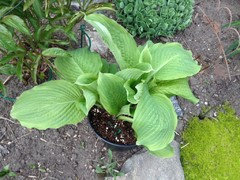
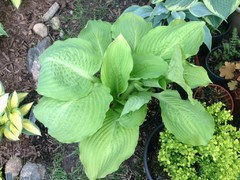
    Well, Mocc I've done it! Successfully added Squash Casserole and Jujen to my collection. Both huge!

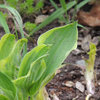
    Jujen is taking on some margin colour...

    Then the queen of your garden, Squash Casserole, pic below. Pics taken last Wednesday, and still unfurling. This is a division from a display plant at Hosta Choice Gardens. Glenn took HVX tests of both after both were dug up and divided while we were chatting. Clear!

    Mocc, I really scored on Jujen! When I exclaimed at the number (multiple) of shoots and offered to pay more, Glenn said he couldn't make the division smaller without affecting the plant so I got the deal of a lifetime! :-)

    You must have your Jujen too if you have the entire family then? :-) way to go!

    User thanked josephines167 z5 ON Canada
  • 11 years ago

    Mocc, I have lost two hostas to SB and saved two othes from it. None of them were crowded but each of them were in a part of the garden that I may not have been watering enough. The rain can just flat stop for weeks and weeks in the summer here in the piedmont of North Carolina. My irrigation system has not kept pace with my hosta acquisition rate.

    My understanding of SB is that it frequently shows up after a rainy period that has followed a dry spell. So just when I'm giving thanks that it has finally started raining, the conditions for SB are perfect. Three of the affected hostas were at the same time following just such a scenario.

    I've used tebuconazole which I got at Home Depot and I need to order some flutolanil now. How do you use the diluted peroxide?

    Kathy

    User thanked zkathy z7a NC
  • 11 years ago

    I am updating what I wrote above since I what I said would not dilute it enough and might lead to chemical burns...of the plant.

    The ratio is correct though. TEN parts water to ONE part hydrogen peroxide. I equated it to one Bottle peroxide to ten bottles of water but DH convinced me that was wrong.

    So to mix up a gallon or so, you put the 128 liquid ounces of water (a gallon) in your watering can. Then you add 12.8 liquid ounces of hydrogen peroxide to it. About a cup and a half of the stuff. He pours that mixture on the soil nearest the roots. It is not a foliar spray or drench, strictly a soil drench, if you see signs of the problem. Of course remove any of the orange or tan bee bees you see in the plant. He commented there were several ingredients in the expensive product but the ACTIVE one was really equivalent of hydrogen peroxide.

    Take the money you save and buy more Hosta, right?

    Oh yes. My Hosta being in containers, the garden sprayer is easier to use. I stick the wand beneath the leaf cover and give a good dosing to the soil. If it is dry where you live, and you get the rain, seems advisable to do them soon after it stops. That SB can take out a healthy plant in a day, so the sooner the better after it rains.

  • 11 years ago
    last modified: 11 years ago

    So which product is he talking about? Hydrogen peroxide in a bottle is a three % solution, so 10:1 further dilution is pretty weak. Of course the X15 flew on a 75% solution.

    Kathy

    User thanked zkathy z7a NC
  • 11 years ago
    last modified: 11 years ago

    Congratulations on the new arrivals, Jo! Jujen (2 big eyes) was my most recent arrival from Van Wade, and I forgot I had ordered it. Pleasant surprise. Also got a new Tickle Me Pink since previous ly I fatally misplaced TWO of those. I am hoping this new one will lead me to them!

    I hope the girls grow nicely for you. ;)

    Up Utah way, unless altitude makes a difference, SC should handle sun very well. We have 90s from end of May onward all summer, plus high humidity, and mine was taking summer sun from late morning to mid afternoon, then broken shade in the swelter of late afternoon. Of course I misted extensively to cool things down and watered daily, which perked things up a lot. I water depending on temp and sun exposure, whether it has rained a little or none at all. Enjoy growing it, and it grows pretty fast I think.

    Kathy, he means OTC from the drug store, 3% yes. Even 3% can burn the roots of a plant, and diluted further as described stops the pathogen of SB in his veggie garden. He said we could experiment on a spot of grass to see how long it takes 3% straight from bottle to kill roots of grass, but it is raining for several days and could skew the results. DH is very precise and loves experiments.

    I wish it could be used on foliar nematodes!

  • 11 years ago

    Gee, I cannot edit my original post. Must be some time factor involved that I never noticed before. Spell check or auto complete turned "crowns" into "crows" which is amusing but irritating.

    I wonder what old recipes lurk in formularies that could save gardeners a bunch of money and be kind to the environment at the same time?

  • 11 years ago

    Thank you for thoughtfully providing your maintenance routine for SC, etc. I read, and have read your previous posts, with interest when you talk about your care of SC...I was storing this information for use with mine. High summer temps, lots of humidity, not enough shade .. that is the bane of my hosta's existence in the garden. "The girls" look happy so far, thanks! :-)

  • 11 years ago

    As you are a nurturing soul, Jo, it will take you no time to note the need for water to cool or water to nourish. Misting an area can temporarily lower temps 20 degrees, and that can make a big difference.

    If you keep this Hosta as a container plant, dark colored pots need screening from the sun. They get as hot inside as the water in a black hose! Before putting hose water in a pot or on any plant, I prefer to spray or loft the hot water high in the air ...which can cool me and the atmosphere...as long as I do not have my camera.

    when I mist the garden fills up with birds. Some bathe on wet tree leaves, others go from pot to pot hopefully after slugs or unfortunate cutworms.

    And now good night all. Did not expect to write so much on one thread or I would have used the laptop...a stylus is for emergencies only.