

Echeveria 'Opalina' beheading
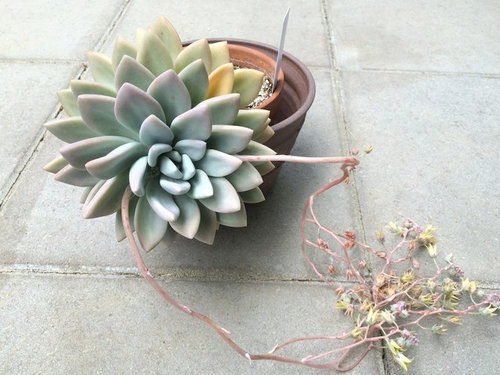
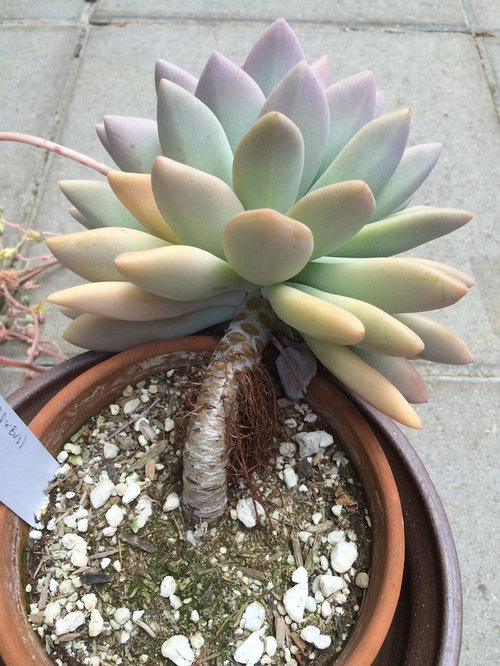
I think it's time to behead this one. The stem is long and the head is so heavy, it needs the weight of a second pot to keep it from falling over! Nice plant though, it's about 6" across and has thrived despite its soil being like a brick. The rooted head will go into gritty mix. According to my tag I bought this in 2004 and I've beheaded it twice since then.
Btw this was labeled echeveria when I bought it but I suspect it's really a graptoveria.
Comments (31)
 11 years ago
Hi Andy, I'm pretty sure it's a Graptoveria judging from the flowers. Echeverias usually have a more exclusive spike carrying its flowers in a cascaded arrangement.
Very pretty plant though! Looking forward to more updates after you repotted.
- Bernard
andy_e
Original Author11 years agoYeah I guess after 11 years I should update the tag. :-)
I'll post more pics as it progresses. I'll hack it this weekend, then probably a few weeks to get good roots.
Related Professionals
Atlantic City Landscape Architects & Landscape Designers · Lawrenceburg Landscape Architects & Landscape Designers · Oshkosh Landscape Architects & Landscape Designers · Springfield Landscape Contractors · Laconia Landscape Contractors · Pueblo Landscape Contractors · Everett Landscape Contractors · Vancouver Landscape Contractors · Wenatchee Landscape Contractors · Mount Vernon General Contractors · Atlantic City General Contractors · Waterloo General Contractors · Buffalo General Contractors · Eau Claire General Contractors · Grand Junction General Contractors 11 years agolast modified: 11 years ago
Andy,
I was hoping that you'd have it on a tumbrel.
What a lovely plant! Mine never flowered for me, so I'm doubly happy yours did. Such a great plant as it is, and flowers are a bonus. One of the truly beautiful crosses of sculptural-like Carrera marbleness.
Bernard,Your description also fits pure Pachyphytum flowers, if I'm reading your comment correctly.
- 11 years ago
Charris - You're right!
Andy's flowers blooms more like a Graptopetalum/Graptoveria, it carries a spike with a web-like network of flowers.
Andy, your plant is 11 years old!? That's really impressive! Congrats on the bloom!!
Bernard
andy_e thanked bernardyjh andy_e
Original Author11 years agolast modified: 11 years agoYes, 11 years. I use the tags to keep track of when/how I got each plant and all the subsequent repots, beheadings, etc.
Btw here's some additional info I came across: http://www.smgrowers.com/products/plants/plantdisplay.asp?plant_id=3804
andy_e
Original Author11 years agoNeil that soil is like a brick (probably five years old) so I'm just amazed that the plant is so tolerant. It stays outside 365 days a year so it must like our climate, and I just make sure it gets the right light and gets watered once in a while. Given how well it has done while living in a soil brick, I'm pretty excited to see what it will do in gritty mix.
Six rosettes on one stem is amazing. What a treat! I didn't get stump rosettes from the last two beheadings but I always give it a shot. Fortunately I've been able to get offsets from the live plant and I've successfully propagated it from leaves too. 11 years ago
Andy- That's even more amazing. I can't wait for you to post what happens after the re-planting. It will probably take off like a rocket! (Which will hopefully land on my balcony)!!
 11 years ago
Andy, how long do you allow the cutting to callous to get successful results?
andy_e
Original Author11 years agoIt'll only take a few hours for the cut to dry out (it's very dry here) and then I'll leave the head in the shade, sitting upright, until roots appear. It might take a few weeks.
andy_e
Original Author11 years agoOk all done. For the benefit of those who are curious how this works...
First you want to have a good set of pruning shears. I use Felco but as long as it's sharp and makes a clean cut it'll work. I sanitized the blade beforehand to reduce the chance of contaminating the cut.

This is where I planned the cut. I like to leave a bit of stem beneath the leaves in case I screw it up and need to re-cut. You don't want to leave too much though. A few of those bottom leaves will dry up and fall off by the time it roots and I don't want several inches of stem sticking into the soil when I plant it (more chance of rot).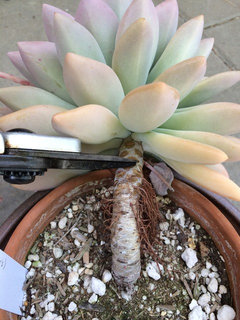
Here's the cut stem. You can see the stem already has some older roots so I could plant it tomorrow and hope they grow, but I'm going to let it sit out and wait for new roots anyway. Two reasons. One, I don't know how active those roots are and they may not grow at all, and two, I like to see the new roots emerging as a sign that the plant is healthy and in growth mode. This way when I plant it I'll know exactly what's happening in the pot and I don't have to disturb it repeatedly.Btw the head of the plant was surprisingly heavy while I took the picture, I'd guess almost a pound. Lots of water in those leaves.

The stump. I'll continue to water this and hopefully get some offsets out of it.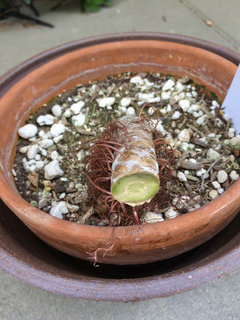
Now that I'm done I just need to let the stem callous over and wait for roots. As I mentioned in a previous comment it's very dry here so the cut should dry out within a few hours. Roots will take a few weeks. The plant will continue to grow during that time and since I don't want that growth going off at an angle, I'll set it on top of this empty pot. It'll stay upright and the stem will get good air circulation and stay shaded. You don't want it getting wet either, but rain isn't an issue for us at this time of year.Finally, I also cut off the two inflorescences because I didn't want it putting energy and water into flower production.
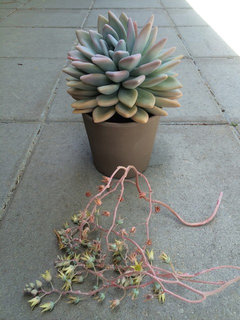
Eventually it should look something like this. This is an E. agavoides I beheaded four or five weeks ago.
- 11 years ago
Thank you for posting this process. It gives me a bit of confidence regarding my own collection.
andy_e
Original Author11 years agoI discovered roots on the Opalina last weekend, so that's almost exactly three weeks from when I chopped it. Here's a photo from this morning, where you can see new roots growing from the stem as well as sprouting from the old roots. I'll pot it up this coming weekend.

- 11 years ago
Thanks for the through demo with pics!. Do you do anything else before potting? Or just right in the mix and wait for new growth? When will you water and move to a sunny spot?
- 11 years ago
Andy!!! I just had a thought (I don't get many so pay attention)...what about putting your deomonstration skills to videos uploaded to YouTube??!! I would definitely tune in! I've taken your advice on a number of things and so far so good. I'm sure most of us on the forum would love that. Besides, you could become famous!
andy_e
Original Author11 years agoNeil haha I appreciate the thought. I've considered doing videos but it takes about 10x the time of just taking photos and posting them here. That's time that could be used for repotting more plants!
J Carter I'll put it straight into gritty mix and start watering. It has so few roots, it'll be easy to pot up. With established plants that have lots of roots it's a painstaking process to work the mix in among the roots so that there aren't any big voids, and to make sure that the roots are evenly distributed. No such issues here. I'll keep it in shade for a week so the roots can get started on sucking water up into the plant. After that I'll start acclimating it to the sun again. I'll start fertilizing two weeks after potting up.
andy_e
Original Author11 years agolast modified: 11 years agoDone! As I mentioned in my previous post this was fairly straightforward to pot up since it has so few roots. The biggest challenge was just dealing with the fact that it's so big and floppy. The bottom leaves sit right on top of the mix so in order to make sure the mix got all around the stem I had to carefully lift one or two leaves at a time and spread the mix around with a chopstick. Also, see my note below on the caterpillar I found chomping on the leaves.
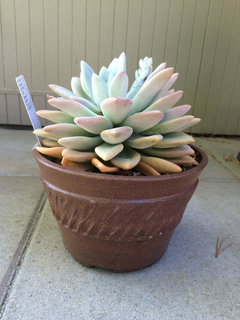

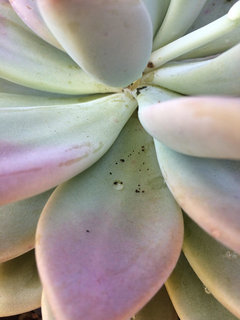
Late last week I did a quick check on the plant and noticed a shriveled leave near the top of the plant. That's not a normal place to have a shriveled leaf so I looked more closely and found some black particles sitting on the leaf just below. My suspicions of a caterpiller were quickly confirmed with a little more investigation and the offender was removed and smashed. Luckily he didn't do much damage beyond the one leaf. I was concerned that he would have gotten into the stem, and fortunately he didn't, but it makes the point that you need to keep an eye on plants that you're rooting because they're likely to have lower defenses than when they're growing vigorously.
Here's what the caterpiller poop looked like.
 11 years ago
Beautiful! Great post for those that wants to behead their echies. I've done so once with a really stretched blue echeveria, even though both top and bottom part rooted fine and was growing, it just requires too much more light than I could give, so eventually I had to give it away.
- 11 years ago
Here is one of my beheadings:
top left: plant after last winter
middle: largest rosette beheaded; I left the stem - so far it is not growing pups
top right: rosette after the cut
just below: sitting in the cup, waiting for callus/roots
large pic: rosette today, potted in gritty mix, in 5.5" clay pot. It is still inside, because it has been raining almost every day since it has been potted.Rina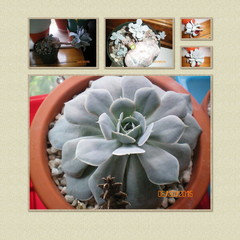
- 11 years ago
Beautiful plant! Thank you for sharing all this, and the wonderful pictures! I am new to succulents and this was extremely informative and helpful, thank you again!!
 11 years ago
Thank you for the very thorough explanation/demonstration. I just recently bought a opalina that a saw a Wal Mart. The poor thing was just sitting looking pitiful. Mostly stem, most of the rosette leaves were gone, and the stem was curved like at one point in time it held a heavy head. I figured I would bring it home and behead it and see if I couldn't help it become a healthy plant. ( I've only had to behead one plant before. Still pretty new to succulents but I know the basics). Now thanks to your post I have full confidence to go all "Queen of Hearts" and know I'm doing it correctly. Thanks so much.
- 11 years ago
I agree. Everyone is always so kind to share his/her techniques on this forum. Very educational and appreciated.
 11 years agolast modified: 11 years ago
OK Andy. Now for the important part of this thread: The old stem. You beheaded this plant over a month ago. By now you might have new plants on the stem... Well, do you? The reason I ask is some Echeveria don't produce plants on old stems after beheading or at least for me living in Michigan they don't.
NB: After going back and reading the the earlier entries to this post, I see you haven't grown plants from previous beheadings. What is interesting to me is that you have been successful propagating from leaves but not old stems!- 11 years agolast modified: 11 years ago
Andy, I trust you won't mind if I demonstrate how I treat beheading. This is an Echeveria 'Cubic Frost' that I found at one of the BBS's earlier in the week, neglected. It is becoming somewhat etiolated and the crown leaves are small. I negotiated a VERY nice price.
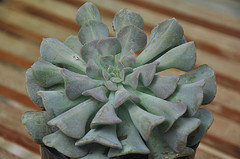
These are my older plants of the same Echeveria that have had full sun all summer. The heads are tight with large leaves.
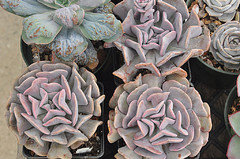
After bringing it home, I immediately beheaded it and set out to callous.

It's been about a week since this was cut. I usually don't wait until roots appear. For me, it's easier to plant sooner. For this plant I have decided to use a grit/coir mix.

I like to fill the pot and form a "cone" of mix in the center of the pot. This is where I will insert the cut stem, pushing down gently until the base is as deep as I can get it. I'm using a 5" pot.

Pushing down on the crown, I gently tap the pot on the countertop several times to seat the stem and pack the mix around the base. keep it in a "brightly shaded" area for a week or so until roots form. I know when this happens, because I gently wiggle the plant and if the mix moves, it's got roots and watering begins!
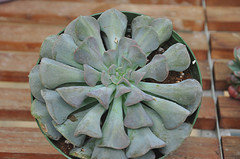
Thanks, Andy.
andy_e
Original Author11 years agoThanks for sharing your method! There's more than one way to skin a cat for sure. My way is one way to do it but it's not "the" way.
To your earlier question, yes, I'm getting three offsets on the old Opalina stem. They're still pretty small. I'll take a pic at some point.





Neil