Software
Houzz Logo Print
hector_perez9129359

Solarization to remove lawn

11 years ago

Hello I live in San Bernardino and want to remove the lawn from the parkway or the strip of grass between sidewalk and street. I want to put drought tolerant plants or ornamental peanuts.


My question is if I was to put plants do I put them before covering the lawn with the plastic or after. I read that you shouldn't dig deep after the process because some weeds might start coming out but if I put them before won't it kill the plant from too much heat?

Comments (21)

  • 11 years ago

    Solarize first, then plant. What type of grass do you have? Solarization won't work well on Bermuda.

  • 11 years ago

    I'm not sure. I just moved to the house less than two years ago.

    but once it started getting hot it turned yellow right away will a picture help identify it ?

  • 11 years ago

    Solarize first. Make sure to put down a weed barrier at the time of planting. I like the mesh stuff as it lets water drain into the soil. Crab grass comes right up through it though so use a double layer.

  • 11 years ago

    Weed barrier should only ever be used under gravel pathways and other hardscaping features. Most people end up cursing weed barrier as they rip it out.

  • 11 years ago
    last modified: 11 years ago


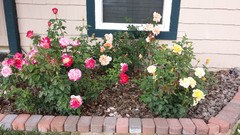
    I have a single layer of fiber weed barrier under large chunk bark mulch in my rose planter and am very happy with it. I have to spot spray crab grass that comes up through it about twice a year which is why I recommended 2 layers. If it should "only" be used under gravel pathways and other hardscape, I'd never heard of that rule and ignorance, as they say, is bliss.

  • 11 years ago

    If your lawn has blades attached to runners, it is probably bermuda or St. Augustine. Solarization will not be effective. If you have Marathon or other fescue, go ahead and solarize. Use clear plastic, not black. Here are more instructions for removing your lawn.

    It's probably too late for you to go now, but Tree of Life in San Jaun Capistrano has a free class on removing your lawn. You can read there information if you scroll down the link below. There is a pdf on lawn removal.

    Kill Your Lawn

  • 11 years ago

    Thanks guys I kinda have an idea of what u need to do now

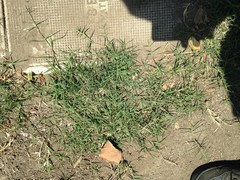
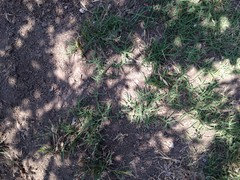
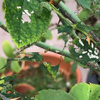
    Here's some pic of the grass


  • 11 years ago

    That is bermuda. Solarization won't work. Mulching over it won't work. Glyphosate (Round-Up) will work as described above.

  • 11 years ago

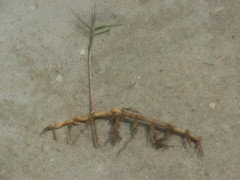
    The black "weed blocker" plastic from Home Depot is useless against the grass. I dug mine up by hand (over the course of several weekends) and now pull them up as they sprout. I try to get the root. The rhizome is usually about 6-8" below the surface. The roots of the rhizome go another 6-8" down. Nasty stuff.


    A neighbor observed me digging down with my bare hand. His observation is that I'm working too hard. But there is tremendous satisfaction when you yank up a 5" section of rhizome (attached to two blades of grass which peeked out above the surface). It's become my obsession/therapy. People think I'm weird.

  • 11 years ago

    AHa! Got you, you rotten dirty @&%^$#^&!


  • 11 years ago

    Lol. So from everyone's advice this is what I plan on doing

    1. Remove grass and excessive dirt. For some reason there is too much dirt and it is too high

    2. Use round up

    3 wait a few weeks for anything that comes out and use round up again. May repeat 3 times

    4 use 2 weed barrier just incase ;)

    5. Lay cardboard add drip system

    6 add some fresh soil

    7 dig holes and plant plants

    8 add mulch

    9 done


  • 11 years ago

    If you're applying for a rebate, you have to get it approved before you remove the lawn, not after. As long as you're moving dirt, you may want to see how you can create a swale to collect runoff when it rains some day. The idea is to have water soak into your landscape rather than run into the gutters and into the ocean via the Santa Ana River. If you make the parkingstrip a bit lower than the curb rather than higher, water will be able to soak into the soil.

  • 11 years ago

    One more thing - you're better off spraying the Roundup first. It is absorbed through the leaves, and if you remove the top and leave roots in the ground, there is nothing to absorb the Roundup.

  • 11 years ago

    Yes it is a bit high that's why I'm removing dirt and there's no rebates in my area. I didn't quite the part that you said roundoff being absorbed through leaves? You mean the grass?

  • 11 years ago
    last modified: 11 years ago

    Roundup has to be sprayed on the grass blades to work. I would spray first, wait until the grass looks dead, then remove grass and dirt, then continue with step 3.

  • 11 years ago

    Oh ok gotcha. I will do that. Thanks. I'll keep you guys updated lol

  • 11 years ago

    Over the years as the grass was mulched, fertilized, manured, and had leaves and other detritus fall on it, the material slowly decomposes to soil and the soil level rises.


    There are water rebates if you are in the city and use San Bernardino municipal water company. I applied for the grass removal and was approved, though it took a month and a half. Look on their website and search for the rebate page.

  • 11 years ago

    Yes I do live in San Bernardino. I checked their rebates page but they are not to remove grass. They have for plants, irrigation systems and others.

  • 11 years ago

    Actually you are better off waiting until autumn and cooler weather to plant new plants. After everything is dead, just mulch to make the area tidy and wait until the first heavy winter rain--see what comes up. Pull that before you plant anything new. Winter rains bring up all kinds of seedlings, and if the bermuda is still there, it will re-appear.

    Weed barrier--what happens eventually is that the weeds simply sprout on top of the weed barrier, which they have no trouble doing.


  • 11 years ago

    http://www.ci.san-bernardino.ca.us/water/residents/rebate_information.asp

    This link will take you to our water department rebate page where you will see there is a rebate for replacing grass with mulch or gravel, another for planting drought resistant plants, another for a drip system, etc. Again, it takes awhile to get the approval but you stand to spend less money.

Sponsored
Peabody Landscape Group
Average rating: 3.5 out of 5 stars8 Reviews
Columbus' Reliable Landscape Design & Contracting