Software
Houzz Logo Print
amir_eghbal

Landscaping Fabric

11 years ago

I have placed landscaping fabric this year for avoiding weeds in the garden bed. I have planted new hostas and hydrangeas. Does the landscaping fabric which is around the stem of the plant, effect their growth? If the plant needs to make new stems from the bottom, is it going to need a larger circumference or it will figure something out lol?


Comments (8)

  • 11 years ago
    last modified: 11 years ago

    When you say something like that, I don't know to take your advice or not because it most definitely does prevent or atleast reduce by a very significant amount, the amount of weeds. I am a begginner to gardening and as I am learning from different people, one thing I have noticed is, everyone talks about their personal way as the only way. That's not how it is. and not fair. I really appreciate your help, all I am saying is, one person is fond of it and says it's the best, another person calls it evil. It is obviously neither. A peron's personal likes or dislikes should not be provided as fact and knowledge. That is a personal thing.

  • 11 years ago

    There is no way to get around pulling weeds when gardening, except by using chemicals. After you pull them the first year in a new spot, there should be few the next year because the dropping of new seeds was prevented (by pulling the unwanted plants before they made & dropped new seeds.)

    But, like I said above, there are days' worth of reading material about
    landscape fabric here, my opinion is only one of many. Here's a spot
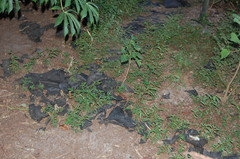
    about 4 yrs after being covered with landscape fabric and mulch, then NOT pulling
    the weeds that grew on top of it.


  • 11 years ago

    yes but that's because the multch had become soil and the weeds grew on top of it. It very significnatly reduces the number of weeds. Very significantly.


  • 11 years ago

    The discussion about landscape fabric and its ability - or lack thereof - to retard wed development abound on these forums. It's just a matter of pulling up some older or archived threads. Or just Google 'landscape fabric pros and cons' to get a broader sense of how well accepted this product is.

    As a horticultural consultant and landscape designer, I only recommend it for use underneath pavers or other hardscaping, where it is most efficient. For suppressing weeds in planting beds, it's not very effective. Perennial weeds are able to grow through it from below and weed seeds that blow in can root in the soil or mulch that covers it and become even more difficult to remove as their roots grow through the fabric mesh. And it hinders the ability of desirable, wanted plants to spread or self-seed. In fact, some of the most vocal anti-landscape fabric proponents are landscapers or others in the industry. It's kind of the lazy gardener's weeding shortcut but only on a very temporary basis.

    A thorough weeding before mulching and then an appropriately thick layer of mulch will equal any weed control that landscape fabric might offer and with far less hassel. And if weed seeds do blow in and germinate, they are much easier to remove. And with no barrier in between, the mulch is able to degrade and nourish the soil.


  • 11 years ago

    Now that I have already placed the fabric, should I cut around where the plants are more so they have more room?


  • 11 years ago

    What I hate about landscape fabric - I do not use the stuff - is that I am doing nothing to improve the soil. Instead of the fabric, I may put down some newspaper and shredded leaves. It starts breaking down immediately. Worms start working into the leaves, pulling organic matter into the soil. The soil remains soft and moist, so any weeds that do sprout are easy to pull - and there just aren't that many. If I choose, I can mix the decayed mulch into the underlying soil, and apply new mulch in late fall when I have an abundance of leaves again. Just two years after establishing my gardens, just applying ground leaves as mulch to an area that was covered with weeds and grasses just a few years ago, I really have very few weeds in my garden beds - it is very easy to manage. If you are going to have plants that are going to be staying in place, it is even worse, because the biggest difficulty you have is improving the soil without disturbing the plant. If you are not applying mulch and compost and letting it decay in place, then you really are not doing much in established beds with good soil. Landscape fabric makes it impossible. One of my biggest headaches when cleaning up investment properties for resale was landscape fabric buried under soil that had built up on top of it as decayed organic matter - and the soil underneath was like concrete. Breaking that connection from the organic matter on the surface to the soil underneath is a terrible thing to do in my book.


  • 11 years ago

    One of the 386 things that I hate about landscape fabric is that the plants roots grow directly underneath it, presumably in their search for air... or water. Or both.

    Another reason I dislike it is because organic matter cannot mix with the soil because worms, spades, hands and other 'mixing agents' can't get through the cloth.

    Whatever the manufactures say about their product is very good marketing but it just isn't true.

    I have pulled it out of previous gardens. I would never put it in mine.

Sponsored
High Point Cabinets
Average rating: 5 out of 5 stars21 Reviews
Columbus' Experienced Custom Cabinet Builder | 4x Best of Houzz Winner