Software
Houzz Logo Print
dabeevm25

Logan Lab Test Results

11 years ago
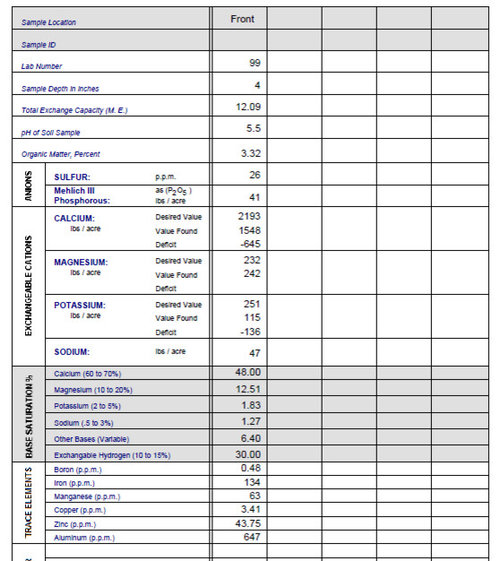
Hi, I was hoping to get some thoughts and recommendations on how to improve my soil. I am going to do a renovation of my lawn this year on approximately 11,500 sq ft. I've already killed off the lawn to deal with some poa triv issues and have until around the middle of August before I will be seeding my lawn. Here are the results of my soil sample for 2015. Last year, I had a PH of 5.7 and I put down 9lbs/1,000 sqft of pennington fast acting lime twice spaced 90 days apart. I was really surprised to see the PH drop to 5.5 this year. My OM also dropped from around 4. If it would be helpful, I could post my 2014 results as well.


Comments (17)

  • 11 years ago

    Here are the 2014 results if it is helpful.

  • 11 years ago

    Did I miss this? Sorry! It's been a busy week for me!

    Thanks for posting both, you've shown a minor but normal slide in the last year (and there should have been some corrections last year...did I make recommendations on this test at that point?)

    The Pennington you put down may still be working in, or it simply neutralized some of the soil acidity without much impacting the soil solution. We'll keep going on a slightly odd schedule.

    Anyway, without further ado...

    EC 12.1: Silt. It could have some sand, or some clay, but it's mostly silt. The soil, once corrected, won't drift terribly quickly but does require considerable mass to correct.

    pH 5.5: Always nothing more than a symptom, we'll handle this below. It's riding low, but we'll correct it.

    OM 3.3%: In the fair range. Although not critical, I'd always mulch mow, mow your fall leaves, and consider organic feeding.

    Sulfur 26: Optimal, with some margin for playing. Which is good, we're going to play with this a bit.

    Phosphorus 41: Low, and a limiter to your lawn quality (and gardens, if you have them). Recommendations are below. Although I recommended starter fertilizer below, for the June and July applications I'd almost rather see you use triple super phosphate at 2.2 pounds (for bag rate) or 4.4 pounds (for double bag rate) per thousand square feet instead. There's no need to throw the nitrogen around as there's nothing to use it. If you do use starter fertilizer, just get the cheapest.

    Calcium 48%: Very low, and a limiter to your lawn quality. You'll want to purchase Encap, Mag-I-Cal, or Pennington Fast Lime, all of which are calcitic (95%+ calcium carbonate).

    Magnesium 12.5%: Exactly in perfect range. No magnesium is required or desired.

    Potassium 1.8%: The only reason it's this high is that calcium is so low that there's plenty of spare EC. Recommendations below. You'll want potassium sulfate (sulfate of potash), which most garden stores or landscaping shops either have or will order for you.

    Minor Elements: While boron is a little low, we're short on time left in the season and I'm going to ignore it this year.

    Recommendations:

    Note: These are tuned for the fact that your lawn is already gone for renovation. If you had a living lawn, I'd never do what I did here!

    June 15: Apply starter fertilizer at twice the bag rate.

    July 1: Apply Encap, Mag-I-Cal, or Pennington Fast Lime at 12 pounds per thousand square feet.

    July 15: Apply starter fertilizer at bag rate.

    August 1: Apply 3 pounds of potassium sulfate per thousand square feet.

    Seeding Time (mid-August or so): Apply starter fertilizer at bag rate.

    October 1: Apply starter fertilizer at bag rate.

    October 15: Apply Encap, Mag-I-Cal, or Pennington Fast Lime at 6 pounds per thousand square feet.

    November 1: Apply 3 pounds of potassium sulfate per thousand square feet.

  • 11 years ago

    The Pennington was the correct response. I don't have any direct experience with it, but I approve of the chemistry (95% calcium carbonate, most of the rest is polymers and binders to hold the stuff together). I don't know what the sieve rating on the stuff is, so it could also be slower than Mag-I-Cal or Encap.


    Higher EC soils do require higher rates of calcium to shift pH, and during the period your grass is happily using the calcium as well. In my case, with an EC of right around 15, it took several years to correct my pH from 4.5 to 7.2 (I overshot a little bit and let it leach out for a year--but better to overshoot than undershoot in that instance).

  • 11 years ago

    It looks like I can get both the triple super phosphate and the sulfate of potash. Should I go with the bag rate or double bag rate for the TSP?


  • 11 years ago

    For June, use 4.4 pounds of TSP per thousand square feet. For July, 2.2 pounds per thousand. So twice July's rate for June, but that's probably not anywhere near the actual bag rate--I'm targeting 2 pounds per thousand square feet phosphoric acid equivalent, so there's a lot of weird math in there...

  • 11 years ago

    Perfect. One more question because I just noticed this yesterday with the grass dead and scalped now. I am seeing quite a bit of moss in the areas that will be renovated. This is a full sun area, so shade is definitely not the issue. Some of it is starting to turn brown now that there is no grass over top of it. Should I put something down now to get rid of the moss (maybe moss out)?

    The yard is sloped and it takes a while for water to percolate in some areas. I'm thinking that might be the reason there is moss? I just want to be sure that I do everything now to give me soon to be lawn the best growth environment.


  • 11 years ago

    Mosses are weak opportunists, and they'll happily grow in damp conditions (some species don't even require that much damp). Fortunately, none of them will outcompete sprouting and growing grasses.

    You can use Lily Miller's moss killer, or any other moss killer that's based on ferrous sulfate if you really want to. However, I haven't left you much margin in the schedule to do that. Close to June 15th would be the best area to add it, but that gives the mosses plenty of time to come back.

    Percolation problems can be confounded over time by spraying with shampoo (plus the huge burst of calcium going down will also lighten and loosen soils over time). Shampoo at 2 oz per thousand square feet can be sprayed up to monthly in a hose-end sprayer at any convenient dilution level, and won't interact with anything I recommended above.

  • 11 years ago

    I put down the Lily Moss killer yesterday.

    The supplier had to order the TSP, so I probably won't have it for a week or so. Can I apply the lime now and then the TSP on July 1st?


  • 11 years ago

    On a dead lawn, no problem. If it were living...well, fortunately, it isn't. :-)

  • 11 years ago

    Hi Morph,

    Does this revised schedule look good?

    June 15: Apply Pennington Fast acting lime at 12 lbs/k - Done

    July 1: Apply TSP at 4.4lbs/k

    July 15: Apply TSP at 2.2 lbs/k
    (Should I apply this 15 days after my first app since I adjusted my
    schedule?)

    August 1: Apply 3 pounds of potassium sulfate per thousand square feet.

    Seeding Time (mid-August or so): Apply starter fertilizer at bag rate.

    October 1: Apply starter fertilizer at bag rate.

    October 15: Apply Encap, Mag-I-Cal, or Pennington Fast Lime at 6 pounds per
    thousand square feet.

    November 1: Apply 3 pounds of potassium sulfate per thousand square feet.


    What about Milorganite and Urea after I put my seed down? I guess I should just keep my nitrogen apps
    two 2 weeks away from the October lime application?


  • 11 years ago

    That revision is fine on a dead lawn (note to those following along whose lawns are alive, don't try this as it's way too much TSP in too short a period at a terrible time for living lawns to try to deal with it).


    The starter at seeding time will also feed the lawn as it grows, and newly-sprouted lawns aren't all that interested in eating anyway. The roots are too basic to absorb much nitrogen, but fortunately the seed itself contains everything they need for the first 30 days or so.


    That October 1 starter app will arrive just about the time the root systems are developing and supply plenty of nitrogen.


    However, if you want to use Milorganite, have at. It can be applied at any time, even directly atop the lime on October 15. Urea, if you use that, should be moved at least 2 weeks from the liming date, and even so you're going to lose a lot to out-gassing due to the high pH at the top of the soil layer. Personally, this year I'd use Milorganite, which won't do that to nearly the same extent!

  • 11 years ago

    Hi Morph,


    I'm not sure what is going on with the soil in the areas that I am going to reno, but I thought I would post a picture to see if you could give me any advice.

    Before the pics, here is what I've done thus far to the soil:

    May 25th - Glyphosate
    June 14th - Lily Moss Killer
    June 15th - Pennington Fast Acting Lime (12 lbs/k)
    June 29th - TSP (4.4 lbs/k)
    July 5th - Spot sprayed glyphosate
    July 22nd - TSP (2.2 lbs/k)
    July 23rd - Spot sprayed glyphosate

    We had heavy, heavy rains throughout June and into early July, so I'm not sure if that had an impact.


    Here is a picture of what the soil in my reno area is looking like throughout most of my yard. The area to the left is what it looks like. The area to the right is what it looks like after I rake it up.


    Any idea what is going on? Should I be raking up the entire yard because of this?

  • 11 years ago

    Evaporation crust plus a layer of dead stuff liquifying and decaying to make it even crustier. It probably feels kind of semi-solid but thick paper-like, yes? And if you fold one of the chip-like bits, it cracks between your fingers easily?

    You can actually seed right on top of that as even baby roots can shatter rock. If you really, really want to you can certainly rake it, and if that makes you happier then go for it.

    You could also try applying shampoo at around 4 ounces per thousand square feet to get it to break up a little bit. Spray in any convenient amount of water (I use a hose end). At the very least, it'll keep the layer from repelling water.

  • 11 years ago

    Yep, that is a pretty accurate description of it. I will give the shampoo a try because I really don't feel like raking 12k sqft in 90 degree weather. Thanks!

  • 11 years ago

    >>I really don't feel like raking 12k sqft in 90 degree weather.

    I don't blame you.

    A slit seeder used at seeding time (you can often rent those at Home Depot) will certainly penetrate the crust layer and make sure the seed has good soil contact in the sliced rows. Areas between should still be fine, but the slit seeder would give you extra assurance that the seed is nestled in.

    Really, you could also use a dethatcher with the tines set to just nick the soil surface (normally they're set a little high to avoid soil disturbance). That's also going to bury any weed seeds that drifted in--and at just the right depth to sprout when you start to water--so I'd be mindful of that.

  • 11 years ago

    That's an "algal crust", almost for sure. It's the summertime state for a Cyanobacteria (not "algae", it's misnamed) patch.

Sponsored
Haus Studio
Average rating: 4.8 out of 5 stars28 Reviews
Franklin County's Preferred Custom Cabinetry & Design Studio