Software
Houzz Logo Print
dropnbassonu

Is this brown patch?

11 years ago
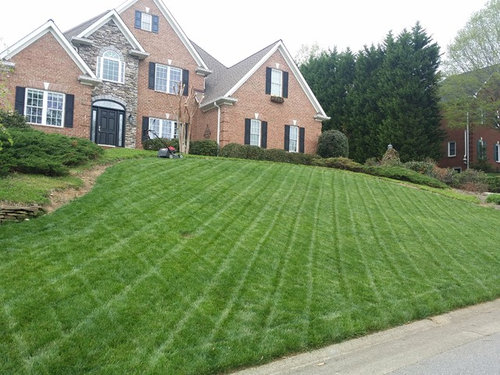
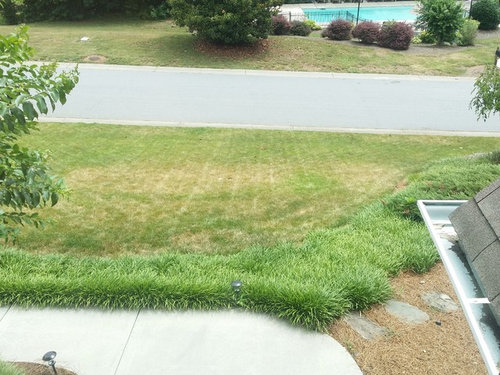
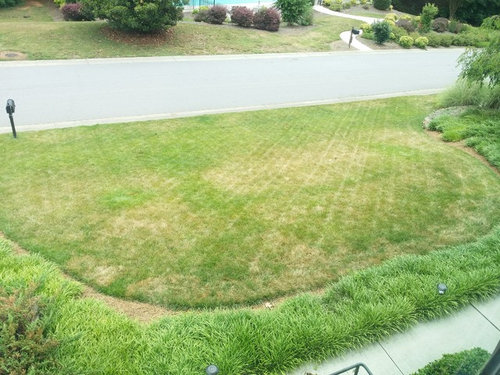
Does this look like brown patch to you all? Never had it before. I'm in central NC where we've had an extremely hot and humid June. I have an irrigation system and was watering 4x/week at 6am for 5 mins because the yard is on a pretty good slope. What is interesting is that the areas at the top of the yard surrounding my 2 sprinkler heads are green. Could this just be an indication I'm not watering enough? FWIW the affected blades of grass are solid yellow intermixed with some half green/half yellow with brownish spots on them. Here are some pictures for reference now vs how it looked in April.

April:


Now:


If it is brown patch, do I just treat the affected area that is yellow or spray the whole yard?

Comments (12)

  • 11 years ago

    Forgot to mention, my yard is tall fescue.

  • 11 years ago
    last modified: 11 years ago

    A close up picture when the grass is shaded would be very helpful for a good diagnosis.

    I'm also in central NC and my lawn looks exactly the same. It started early June when the temps went into the 90's however I haven't seen any spots on the blades that would indicate a fungal issue. Also, the worst areas are in full sun while the areas that get more shade don't have the brown areas. I'm thinking mine is due to the temps being so high for the past several weeks.

    Watering 4 times per week for only a few minutes is not going to help your situation if it is a fungal disease. That's only giving a fungus what it needs. With the heat we've had watering one full inch every 5 days would be much better for the grass and help out if it is a fungus.

  • 11 years ago

    Where did you come up with that watering schedule? That's the second time this week (and forever) that someone mentioned 4x per week for 5 or 10 minutes. A much better watering schedule for your area for right now would be to water deeply once every 2 weeks. Deeply means one inch of water all at one time. Time your sprinkler system by putting out cat food or tuna cans. Time how long it takes to fill the cans. That will be your watering time from now on. Infrequently means once per month with temps below 70, once every 3 weeks with temps in the 70s, once every 2 weeks with temps in the 80s, and once per week with temps in the 90s. This works in Phoenix, so it should work for you. My oscillator sprinkler on a hose takes 8 hours to fill the cans. A guy wrote in here yesterday and reported his sprinkler filled the cans in 20 minutes. You have to time your own system. But since you're watering the opposite of deep and infrequent, if you try to switch cold turkey your lawn will die. The roots have to be trained to grow much deeper than you have them trained. You're going to have to go at this gradually to switch over. I'd start with deeper watering and then skipping more than 1 day in between. Watch the grass and don't let the soil get soggy. If you get runoff before you get a full inch, then stop and let the water soak in. Then resume watering in 15-30 minutes. The result of the change will be no more disease (expensive fungicide), no more weeds (weed seeds need continually moist surface soil like what you're providing), and a much more drought tolerant lawn.


    Yes that's a disease but which one can't be determined from this altitude. The organic solution for disease is ordinary corn meal from your local feed store. Apply over the entire lawn at 20 pounds per 1,000 square feet. It takes 3 weeks to see the improvement. It's finally stopped raining for me so I'm about to use some today. If you want to use a chemical fungicide, someone else will have to help you.

  • 11 years ago

    Interesting picture there. I'd be willing to bet that not only are they watering differently, but they also are on a different maintenance schedule. Hence the distinct line between properties. If it was solely due to watering it would be more feathered between properties.

    As far as where I came up with that watering schedule.....since you can see from the April pictures my yard is on a hill. If I water more than 10 minutes at a time I have runoff. The problem is my irrigation system can only be set for 1-4 waterings a day, with intervals of 3,4,6,12 hours between. Which reminds me, I was actually watering for 5 mins twice a day, once at 6am and the other at noon. Best case would be to water early in the morning for 10 minutes, let it soak for 30 mins, then hit it again for another 10 mins as you suggested.

    What baffles me is that the immediate area surrounding the top sprinkler heads are green as well as the lower half which accepts all the runoff from watering. The brown areas are basically isolated to the top half (for now). The company who handles my lawn said it was brown patch, but my yard doesn't meet any of the qualifications for that. It's in the sun, on a hill, fertilized like everybody else's, not watered after noon, and mowed at the correct height.

  • 11 years ago

    Sorry for the double post, didn't realize my wife was signed in when I posted the first response.....

  • 11 years ago

    Gorgeous pic.


  • 11 years ago

    That there lawn is mine.

    --The grass type is different. Mine is elite KBG. All the surrounding is builder-grade tri-mix. Mine is actually more finicky and particular about conditions and care.

    --All surrounding neighbors mow too short except the right-hand neighbor (not in shot). Even his lawn looks the same.

    --I feed organically, all others feed synthetically or not at all.

    --My soil has been and continues to be resource-balanced.

    --Mine sees proper watering. Theirs sees no watering, or improper watering. My back neighbor (not pictured) waters daily. Left waters rarely. All others don't water, or water rarely.

    A photo right now wouldn't show the extreme difference. June has been exceedingly wet, so my lawn's actually lost color from mobile iron being bound up. It's still thicker and richer, and far healthier, but the visual wouldn't knock you on your butt like this one does.

  • 11 years ago

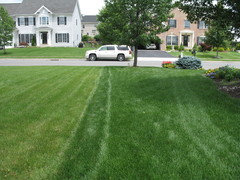
    Here's a current image, shot today and not taken during any drought stress at all (in fact, the soil is saturated and flooding is common this month).

    I've lost color due to the waterlogged soil--which binds iron. That stripe at the edge of the property has been mowed, the rest has not, but was immediately after this shot.


  • 11 years ago

    Wow - nice turf, Morpheus. Curious ... if your neighbor wanted to switch from his tri-mix to elite KBG, would he have to kill his grass and then seed w/ KBG in order to switch?

  • 11 years ago

    A full renovation (kill and reseed) would be best. Overseeding could be done, but the results would be questionable at best--that lawn isn't terrible, just thin, underfed, and treated poorly overall.

    As to how the KBG would do under that treatment, the answer is "not well," so its level of dominance would rise slowly, if at all.