Software
Houzz Logo Print
hairmetal4ever

Tree seedling update

11 years ago
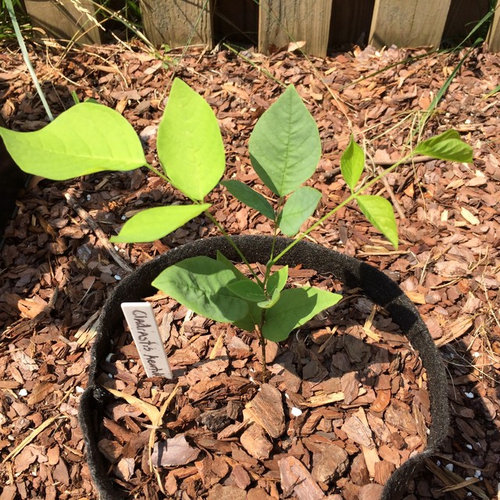
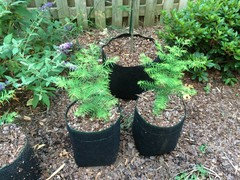
Cladrastis kentukea. Finally growing more rapidly.

Comments (45)

  • 11 years ago
    last modified: 11 years ago
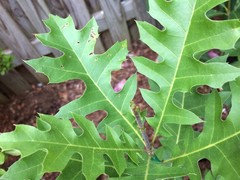
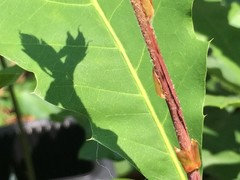
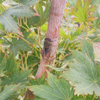
    Black streaks on the new shoot of a Scarlet Oak (Q. coccinea) seedling.

    This is my most vigorous and straightest-growing coccinea, so I hope this doesn't stunt or harm in it anyway, or cause any permanent damage. I'm not sure what causes it, but I have seen the black streaks on new oak growth before. So far, they don't appear to cause any permanent damage, but I wonder what causes it.

  • 11 years ago

    BTW, is it just me, or does Scarlet Oak as a seedling really, really, really, not want to grow straight? Most of mine have some sort of a slant or zigzag to them.

  • 11 years ago

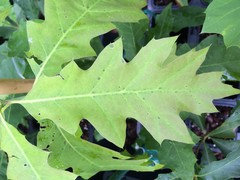
    Now I'm not sure this is a scarlet oak. The ones I grew last year, the leaves by the THIRD FLUSH in their first season did look very much like adult scarlet oak leaves. The first two flushes did not, as is typical of oak seedlings.

    This year, it's different. These are third growth flush leaves, but don't look all that coccinea-like. They are in full sun, so they aren't "shade leaves" which do often look different.

    The acorns definitely looked like typical scarlet acorns. The leaves look more northern red, shumard, or nuttall (but the acorns I grew them from did not look like any of those). Could they be hybrids, or just coccineas that are still growing juvenile leaves, despite my past experiences?

  • 11 years ago
    last modified: 11 years ago
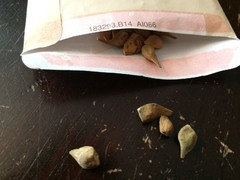
    The acorn it grew from definitely looked like a coccinea - too small to be rubra, had the "rings".

    My other thought was, maybe it's actually a velutina, since they also have smallish nuts. Or a coccinea hybrid, with a coccinea mother tree pollinated by a rubra or other red oak.

    I'll keep the tree regardless, but I hope it at least has decent fall color as it matures (IME just about all small seedling oaks turn red in fall, even normally boring ones like macrocarpa, so it'll be a few years before I know for sure).

  • 11 years ago

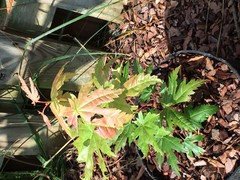
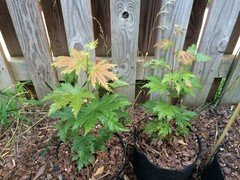
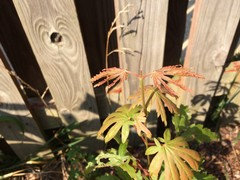
    One of my Acer japonicum. @$%£¥#€# Japanese beetles had some of it for lunch. Still growing, which seems late for a maple, most of which have already ceased terminal growth for the season. About 8" high.

    I'm mad about the beetles. I know it should be fine, but it had such nice looking foliage.

  • 11 years ago


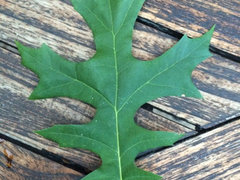
    This is more what I expect a typical Scarlet Oak leaf to look like-this is off an older (but still young) specimen at a park nearby.

  • 11 years ago

    Japanese beetles are terrible this year, I don't know why there would be a connection like this but it seems like the colder the winter, the worse they are.

  • 11 years ago

    Is it normal for leguminous tree seedlings to start really growing more rapidly now, in July? Both my Redbud and yellowwood seedlings are growing faster now than they have all season so far.

    Metasequoia seem to do that as well.

  • 11 years ago

    I would love some yellowwood or redbud seedlings! My redbud seedling did not make it last year, which was the first year I tried it. I don't own a yellowwood or know anyone that does, but I'd love to find a tree and grab some seedlings this fall

    I have a 3 year old red maple seedling and I 1st year hybrid maple seedling.

  • 11 years ago
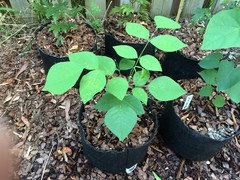
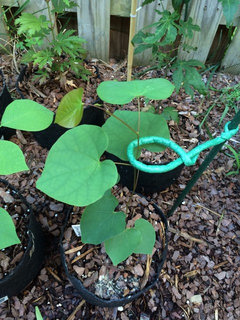
    Cladrastis today. Growing more than it has all summer.
  • 11 years ago
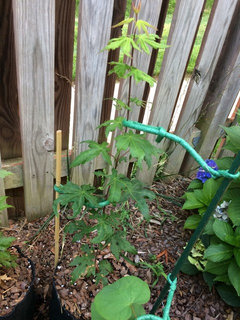
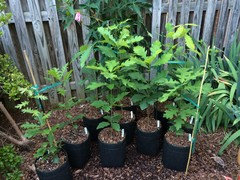
    Cercis canadensis. Loosely staked to try to force a single, straight trunk, it was at a 45 degree angle.

    Two Acer japonicum. Looking good, but mild to moderate beetle damage.

    Acer micranthum-so tall it wouldn't stand up anymore. Also LOOSELY staked. Still moves in the wind.
  • 11 years ago
    Metasequoia glyptostroboides.
  • 11 years ago
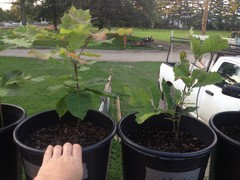
    Various oaks-Q. xsternbergii on far left, mix of Q. prinus/montana, michauxii, coccinea, and xschuettei. Macrocarpa pics to come.

    Notice the stakes. All of them seemed to develop a lean of 20 to 35 degrees last month. I wonder if constantly wet foliage last month (11" of rain here, 13 at the airport) caused a lean during caliper expansion to become permanent.
  • 11 years ago


    Hey everyone, I'm new to this. I'm CJ and I started growing oaks last September. I'm not even sure what kind besides being red oaks. Anyways, mine are about 8inches to a foot and a half high. Some are skinny and some are decently thick. Anyways, should I plant them in the ground this year, or will they be okay in their pots over the winter???

  • 11 years ago

    I would go a head and plant them as soon at the fall season arrives so they have a head start on root establishment before next spring and summer. Very nice trees you have there.

  • 11 years ago

    Hairmetal,

    Forgive the obvious question, but do you rotate your pots? I forget to do that sometimes and now try to remember to rotate them a quarter or half turn at each watering to avoid the tree reaching for the sun unevenly. You've done a great job getting a nice variety started!

    CJ,

    I'd either plant them where they're going in fall or plant them in a holdover bed for winter to transplant them in spring. It's tricky to overwinter plants in pots.

  • 11 years ago

    YMMV, but I overwintered some trees in pots last winter. Put them in a shaded area against the house and piled shredded leaves around and a bit over the pots. That said, I'm in zone 7 and our coldest temps were right around zero or a couple degrees below.

  • 11 years ago

    In previous years, I have dug a hole and placed the pot in it for winter. You can even leave the pot in the ground through the year if you re-pot in fall. If you do not have a permanent location, this option may work for you.

  • 11 years ago

    You've mastered growing trees, hair. I don't even come close to those kind of results.

    Dax

  • 11 years ago
    Thanks, Dax. I’m not sure what it is, but I’ve had good results! Dumb luck, I suppose.

    Here’s what I do.

    I don’t have a greenhouse (yet). I start them outdoors around April 1 (with freeze protection if needed) and normally use root pruning pots of some sort, either Pioneer Pots (I got from Steuwe and Sons) or Rootmaker. I use a potting mix that I made myself, a modified ‘5-1-1’ (Al’s mix from the Container forum), and I use Dynamite CRF instead of Osmocote Plus for nutrients. Once they outgrow the initial pots I move them to one of several containers, usually fabric Smart Pots, or new ones I’m trying this year that are similar, but taller (allows for deeper rooting before root pruning occurs) called Gro Pro.

    There are many ways to skin a cat, as they say, and while root pruning containers are not the be-all, end-all, they do work well, especially when you don’t have the time to “babysit” them. It doesn’t mean you can neglect potting-up, but it does give you a BIT of leeway. However, for initial germination, I almost always use them to help deal with the taproots on species that tend to have them. When I do use regular containers, I normally manually root prune and/or untangle any circling roots anyway.

    They get about 3-6 hours of sun, depending how I situate them, mostly earlier in the day (the oaks, being a bit tougher than most, are arranged to get the most afternoon sun) against a wooden fence that shades them in the afternoon.

    For oaks, I’ve gotten 3 growth flushes and the sternbergii are on their fourth (!). I’m at a point where I’m worried they might not harden off in time, but it is only July and last year the oaks grew into August, and overwintered fine during our hard winter.

    BTW, those Q. macrocarpas I am growing for grafting will likely break the 3’ mark by the end of the season at the rate they’re going. Since I’ll be bare rooting them anyway to ship, they’re all in one large pot now.
  • 11 years ago

    Good. I was wondering how you were going to get seedlings to me.

    I know it's your mix and containers. I simply grow too much to make these better mixes such as you use.

    Dax

  • 11 years ago
    If I were growing hundreds rather than dozens, I wouldn't be able to afford to do it my way, time or money wise.
  • 11 years ago
    I gave a few of the Acer micranthum and a redbud to a coworker.

    Next year I want to try:

    Liriodendron tulipifera
    Nyssa sylvatica
    Taxodium distichum
    Acer saccharum
    Acer triflorum
    Quercus alba
    Q. nutallii
    I'll probably also dive into some conifers like Pinus, Abies and Picea, but they are so slow to start.
  • 11 years ago

    You ever feel like helping out a nice young man in Indiana let me know: hehe. I'd love to grow a few more trees on my lot, but I want them to be seedlings that I raise into specimens.

    Yellowwood is on my list too.

    i noticed a vacant property off of a nearby walking trail had a nice tulip tree seedling growing. I am probably going to dig it this weekend.

  • 11 years ago

    Thanks for all the comments everyone!!!!! I appreciate the good feedback, I'm the only one anywhere near here, that I know of, trying this, so I really had nothing to judge mine off of until now.

  • 11 years ago
    @%#€£@/(!!!!!

    Something bit growing tip off both Acer japonicum seedlings.

    I assume they'll probably make a double shoot (since they have opposite leaves/branching) in response. Should I pinch one off, or let it go until spring at least?
  • 11 years ago

    I would wait so that I could keep the stronger growth and pinch the smaller; I've never seen each side grow evenly after being topped or pruned back. At this point all energy will go into root growth and side shoots, you will want all leaves to help with energy production for sure.

  • 11 years ago

    I'll do that, plus many growers of Asian maples do this on purpose to encourage branching and a "multitrunk" look anyway.

  • 11 years ago

    When does anyone limb up their tree seedlings? Do you wit until the tree is 4-5 feet tall? Just curious when you start forming a canopy.

    Also on the Kentucky yellowwood, it has a tendency to branch at weak angles, when you prune off weak crotches? Do you let it grow fir some time and then prune it, or do you remove the branch when it is young?

    thanks.

  • 11 years ago
    Aaaaaaagh! @@)&@$&)&/$/(:$ bugs!

    Something bit the top off one of my Q. xsternbergii seedlings!

    The top was broken over, and some green grasshopper-like bug jumped away as I approached.

    Spousal unit just asked what I was swearing about.
  • 11 years ago
    This was an actively growing FOURTH flush of growth. The leaves were still pink and not even a half inch.

    Will it send another shoot (or multiples)? Or just kinda harden off w/o a terminal bud this fall?
  • 11 years ago

    Difficult to say. You may get a bud or buds on that bare shoot, or, you'll certainly get a cluster beneath at the junction of leaves. A little training is all... no big deal. Keep the bare shoot if you need to use it to tie an emerging new-leader from beneath.

    Dax

  • 11 years ago

    Hair: if you're going to grow triflorum, it's time to get your seeds. These require a 3-month warm strat followed by a 3-month cold strat.

    Dax

  • 11 years ago
    Funny you should mention that...
  • 11 years ago
    I just ordered an ounce of Acer triflorum from Sheffield's. Due to the known difficulties of germinating that seed, I ordered a large quantity to attempt the brute force method of getting a decent number of seedlings.

    I'm wondering if breaking open the samaras will increase germination at all.
  • 11 years ago
    Scratch that idea, these things are harder than walnuts!
  • 11 years ago

    I was reading the FW Schumacher fast method about finding the rounded end and crack that with a pair of pliers and kind of wondered myself how many I'd damage or get hurt in the process.

    Dax


  • 11 years ago

    Dax, I'd be paranoid that I would crush the embryo using pliers. I tried clipping with fingernail clippers until I got far enough to break open with a knife blade (I've done that on A. Palmatum and japonicum) but no dice.

  • 11 years ago

    I was thinking about it of course after I posted and it seems to me that a vice would work best. Surely slower but a relaxing time cracking them one after another some evening.

    A friend of mine extracts the embryo from truncatum. I didn't ask his method but he said it improves germination really well.

    Dax

  • 11 years ago
    I tried using pliers, and did exactly what I feared; by the time I put enough pressure on it to crack the samara, I crushed the embryo.
  • 11 years ago

    From a previous post, I did dig the tulip tree seedling from a neighboring property, sadly it was nestled tightly between some roses and weeds and I wasn't able to get a good root mass. I tried my best, but it died quickly.

    On a brighter note, a neighbor had a redbud growing nicely and neatly near my property and I dug that little guy up and potted it on my porch. It is about 50 yards from my appilacian redbud, so it may be an offspring. I don't even care if it reverts to the genus, this is a tree I have been wanting to grow from seed for a couple years now but have been unsuccessful. Yay.

    P.s. I was wondering when everyone limbs up their seedlings? Just curious if you do it after 3-4 years, or if you wait for height, or something else.


  • 11 years ago

    I believe the consensus is to leave the lower limbs for the reasons outlined at this link... (See Problem 4)

    http://www.lawn-care-academy.com/tree-drawings.html

  • 11 years ago

    I like to let them grow to their natural form.

    If you are concerned about weak crotches i would cut them off when they are young, so that the tree may be able to "reconfigure" itself while it is still small and vigorous.

  • 11 years ago
    last modified: 11 years ago

    Thanks, both of you. I'm asking in regard to eventual canopy height, and also just as a general inquiry. I'm only a second year newbie and have found discussions here at gardenweb to be very resourceful.